Ding Dong, The Witch Is Dead

So much has happened since the last “On the Ravine” post. Elder son Jade married Anjie in a surprise ceremony at their engagement dinner. Easter came and went, along with Holy Week. Our Santa Cruz friends visited for a week and we had our touristy picture snapped as we gathered around a microphone onstage at the Ryman. Sunday, some jewelry went missing and we buried one of my favorite aunts, two unconnected events.

I can’t tell stories about any of that until I figure out how I feel about this bin Laden thing.

I was up much later than my usual bedtime. An email alerted me to a Presidential statement of some sort. Then another email followed to say that Osama bin Laden was dead. It was time to turn on the TV.

My elder son Jade called to make sure we had the TV on.

“You weren’t asleep, were you?” he asked.

“No, I’m watching TV. Dave is in bed.”

“Just wanted to make sure you knew that Osama bin Laden is dead,” he said.

We made a few sentences of small talk. I wondered why Jade wouldn’t have thought I was in bed since 9:00 P.M. had long passed. I wondered if he would have called anyway.

I thought about waking Dave and imagined his response. Good. I’ll read about it tomorrow. I’m going back to sleep.

John King on CNN said people were gathering outside the White House. President Obama was to make a statement in just a few minutes to officially inform us that Osama bin Laden was dead. The crowd started with thirty or forty people and, before the President made it to TV, grew to several hundred or a thousand or more, a few waving flags, jumping up and down for the camera, singing The National Anthem off-key. Someone must have called for another song because they started “God Bless America.”

I was relieved when President Obama strode to the microphone. I was not offended by the first sentence starkly informing us that bin Laden was dead but I got irritated with the next several paragraphs telling us the story of what happened on 9/11…again. Is there anyone who doesn’t remember? Would there be anyone who didn’t know the name Osama bin Laden? Is this reminder some sort of  justification for our taking him out?

I made circles in front of my chest with my right hand.  Come on, come on!

My first reaction to this “targeted operation” carried out by “a small team of Americans” was “Wow.” It wasn’t a loud wow, but a quiet awe that generated by the thoughts of a few guys, maybe Navy Seals, sneaking into this protected compound, scaling walls, taking no prisoners. Wow.

I thought our military’s special forces could do that, this movie-quality action. In fact, I’d said several times—most frequently after two glasses of chardonnay—that “they ought to take him out” in the same way, as it turns out, that they actually did. I just couldn’t think of anything else but “Wow.” I was alone, but I said it aloud several times.

After the speech, I watched our celebration of death…the death of bin Laden. John King said we should take a look over at Ground Zero, where the mood was “more somber, and quiet.” I was in favor of somber.

I wasn’t what you’d really call “happy” that bin Laden was dead but I was okay with it, maybe relieved. The world is better off without bin Laden. I watched the gathering; it seemed that since we gathered after the Twin Towers fell and planes crashed and grief overtook us, so we ought to gather again to say “It’s over.” I just don’t know what that “it” is and I’m not sure whatever it is, that it is over.

I felt strange and some of the talk bothered me.

“Did you think we’d ever KILL him?” John King asks some man on the screen.

And then, “Are you surprised that President Obama praised President Asif Ali Zardari of Pakistan for aiding in the killing of bin Laden?”

So he was hiding out in a mansion a few miles north of Islamabad. A mansion. Same place you find some American criminals, except I didn’t think the mansion in Pakistan looked like a mansion.  Our mansions are much more elaborate, and bigger, too.

“Look at the crowds,” John King said. “They’re celebrating. This is pure joy.”

Wolf Blitzer says, “Let’s listen in to the crowds outside the White House so we can get a little flavor.”  Where did he come from?

There was great jubilation with lots of flags now waving, lighted cell phones held high in the night air, and young people climbing in the crape myrtles for some reason.

I needed to go to bed and I did, but the last time I remember looking at the clock it said “3:00.”

Yesterday afternoon, still tired from too little sleep, I visited with my dad, a wise old man if ever I knew one.

“It’s no cause for celebration,” he said. “We did what we had to do, and our boys did it very well, but we grieve that it took a killing to do it.”

Today, after a good night’s sleep and the passage of several hours, I know what I feel about bin Laden.  It is “not much.” I still find no joy in the death of this mad man.

I know some things that I feel about us. I wish we didn’t look so much like those who celebrated after they took down the Twin Towers. I hope we have crippled Al Qaeda. I am still in awe of the operation and those who carried it out.

And how do I feel about me? I am ever committed to non-violence and I hope that we will always try, and try, and try diplomacy-again. I pray that we will find a way to be peaceful not just with our enemies, but with ourselves.

My friend posted on Facebook, “He’s dead. What is there left to be said?”

***

How Best to Weather a Storm

     When a storm blows up in the daytime, our Shih-tzu, Murphy heads for Grandma and Grandpa next door. If neither one hears her coming, she barks at the apartment door until somebody lets her in.

     Grandpa greets her with, “Here comes Poodle Hound.”  She gets as close to Grandpa as she can, and then he usually picks her up and holds her to his chest until her heart calms down.

     If the thunder rolls at night, Murphy sleeps with Dave.

     We had a big one this week. Mom was to see Dr. Dibble on Monday at 1 p.m. for a nasty-looking arthritic finger. We knew a storm was on the way but we figured we could endure. She needed this appointment. She has been in big arthritis trouble for several weeks now and her right index finger seemed to be the settling spot, if there is such a thing as a settling spot.

     I called her at 11:00 o’clock, just after I cleaned up from some work outside. Spring is finally here.

     “Mom, I know we’re getting some weather but I think we better try to keep that appointment.”

      “Yeah. I just told your dad this morning that I’m actually looking forward to going to the doctor. This thing has hurt long enough.”

       I didn’t tell her that I didn’t know if Dr. Dibble could do anything to help that finger. Maybe he could give her something for pain. He could increase her anti-inflammatory. Or, I guessed, he could send her to a specialist of some sort. Geez, what if they wanted to do surgery on it?

      “Okay, we’ll leave at 12:30. That should be plenty of time. Your appointment is actually 1:10.”

      After I’d thrown Dolly, the red Rollator walker, into the back of the van, I said, “You’re holding that finger. Is it hurting right now?”

      “Yes, it’s throbbing.”

      “How’s Dad doing this morning?” I asked.

      “Not good. He’s having those spells again,” she said.

      “When did that start?” I asked.

      “Oh, last night,” she said.

      “Did he eat breakfast?” I asked.

      “I think he might have had a bowl of cereal.”

      “Well, I better call Dave,” I said as I pulled out of the drive.

      “Dave,” I said, “You’re going to have to look out for Dad. He’s having those spells.”

      “Okay, I will. I’ll take Murphy and go over there right now,” Dave said. “She’s all antsy about this weather.”

      “Those spells” are unexplained fainting episodes and Dad has been having them for years. With most episodes, he weathers the inconvenience at home. But there have been times that he overlooked the signs of an impending spell and fell off a lawnmower, went down while weed-eating, or slid off a tall stool. Each of those occurrences precipitated either a trip to the emergency room, a brief hospitalization, or both.

      The emergency room doctors always think it’s his heart. The cardiologist never thinks so. The neurologist always thinks it could be some sort of seizure but they’re never sure so they prescribe one of the new anti-seizure medications. Dad takes three days of those and declares, “I can’t function taking this stuff.”  The ink—or laser print—is barely dry on the prescription before he quits it. 

     He took Dilantin for a few years before he developed Raynaud’s Syndrome. The diagnosing rheumatologist said, “You have to get off that stuff.”  Dad was thrilled. He said he never thought it prevented much of the fainting problem anyway.

     “You know,” Mom said, “I’m getting hungry. I’m going to be starving by the time this is over.”

     “Mom, I don’t think we can go to lunch today.” Mom is always prepared to go to Golden Thai or J. Alexander’s or Sonobana after a doctor’s appointment. Those times are some of our best together.

     We got to the fourth floor of the St. Thomas physicians’ building in time to witness some monstrous lightning through the plate glass windows just to the right of the check-in desks. The clerk beckoned us to approach from the rope-designated queue.

     “If I get up and run,” she said, “It’s because the lightening scares me.”

     “I’ll be right behind you,” Mom said.

     You couldn’t run right now if Satan was closing in, I thought.

     She must have read my mind.

     “Hey, I’m pretty fast with Dolly,” she said in my direction. She gripped the Rollator’s handles and rolled back and forth a few inches. Prepared, she was.

     Our visit with Dr. Dibble was uneventful. Change anti-inflammatory. Apply ice. Make an appointment two weeks out with the rheumatologist next door.

     By the time we drove out of the patient parking garage, Nashville was, quite obviously, in the center of the storm. The weather woman on the radio said as much, too.

      “Oooooo, I don’t like this,” Mom said.

      “Yeah, I think I’ll just pull into this other garage right here and we can wait it out,” I said. I turned in, looped around the first level of vehicles, and parked facing the street in a space marked “Maintenance.” 

      “We’ll just sit here until it blows over,” I said. I turned the radio up a little.

      “I’m really, really hungry,” Mom said. 

     “Well, I think I have a piece of string cheese in my purse,” I said. “You want that?”

     “Yes. Let me have it.” She never asked why I might have a piece of string cheese in my purse.

     I clicked on the map light and started the search through my crowded-but-well-organized purse.

     “You can’t find it,” she said.

     “Yes, I can,” I said. “See, here it is. It was hiding on the side.”

     I handed it over.

     “Do you want half?” she asked.

     “No, I had some this morning,” I said. Mom didn’t ask why I was eating string cheese for breakfast.

     She finished the little white stick in four bites and lifted my water bottle out of the cup holder to wash it down.

     Why won’t you bring your own water? I thought. Just then, I remembered that I had tucked a protein bar into one of my purse pockets the day before. I started foraging for food a second time.

     The radio said the storm was passing right over downtown Nashville, headed east. We were on the southwest fringe of downtown. I tried to get my directions straight in my mind.

     “What are you looking for now?” Mom asked.

     “I have a protein bar in here somewhere. I remember putting it in here yesterday.”

     “Oh, good. I’m still hungry,” she said.

     “Here it is! Okay,” I said, holding the four-inch bar in the air, “This is a peanut-caramel bar.”

     She took the bar from my hand and opened one end.

     The radio reported that a tornado had touched down in Cool Springs, about fifteen miles south. I guessed that had happened on its way to downtown.

     As Mom raised the last of our food supply to her mouth, I stopped her.

     “Mom, you have to give me half.”

     “Oh. Well, okay.” She sounded surprised but she broke off almost half and handed it to me.

     “This is good,” she said. “It’s like… it’s like a Baby Ruth.”

     “There’s no chocolate in it. It’s just peanuts and caramel. It reminds me of those pecan logs we used to get at Stuckey’s,” I said.

     The radio said that the storm was especially violent east of Nashville in Hermitage and Mt. Juliet. Son Jade and his new wife, Anjie, live in Mt. Juliet. But, I thought, he’s in Lebanon in his office and she’s in Smyrna in hers. I ran through the rest of the kids in my mind. John, Vicky, Jameson, Carly, Darrin, Dana… I said a silent prayer and then let go of them.

     “It’s not pecans,” Mom said.

     “Right. Okay, well, then maybe it’s more like a Payday,” I said.

     “That’s it! It’s like a Payday!” she said. “I’m going to get me a Payday next time I go to Wal-Mart.”

     She turned to face me. “Do they still make Paydays?” she asked.

     “I think so,” I said. “I think I’ve seen them, like, in the checkout aisle.”

     “I’m getting me a Payday,” she promised.

     I’m sure you will, I thought, but I said, “Looks like the storm has pretty much passed by.”

     “Are you sure? Because we can sit here however long it takes,” Mom said. “I wish you had another Payday.”

     “Hey, did you know that if you eat that corn candy and popcorn together, it tastes like a Payday?” I asked.

     “No, how did you happen upon that?” she asked.

     “I think Matt Williams told us that one weekend when he and Kristy were visiting at John and Vicky’s,” I answered. “Must have been Halloween. Vicky always buys corn candy at Halloween.”

     “I’ll have to try that. I always buy that corn candy,” she said.

     “Alrighty then!” I said as I wheeled the van out onto West End. “Let’s go home!”

     The radio reported 60,000 homes without electricity all around us. Does that mean Nashville, or does it mean Middle Tennessee? I wondered.

     The first downed tree we encountered was just a couple of blocks on Woodmont Boulevard after our first turn. By taking turns, the traffic was moving around it in one lane.

     The second was just another two blocks and it lay across the entire street. Cars were driving around the big root system onto one of the residential lawns.

     “I’m not going to do that,” I said. “Look at the ruts already in their yard. Now it would make me mad if somebody drove through my yard like that.”

     I turned right on the street adjacent to the corner lot, home to the fallen elm. And so began the navigation of a newly assembled maze. Trees were down all over the place. We dodged limbs, avoided dead-end cul-de-sacs, and backed into driveways to backtrack.

     “Well, this is such a pretty area of town,” Mom said.

     It is a pretty area of town, but it would have looked a lot better with all the trees rooted in the ground.

     “I best call Dave,” I said. “There’s no telling when we’re going to get home.”

     “So are you and Dad making it okay?” I asked when he picked up the phone.

     “Oh, yeah, we’re in The Cellar. We brought Murphy down here when all the tornado sirens started going off.”

     “I guess she’s okay?” I asked.

     “As long as I’m holding her,” he said.

     Then he added, “The power is out. We’re in the dark.”

     “We’ll be home as soon as we figure out the path,” I said. “We are dodging all these trees that are down. Surely we’ll make it home in less than half an hour.”

     “Do you have a battery operated radio down here anywhere?” he asked. “The power is out.”

     “I know. I heard you. I don’t think I do. At least, right now I can’t think of where it would be,” I said.

     It took an hour and a half to get from the hospital campus to home, a trip that usually takes twenty-five minutes. I dropped Mom off upstairs so that she could roll Dolly up the ramp into our den and walk across the sky bridge to the apartment. The lift would not be working if the power was off. I drove on down the hill to park the van outside—couldn’t open the garage door.

     Dave met me inside The Cellar.

     “Well, that sure took a while,” Dave said.

     “I’m worn out,” I said. “That was like a jigsaw puzzle.”

     “You hate puzzles,” he said. “Say, where is the flashlight that’s usually here on your desk?”

     “It’s in that canvas bag on the floor, right beside the desk,” I answered.

     “We needed that flashlight,” he said. “Could we just leave it on the desk?”

     “Yes, except for when I need it for a Sunday school lesson,” I said.

     “Huh?” he asked.

     “Never mind,” I said. “Where’s Dad?”

     “He went home with your mother,” he said. “Do you want to go over to visit?”

     “Dave, I have been with Mom since noon. It’s after four o’clock. I am worn out.  I just want to sit down.”

     “Well,” he said, “I think we better go over there. Now I don’t want you to get upset and I don’t think you should tell your mother, but your dad had one of those spells and he fell off the stool.”

     “What? Fell off the stool?” I asked. “Were you watching him?”

     “Yes, I was watching him. He got tired of sitting on the couch and he got up and sat down on one of those stools at your work table. I guess he got that dizzy thing because the next thing I knew he was on the floor.”

     “Did he hit his head or anything?”

     “No, but it took forever for him to get up. I couldn’t get him up. I tried.”

     “Then how did he get up?” I asked.

     “He finally got up by himself. Just sort of rolled around in the floor and pushed and then pulled himself up on one of the chairs and the table.”

     “Oh, good Lord,” I said. “Come on, let’s get over there. Where’s Murphy?”

      “Oh, she went home with Grandpa,” he said.

     We walked in the apartment sitting room to see Dad in his chair with a washcloth on his head, his preferred treatment of his spells. A lone candle burned in the middle of the coffee table. Murphy was curled up on the floor, close enough to Dad’s feet to rest her chin on his foot.

     “So you fell off the stool, huh?” I said. It didn’t bother me to spill some kind of beans. “Did you hurt anything?”

     “No, and your mom already knew,” he said. “I’m okay.”

     “He told me,” Mom said.

     “You’ll need to light some of these other candles,” Dave said. “You have a lighter?”

     “No, I don’t think we do,” Mom answered.

     “Matches?” I asked.

     “I don’t know where any matches are,” she said.

     “I’ll run next door and get you a lighter,” I said. “We have several.”

     “We could turn on the gas on the stove and carry a flame from that,” Dad said. “You can cook on that gas stove, but now, you have to light it by hand.”

     “So the starter is electric,” I said, and then I thought out loud, “so you still have to have either a lighter or some matches to light the stove.”

     “Well, yeah,” Dad said.

     I didn’t think to ask how they lit that one candle and it didn’t occur to me that we could have “carried a flame” from that candle to another. I trotted across the sky bridge, retrieved a Bic torch lighter from the kitchen and a book of matches from the bathroom, and returned to show Mom how to use the torch. She already knew, and she didn’t even have to use her sore index finger to start it up.

     “I wonder if we should ice down some of the stuff in the refrigerator,” Dave said. “I’m thinking the electricity could be down for a while.”

     “Yep. Good thinking. We need to check all three refrigerators,” I said. I forgot about the fourth one in Mom and Dad’s basement but then it rarely holds anything but big vats of pickles, dormant flower bulbs, and the occasional soft drink or beer.

     “Mom, aren’t you supposed to put some ice on your finger?” I asked.

     “I do, but I’m too tired to think about it right now. I’ll get up in a minute and get some ice,” she said.

     “Think Wal-Mart is open?” Dave asked me. “Because we need to make a run. We have one bag of ice in the freezer and that’s not going to be enough for three coolers.”

     “Anything you want from Wal-Mart, Ethel?” he asked Mom.

     “Nope,” she said, “We’re good. I just want to rest.”

     “You got your flashlights handy?” I asked her.

     “I have this one,” she said, pointing to a red plastic flashlight on the table between her chair and Dad’s. “And I have one beside my bed and Dad has one beside his bed.”

     “C’mon, Di. Let’s get out of their hair,” Dave said. “Let’s go to Wal-Mart.”

     I got up off the couch and turned to Mom. “I’m sure that sorry dog will stay with you,” I said.

     Dad took the washcloth off his head. “Don’t call Poodle Hound ‘sorry.’”

     He looked down at our dog by his feet. “You just stay right here by Grandpa, Honey. Grandpa won’t let anything hurt you.”

     She might have opened one eye.

***

Grandpa Gets a Hearing Aid

Year before last, Mom and Dad took the train to Nevada to visit with Denny and Bev, my brother and sister-in-law. They stayed for a month. One day, after one “Huh?” too many—or maybe it was a “What?”—Bev told Dad (in a loud voice, I’m sure), “Would you please get a hearing aid?”

“Oh, my hearing’s not bothering me,” Dad answered.

“Well, it may not be bothering you, but it’s worrying the shit out of the rest of us,” Bev answered.

Dad told us this story on the long trip home from the train station in Kentucky. He laughed as much as the rest of us.

We’re not going to be able to say things about Grandpa now whenever we’re within normal earshot. He finally got a hearing aid. Actually, he got two but he only wants to wear one right now.

It’s possible we should have told him, “Whatever you do, don’t wear both of them at the same time. You’d hear too much.” Reverse psychology, you know.

I was afraid to ask how he liked it after the first day’s use, for fear he’d say, “Take it back.” And then he showed up on the porch above as I was cleaning up the rose bed down in the courtyard. He leaned over the railing.

“Hey, Sis,” he said. “What are you doing?”

“I’m pulling weeds and uncovering these roses,” I said.

“It’s a good day for that. Did you hear it’s supposed to be in the 80’s tomorrow?”

“Yeah, and then it’s supposed to turn cold again, isn’t it?” I asked.

“I don’t know about the cold, but it is supposed to rain Monday,” he answered.

“What’s Mom doing?” I asked.

“She’s in her chair, watching TV and napping,” he said.

Mom had a rough week with arthritis. One day the pain was so severe that I wondered if she’d be able to walk from her chair to the kitchen, even with the aid of Dolly, her fancy rolling walker.

“Tell her to come on down and talk to me while I work on these roses. She needs this sunshine,” I said.

He said okay and disappeared into the apartment. Two minutes later, he reappeared to tell me that she was on her way.

“Hey,” he called again just after I resumed digging. “I have a big problem.”

I looked up, with a handful of weeds, and said, “What is it?”

“Well, I can hear birds singing all over the place!”

I laughed and listened for a moment. There were birds singing all up and down the ravine. They dashed and flitted from feeder to tree to feeder. A pair of doves scooted along the ground picking up leftovers.

“Noisy little buggers. So I guess your hearing aid is working?”

“Oh, yeah. I’m hearing you! I can’t believe that everything in this house makes noise. I’m hearing all sorts of things.”

Mom appeared at the top of the stairs. She must be feeling better, I thought. She’s not taking the lift.

“Can you make it, Mom?” I asked. “Need some help?”

“No, I’m just slow,” she answered.

The rose garden borders the patio dining table, chimnea, and teacart, surrounded by six long planters full of Dad’s favorite multi-colored pansies. This year he proclaimed that he chose “too much yellow.” The rest of us, including visitors through the back yard, think they’re the prettiest pansies we’ve ever seen.

I got up from the ground and stepped over the pansies to pull out a chair for her.

“Isn’t it a beautiful day? I thought this sunshine might feel good on your joints.”

“Oh, it does, and I’ll soak up some vitamin D, too,” she said. “We just don’t get enough vitamin D these days, and I even take a supplement.”

“What happened to Dad?” I asked. “I thought he was right behind you.”

“No, he said he went down on the lift to do something in his study. I bet he’ll come outside later.”

She said she was feeling better except for her index finger. She pointed up with an angry red and white swollen finger. I said we better get her an appointment with the doctor to look at it first of the week. We talked of the pretty pansies, bird feeders, transplanting nandinas, and roses. Mom is not as much of a gardener as I am, but she talked about what was on my mind.

“Well,” she said, “You’ve got that side of the bed finished. How pretty! I don’t think the inside stretch is going to be as hard. Or maybe I just can’t see the inside for all the pansies.”

“I was going to say that there are plenty of weeds on this inside, but you know, they’re actually a lot bigger and they’re pulling easier.”

By the time Dave and Dad joined Mom at the table, I was finishing up with spreading pine straw and uncovering the sundial on the ground between Blue Skies and Lemon Spice. Dave finished the installation of two new compost bins between the apartment and the ravine bank.

“Whoever said these things are ‘easy-assembly’ doesn’t know what they’re talking about,” he said. “I’d no sooner snap one side together than the other would come loose.”

“Dave,” Mom said, “You want that beer now? I’ll get it for you.”

“Yes, I do,” he said, “But I’ll get it.”

“Get me one, too,” I said. “Mom, I’m going to get a bottle of water. Want me to fix you one? Dad, you want some water?”

Dave explained that he was going to divide the top layer from the old compost bin between the two new ones to get them both started.

“Ernie, I think you’ll be able to spread what’s on the bottom of the old bin on the garden,” he told Dad.

“I’ve already treated that ground with a commercial fertilizer and manure. I’m not sure I want to add anything else,” Dad said.

So we discussed what we might do with “all that compost” in the three bins if Dad didn’t work it into the ground for the vegetables and berries.

Dad interrupted as I was admonishing him to use the compost. “Okay, now you can quit hollering at me. I can hear you.”

I laughed. “I’ve developed a habit,” I said.

Dad turned to Dave. “You know, it’s amazing. I can’t even feel this thing in my ear. I don’t even know it’s there.”

“Well, that’s good!” Dave said. “So you’re liking it okay?”

“I’m going to wear it to church tomorrow,” he said.

“You might even hear the sermon,” I said.

Dad laughed, but he was ready to talk gardening again. On to blueberries and cabbage, tomatoes—and the Al-Akashi’s new garden next door. Zienab, the wife and mother, turned the soil, tilled, raked and planted a good-sized plot in less than a week with the help of the four oldest children.  

 “I see her going to look at it a couple of times a day,” Dave said. “She just sort of stands there and stares at it.”

“That’s what I do when I’m trying to figure out where to put something,” I said.

“She already has it planted,” Dave said.

“I thought she planted it too early but then her family’s all farmers over there in Iraq,” Dad said. “She may know more than the rest of us.”

The talk turned to Grandma’s arthritis and which doctor we might try to see come the first of the week. Neither Dave nor I could remember the name of the hand specialist at Premier Orthopedics.

Dad interrupted us. “You know, that woman just spoke directly to me for the first time. In English.” He motioned toward the Al-Akashi house.

“One of the older girls?” I asked. We all accepted that it would be untraditional for Zienab to approach a man, even a neighbor, it seems. Dad always communicated with either Saleh or the children.

“No,” Dad said, “Mrs. Saleh!” (Dad has always ascribed  Mr. Al-Akashi’s first name to the wife.) “She was getting out of the van and she hollered over to me.”

“And when did this happen?” Dave asked. “Was this yesterday, after you got your hearing aid?”

“Yeah,” Dad said. “Yesterday afternoon. And she spoke in English. Asked me how I was doing.”

“She’s probably been speaking to him all along,” I said, trying not to move my mouth. “He just never heard her until now.”

“I heard that,” Dad said.

We all cracked up.

***

Dreaming of Foxes

The first post I saw from my newest Facebook friend went something like this—Actually, it went exactly like this:  I know other people’s dreams are boring, but this one vexed (vixed) me. I was out at night, talking to a guy who had a dog with him. I felt what I thought was the dog nuzzle my leg, so I reached down and scratched under its chin. When I looked down, it was a fox.

“I could tell him where it came from,” I said to myself, “but who asked me?”

Kevin certainly did not ask. In fact, I wasn’t even sure we wanted to be FB friends, much less delve into a discussion of dreams. I friended Kevin based on a friend’s link for a subscription to a college literary magazine. His name was on the magazine’s Facebook page and it was the one I recognized. I’ve meant to subscribe for several months now.

But about that dream… Let’s see, what would I say to Kevin about it—if I said, I mean?

“Kevin,” I would ask, “Remember when you guys holed up at our place for the Southern Festival of Books? Did we ever talk about our foxes?”

We have foxes here on the ravine. We saw two young foxes the first week after we had moved in October, 2009. They seemed to be everywhere on our street but we most often saw them heading either into, or out of, the ravine in our back yard. There were two points of entry, one on the southwest side of Mom and Dad’s apartment and another across the courtyard on the north side of the property, where we’re cultivating a big flower garden.

Last year, the foxes loved the garden. They are expert mole-catchers. They even dig up grubs, the mole’s primary diet. One night in June, we watched several of the foxes leap into the air to catch fireflies lighting up the purple coneflowers, irises and roses.

Kevin and a few of his friends staff a literary magazine, The Pinch, at the University of Memphis. Five of them slept over in various places here in The Compound during the Southern Festival of Books in October, 2010. Kevin slept in Dad’s library. He had to walk across the courtyard to join his friends in The Cellar, for food and drink.

“Kevin, did you know that there was a fox den not fifty feet from where you slept? Oh yeah, right there on the edge of the ravine, a rocky hole big enough to house a mama – right, a vixen!—and five babies. Kits. Or pups. Let’s see, Kevin, you were here in October, 2010. The youngest in the skulk would have been over seven months old at that time.”

There were eight of those babies born in March. According to naturalists’ reports, they’re “naked” when they’re born and don’t leave the den until they’re about four weeks old.
We first saw five little balls of grey fur romping around a small trailer in the neighbor’s back yard, just on the edge of the ravine. It was April 10. It seemed that Mama had brought them out to play in the sunny spot closest to the ravine. Better to be able to make a quick retreat to the den.

A week later, we counted eight babies on one of the play-dates. Three of them seemed a bit smaller. Sometimes the little ones were supervised by two adults, sometimes more. Sometimes it appeared that one mother was watching the whole lot. Maybe the other was taking a much-needed nap. After all, fox babies are like puppies. They’re exuberant, rowdy, pesky.

The mamas disciplined the octet with barks and an occasional slap when a playful pup nipped at mama’s face one time too many. More often than not, the offending youngster bounded off to pounce on a brother or sister or cousin. They played hard until the vixen-in-charge herded them into a ball and sent them marching down to the den in a quick, straight line.

We also became acquainted with the raccoons. One of the regular visitors must have been fifty pounds and twenty-five years old. Raccoons usually weigh about twenty-five pounds and half as long. This one was silver grey and as wide as the doorway into the neighbor’s garden shed. I say “was” because we haven’t seen this old fellow for several months now.

By the time Kevin and his friends were here, we had already begun to treat the local fox population for sarcoptic mange, a common malady in red foxes. The farm supply stores sell injectable Ivermectin for pigs, cows, and horses. It’s a liquid of the same chemical makeup as that stuff we all give our dogs to prevent heartworms. You don’t inject the fox. You inject the fox’s food. What an impossible image that conjures up, giving a fox a shot!

By the time The Pinch people were here, we saw foxes much less frequently than we did during the summer. The males would have left the territory to find adult homes. It seems the daddy runs them off. The vixens would have stayed longer, but not too much. The females hang around to help out a bit and then they’re off, too. In mid-October, 2010, we figured we were feeding and treating three foxes.

By January, we weren’t sure that there was more than one lone fox in the territory. Then there was a big snow and the tracks said that two foxes walked side-by-side across the back yard, along the ravine bank, through the corner garden and back across the yard toward the old den. They stopped to frolic underneath the window of Dad’s library.

December to March is mating season. Maybe we’ll have some spring babies. We hope the $40 bottle of medicine saved at least a couple of our skulk. When we realized that we hadn’t seen the raccoons for months, we hoped we hadn’t killed the rascals with the Ivermectin meant for the red foxes. There is such a thing as an overdose, even though raccoons are also treated for worms and mange with the same drug.

And all of this fox-tale leads back to the night that Kevin dreamed of a fox. We drove into The Compound after dark that Sunday evening and stopped to let the old folks out at the garage of their apartment. Dave started to open the passenger door. He would need to open van doors and turn on lights downstairs so that Mom and Dad could safely make their way to the lift in Dad’s library.

I stopped Dave with my hand on his forearm.

“Look,” I said quietly, “There’s a fox in the garden.”

He (could be a “she”) trotted down the ravine bank.

“Did you see him?” I asked.

“I just saw his tail,” Dave said.

“Wait,” I whispered, “There’s another. No, wait, it’s not a fox. It’s a raccoon.”

“Yep, it is a raccoon. I guess they’re not gone after all,” Dave said, and then grinned. “I’ll just go through the basement. Go ahead and park.”

We met in the den upstairs just a few minutes later.

“Well, I’m glad we didn’t kill those raccoons. If we don’t have fox babies, maybe we’ll have raccoon babies,” I said.

“I sure hope the foxes have some babies,” Dave said. “Wasn’t it fun to watch them?”

Today, I treated a pan of cooked chicken parts, bread soaked in broth, and leftover pork stew and set it outside, just in case a fox trotted in for the afternoon. I saved an equal amount of the same tastiness for after dark.

Right after lunch, the wary little creature showed up to eat. Dave called to me from the kitchen window and I ran to get the binoculars. Mr. Fox is skinny, but not decimated. He has some bare spots, but it looks like the coat is replenishing. He seemed overly cautious, even for a fox, but he kept returning to the pan until it was empty. Then he came back again and again to lick the pan clean.

“Kevin,” I would ask, “Do you get it?”

I felt what I thought was the dog nuzzle my leg, so I reached down and scratched under its chin. When I looked down, it was a fox.

I’m going to send Kevin a message on Facebook.

I’m going to ask, “Did you mail my copy of The Pinch? Are you guys going to stay at The Compound again this year?”

***

Pajama Day

Last Friday, Carly showed up for Grammy Day wearing penguin-printed fleece jammy pants and a matching long-sleeved soft knit aqua shirt.

“Well, Carly, you look comfortable already,” I told her. She and her brother Jameson always change into jammies as soon as they can drop their overnight bags. They each have a couple of pairs waiting for them in the chest between the two twin beds in the guest room.

“Today was Pajama Day at pre-school,” Vicky, my daughter-in-law, explained.

“Well, I do love those little penguins,” I said, wondering silently if I bought those pajamas and didn’t remember.

“I’m going to change,” Carly said, heading for the bedroom.

She came back wearing a pink princess set—the tee said “Princess” in glittery cursive. Jameson followed in his favorite pair, a very tight basketball-print knit. They’re two sizes too small but he makes me promise not to send them to the thrift store just yet.

Grammy Day—mostly night—was as much or more fun than usual and we were all worn out by their bedtime. When I stepped back into the room for prayers just fifteen minutes after we raised the covers, they were both snoring. Jameson slept until 7 a.m. and Carly emerged from the bedroom about fifteen minutes later. We cuddled on the couch until they both decided they were hungry.

Four blueberry waffles and four slices of bacon later, Jameson said to Carly, “Come on, Sissy, let’s go get our clothes on and then we’ll go downstairs and play Nerf basketball.”

“Okay,” Carly said, making a run down the hall, “But I have to go to the bathroom first.”

Jameson turned around as he was leaving the den.

“Grammy, I brought my How to Train Your Dragon pajamas. I think I’ll wear those today. I really don’t feel like wearing jeans.” I knew I bought those pajamas. That was the pair I had hoped would replace the too-small ones.

“Fine with me,” I said. “We’re not going anywhere. Mom and Dad are picking you up at ten.”

“Want to play basketball with us?” he asked.

“Sure,” I said. “You get dressed and I’ll finish up these dishes.”

“Dwammy,” I heard from the bedroom, “Jameson is…”

I couldn’t hear the rest. I walked down the hall drying my hands.

“What’s the matter, Carly?” I asked.

She pointed at Jameson pulling on his fleece pants. “Well, Dwammy, Jameson is trying to wear his pajamas today.”

“It’s okay, Carly. I already told him he can wear them.”

“But, Dwammy, he’s just trying to have Pajama Day.”

“Well, he didn’t get to have Pajama Day like you did yesterday. If you want to wear your pajamas again today, you can,” I said.

“I don’t want to wear my pajamas,” she said.

“Okay, then just put your jeans on. Jameson can just have his own Pajama Day.”

I was almost back to the kitchen when she called me again.

“Dwammy, could you come in here?”

At the door of the bedroom, I asked, “What is it?”

She leaned her back against the bed, twisted her hands behind her back, and stared straight up into my face.

“Dwammy, yesterday was Pajama Day and today is not. Jameson is just trying to have Pajama Day today.”

“Yeah, well, I think we covered that, Sweetie. But it really won’t bother you for him to wear his pajamas, will it?”

“Dwammy,” she whispered, “I don’t want anybody to have Pajama Day today.”

“Well, Carly Rose, I just don’t think you get to decide that,” I said. “How about Grammy helps you get those jeans on?”

She laughed while we dressed her in a pink tee and jeans with ruffles on the legs.

Yesterday, the Supremes (those of the Court) decided, by a count of 8 to 1, that it’s okay for Fred Phelps and the Westboro Baptist Church to have their Pajama Day, ugly as their pajamas may be. They get to exercise their freedom of speech, even when that speech is so unpopular that most of us believe it to be vile and ungodly and wrong.

These Very Ugly Pajamas belonging to Westboro do matter to us. They cause pain. We parents have no trouble imagining a trip to a cemetery behind a hearse, our peripheral vision catching signs held high proclaiming that God is glad our child died.

This big freedom that we cherish calls us to care for those hurt by such a vile expression. In Tucson lately, a troubled young man took innocent lives and seriously wounded others. When the funerals began, Phelps and Westboro Baptist assembled their signs.

A twenty-year-old college student launched a counter-balance to Westboro’s protest. Chelsea Cohen started an action called The Angel Action. Mourners and friends of the deceased wore 8 by 10-foot angel wings to shield the families from the painful demonstrations. Donations from local businesses and residents paid for the materials to construct the wings. Cohen made it clear that this was no counter protest, that it was a show of love and support for the families of victims.

I’m okay with the Supreme Court Decision. After all, I have a reputation to uphold as a big old Liberal supporter of free speech.

I’m okay with it because some day someone might say to Carly and Jameson, about something much more important than pajamas or penguins or dinosaurs, “Well, it’s not just that I don’t want it for myself—I don’t want anyone else to have it, either.”

On another day, when someone hurts Jameson or Carly by using this protected freedom of expression, I will trust the world to show up, much as Chelsea Cohen and her friends did, to shield them from the pain.

I always learn something from those grandkids.

***

Barbies, Brides, and Bicycles

My first Barbie...

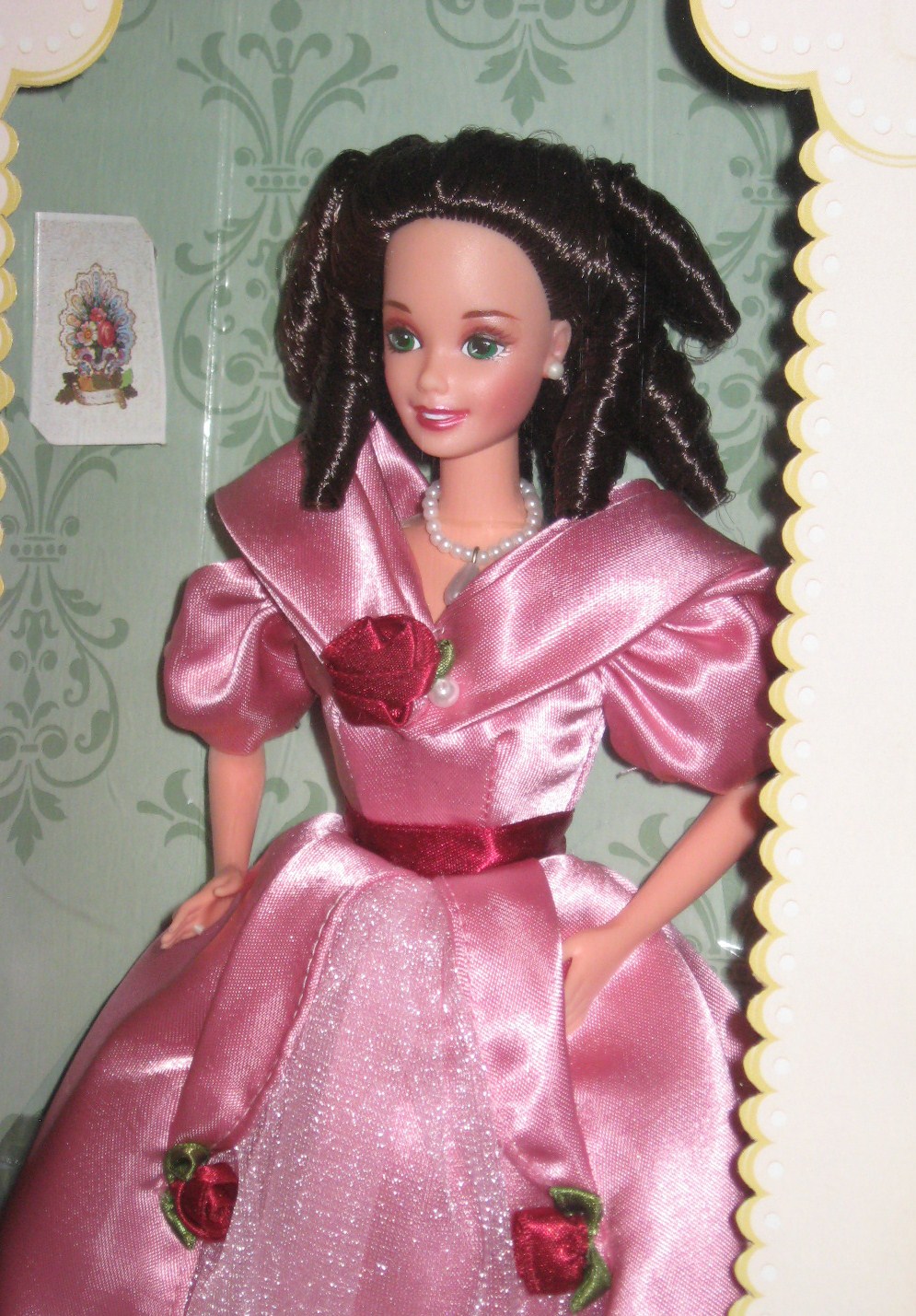
I just got my first Barbie Doll. She’s a blue-eyed brunette with long sausage curls that make me want to call her Scarlett. The pretty box says that she is the Sweet Valentine Barbie. Scarlett Barbie wears a billowy pink satin and chiffon ball-gown, adorned with soft red roses. Her jewels are a simple strand of pearls with matching stud earrings.

She is gorgeous. She is mine.

I never really wanted a Barbie.

“That’s because you were too intellectual for dolls, I guess,” my friend said.

“What? No. I had dolls. I loved my dolls,” I said.

Barbie first appeared on the doll scene in 1959, the year I turned ten, two years after my last doll, but that was only at a show in New York. My family was preparing for a move from Tennessee to California. My dad was finishing at Belmont College in preparation for Golden Gate Baptist Theological Seminary. The next year, I would wear Tangee Natural lipstick and hose with my flats and white satin dress to my piano recital. I never even knew Barbie was around.

By the time little girls of the middle class were getting their first Barbies, I suppose I was through with dolls. But Mom wasn’t. She rescued my two Cynthia’s and my Betsy-Wetsy and gently laid them in a box on a high shelf in a closet.

At the beginning of my senior year at Pittsburg High in Pittsburg, California, Mom and Dad moved to Montana. I stayed.

“Mom,” I said, “Could you keep my dolls for me?” I didn’t need to ask.

Later she told me that dressing the two Cynthia’s made her miss me more during that first Montana winter but she did it anyway because it also made her feel closer to me. When I flew to Billings for Christmas, my dolls were nostalgic adornments for the bed in the guest room.

My three favorites now live next door with my mom and dad. They wear handmade clothing, designed by Mom, and they occupy an entire rocking chair in her bedroom. The three wear a lap blanket to keep them warm. I speak to them as I pass through to the kitchen when I go to check things out over there.

“Good morning Cynthia Dawn, Cynthia Denise, and Betsy-Wetsy.”

Betsy never got a name beyond her brand. She cost $6 in 1956 and Uncle Morgan and I both got in trouble for her purchase; me, because I faked crying to get her, and Uncle Morgan, because he fell for my performance.

Cynthia Dawn is my baby doll. I cared for her daily and we made soft clothes for her and kept her warm in her own bed, always with a receiving blanket wrapped around her like a burrito-tortilla. I felt real love for Cynthia Dawn. And when I thought about naming my first child so many years later, “Cynthia Dawn” was the first consideration. I settled on Dawn Jeanine; I thought we might call her DJ.

When Jade Edward was born—and not Dawn Jeanine—I felt the same love I remembered having for Cynthia Dawn. Oh, it was so much greater, but it was the same love. I learned on Cynthia Dawn.

Cynthia Denise is the bride doll.

I got Cynthia Denise when I was eight, the year that Santa was to bring me a bicycle. Mom and Dad took me “looking” at Kuhn’s, the local pre-cursor of Wal-Marts and Targets, to identify just which model I might choose for Santa’s bag.

After a few minutes of pointing out colors and models and handle-bar tassels, my mother, without covering her mouth, whispered across the line of shiny bicycles to my dad, “She doesn’t want a bicycle.”

“Sis,” Dad said, bending down to one knee, “Do you really want a bicycle?”

I was frank. “No, I really don’t.”

“Well, what would you like to have instead?”

I was frank. “Just get me a bride doll,” I answered.

No one asked me why I didn’t want a bicycle. I’m not sure I would have been able to explain at the time, anyway. The idea of a bicycle sounded good to me. All the boys on Easy Street played Cops and Robbers on their bikes. I played, too, but I ran along behind on foot. I wanted equal status.

However, I was afraid I would not be able to ride a bicycle. I had already tried on my brother’s model several times and I had failed, just couldn’t balance. Actually, I never got good with bicycles.

Sometime during that week after my declaration for the bride doll, Mom went back to Kuhn’s and bought Cynthia Denise to put under the Christmas tree.

It didn’t take long for me to remove her bride’s dress in favor of suits and business clothes. I mean, what does a bride really do? Mom made straight skirts—now we call them pencil skirts—and tailored blouses and jackets. I also straightened her strawberry blonde hair and removed that silly engagement ring, the equivalent of an 8-carat solitaire. 

Cynthia Denise would be a career woman. Today Cynthia Denise wears a two piece, olive green A-line skirt with matching short-sleeved top. Her feet are curved to sport the equivalent of four-inch heels, but she is barefoot. No wonder Mom wants her to have a lap blanket.

Barbie had her fiftieth birthday a couple of years ago. My granddaughter, Carly Rose, had her fourth in early January, 2011. Last year, her birthday party was Spider-man themed. This year, she asked for a “Pink Princess Birthday.”

What a difference a year makes.

Grampy Dave and I bought sets of clothes for the Cruise Ship Barbie she had received for Christmas. All I could find was very urban or rock star-ish, or, well, trashy. I also bought pink hair adornments for Carly’s hair and a sequined carry-case for her “makeup.” Our daughter-in-law Dana brought Carly another Barbie to add to her growing collection.

“You never had a Barbie?” Dana said to me, in disbelief, as I admired the new one wearing a royal blue formal.

“No, never did.” I didn’t feel deprived.

“I literally had a hundred of them and some of them could have been worth a lot today. I wish I had never taken that Millenium Barbie out of the box. I’m not kidding, I had a whole closet full of Barbies,” Dana said.

“Where are they now?” I asked.

“Oh, I gave them away to less fortunate little girls–when I was twelve,” Dana said. “Pretty much all of them.”

She shook her head slowly. “I can’t believe you never had a Barbie.”

Carly dresses her Barbies and cruises with them in the Cruise Ship. Lifeguard Barbie rescues the others and swims with the dolphins. They all lie around on the Cruise Ship in various states of dress and position until the next Barbie session.

Carly’s baby, John Graham (named for her daddy just like every other doll she owns), sleeps with her every night. She feeds John and cares for him. She keeps him warm. He has his own stroller and his own bed for the time that he’s not in bed with Carly. I wonder if she’ll want to call her first real baby John Graham. It could be a girl.

Sometime in the 70’s, Mattel outfitted Barbie with career clothes and began to imagine that Barbie could be a doctor. I figure I’ll look online for business suits and scrubs, just in case Carly’s Barbies want to do something besides cruise, swim, and strut.

Me? I don’t want my Sweet Valentine Barbie to do anything but look pretty in her pink satin dress with the red roses and pearls. I’d never, never, never straighten her hair.

***

Having a Bad Day

Carl, Dad’s physical therapist, motioned to me just outside the elevator door. He was bringing Dad to his room after his morning session and he wanted to talk to me.

I sat down in the activity room across the hall and waited for Carl. (By the way, Carl is a made-up name; the rest of the names in this piece are aliases, too.)

“He’s just not himself today,” Carl said. “He likes to work out hard, but today I had to sit him down. He just couldn’t do it.”

“Do you mean today he didn’t want to do it?” I asked.

“No,” Carl said. “He felt dizzy and sick. I had to sit him down to rest. And after a while, I said, ‘Mr. Blair, let’s go to your room’ and he didn’t even hear me. I got down on my knee in front of him and said, ‘Ernie, Ernie, let’s get you back to your room.’ Then he turned his head and looked at me and said, ‘What? What? Oh! Yes!’ and I got him up and we just came back.”

“How is he now?” I asked.

“I think he’s okay, but he’s just not himself.”

“Carl, my dad has had unexplained fainting episodes for years. That’s not on his chart, is it?”

“No, I haven’t seen anything like that. What do they think causes it?”

“Well, he’s been diagnosed two or three times with possible epilepsy. In fact, he took Dilantin for several years a long time ago, and that made him sick. Last time he saw a neurologist, he put him on some new anti-seizure medication, but he just couldn’t tolerate it. Diagnosis was ‘unexplained fainting.’”

“Now, he didn’t faint…And I took his blood pressure. It was low, but not real low. It could be all sorts of things, maybe low blood sugar. Could be something he ate. Or maybe he’s just having a bad day. Or… maybe he was having a near-fainting episode.”

“I’ll talk to his nurse. If that thing isn’t on his chart, it should be,” I said.

“Yeah, I think so, too. Don’t get too alarmed, though. It may be just a bad day. We see that a lot.”

Carl is Dad’s favorite therapist. He’s a Nazarene youth director; he and his wife moved here from Wyoming. Carl seems to like Dad, too. I like Carl.

“Hey, Dad,” I said, “What’s going on?”

“Oh, I’m just having a bad day,” he answered. He didn’t look good, either. He was too white. He needed a haircut, a beard trim, a bath. I had the barber shears and clippers in my bag, but this was Tuesday; the bath was scheduled for Wednesday after dinner.

“Maybe we should wait until tomorrow for your haircut,” I said.

“Ohhhhh, no,” he said. “I’m getting that haircut today. It will make me feel better.”

“Your shower is tomorrow, though. You’re going to have hair all over.”

“No, I’ve talked to my nurse and she says I can get a bath after supper today since I’m getting my hair cut.”

“Okay, but what happened down there?” I asked.

“Oh, I tried to pass out. Had to cut it short,” he answered.

“Do you still feel faint?” I asked.

“No, I’m better. I just needed to rest for a while. You’re going to have to get a towel.”

“I brought a sheet to put around you. Now where are we going to do this?”

The wing nurse swept into the room; she disappeared behind a dividing curtain to check on Dad’s roommate, Kenneth. Jean looks rough; squatty, blonde, a smoker. She’s always been friendly to me.

“I’m going to cut his hair,” I said. “Where shall I do this? They just cleaned his room. Is there a better place?”

“Oh, don’t worry about that.” Jean pulled the curtain back. “Just call housekeeping and they’ll clean up afterwards. I think I’d do it in the bathroom.”

“If I can just get a broom, I’ll clean up,” I said.

“There’s no need for you to do that,” she said as she left the room.

“Cut it pretty short, Sis,” Dad said after we got all set up. “And then you can put my extra blanket over the bed so that I don’t get hair all over it until I can get my shower.” He’d thought this through.

“Did that wear you out?” I asked after I helped him back to bed.

He laughed. “Yes, it did, but I’m sure glad to get it done.”

I cleaned up the bathroom floor with wet paper towels.

“Dad, you go ahead and get a nap. I’m going to see if I can talk to the nurse.” If there was no information on these “unexplained fainting episodes” on his chart, someone needed to know.

There was no one in scrubs in the hall. I walked on down to the nurses’ station.

“Can I help you?” a young clerk asked.

“Yes, I need to talk to Dad’s nurse.”

“I’m not sure where she is right now, but I’ll tell her.”

Forty-five minutes later, I returned to the nurses’ station.

“I was trying to talk to Dad’s nurse,” I said.

“Okay,” a different clerk said. “I’ll leave her a note.”

“Do you know what time she’ll be on the floor?”

“She’s working now, but she’s just with another patient.”

“Okay.”

Dad was awake and sitting up on the side of the bed. He had good color and said he felt good.

“Except…I need you to look at this place under my arm,” he said.

Once, at the hospital the week before, he had complained that there was a little place under his left arm, “toward the back,” that felt as if it had a small cut. It burned, it hurt, it felt “like somebody stuck me with a knife.”

“Okay. That place is still bothering you?” I asked.

“Yeah. It is painful. Feels like somebody stuck me with a knife,” he said, pulling his arm out of his grey waffle-weave shirt.

I poked and felt around until he flinched.

“That’s it, right there! What does it look like?”

“Doesn’t look like anything much, but I think I can feel a little rise of sorts,” I answered.

“I’m going to get somebody to look at it. The nurse is supposed to talk to me anyway.”

“Sometime this afternoon,” I added, to myself.

I stuck my head out into the hall. No one there, but I did see the nurse practitioner at the nurses’ station. NP, I call her. I can never remember her name, but I know that NP is the highest medical person on staff; the Medical Director, a physician, makes rounds but is not onsite. I rounded the nurses’ station to place myself in front of her.

“Hi,” I said. “You’re the Nurse Practitioner, aren’t you?”

“I am,” she answered.

“May I have just a word with you regarding my father, Ernest Blair?”

“Yes. Have you talked to his nurse?”

“I have asked to speak with her but that’s been about three hours ago and I haven’t seen her. I’m going to have to leave soon,” I answered, with my voice trailing off.

“Okay, what is it concerning?” she asked.

NP is much taller than I am and she was looking over my head, down the hall. Sometimes she leaned her upper body to one side and then the other to look around me. I shifted and then turned to look down the hall myself.

I continued, “Well, there are two things. The first one is, he had a near-fainting episode in physical therapy this morning and I wanted to make sure that you all know that he has a history of unexplained fainting.”

She countered. “That’s what he came in for.”

“No,” I said. “You mean, from the hospital?”

“Yeah, that’s the diagnosis he came in here for,” she said.

“No, actually it was an internal bleeding thing that sent him to the hospital.”

I was going to continue but she interrupted me.

“Same thing. He fainted from the internal bleeding,” she said, still bobbing around me to look down the hall and then in back of her toward another wing.

“Yes, several times,” I said, “but they sent him here for therapy, to get back on his feet and also to treat a sore shoulder.”

I stopped. “I’m sorry, do you need to attend to something else right now?” I asked.

“Oh. Well, I’m trying to get this family’s attention. They’ve been trying to teach their mother to use the wheelchair and she’s down this other hall making wheelies and everything. They need to see this,” she said.

“Okay.” I didn’t know what else to say.

NP called over my head, “She’s down this hall, flipping wheelies and going all over the place!”

The family proceeded past the nurses’ station, toward the other hall.

“I’m sorry,” NP said. “Now, tell me that again.”

So I did.

“Same thing,” she said again.

“No, not exactly,” I said. “He’s here for therapy, to be able to get around again, and also for his shoulder.”

“Oh. Okay. What was the second thing?” she asked.

“He has this little place under his arm that is extremely painful, and I am able to find it. I want to show it to somebody,” I said.

“Have you talked to his nurse?” she asked. “Because you really need to talk to his nurse.”

“No. I’ve been waiting to talk to her but I haven’t seen her,” I answered.

“She’s right down the hall there in front of his room,” she said, motioning with the clipboard in her right hand.

And she was—in the hall—not in front of Dad’s room, but in his hall. She was distributing medications.

“Thank you,” I told NP. “I’ll just run down there and talk to her.”

By the time I got to the medication cart, Jean had ducked into a room. I stood by the cart to wait for her.

“I just need to tell you a couple of things,” I said.

“Okay,” Jean said. She looked at me, my signal to start.

“The first is that Dad had an episode of near-fainting in physical therapy this morning and I don’t think there is anything in his chart to say that this is his history. He has a history of unexplained fainting episodes,” I said.

“Oh, great,” Jean said. Was the tone sarcasm? “That’s good to know.”

“Well, yes,” I said. “And the second thing is that there is this place under his arm that I think you should look at.”

“Let me run in here and give this medicine,” she said, as she disappeared into Mrs. Taylor’s room.

I waited beside the cart. Jean and Mrs. Taylor talked about the weather, the kids, the floral bedspread.

When Jean came out of the room, she said, “Physical therapy never called me this morning.”

“Well, I know that the therapist took his blood pressure, and it was low, but it wasn’t that low…”

“Physical therapy is not nursing. They are not medical people. They cannot make medical decisions,” she said.

“I think they were just trying to make some immediate response. He said he had to sit Dad down, and they didn’t get to finish the therapy session.”

“They’re supposed to let us know, immediately, if something medical happens. I’m going to be calling physical therapy to have a word with them,” she said.

“Oh, you don’t have to do that,” I started.

“Yes, I do,” she said. “They are supposed to call us.”

“I was just trying to let you know, you know, in case Dad got woozy…You know, he took a fall the other day.”

“I know he did,” she said. “Let me give this medicine.”

She ducked into another room and came back out.

“The second thing is that there is this place under his arm, actually on the side of his armpit, that is painful, and he says it feels like somebody stuck a knife in it. I think someone ought to look at it. I can actually show you the exact spot,” I said.

“Okay, I’ll be down there in a minute,” she said.

That meant I should go to the room and wait. Jean passed me as she entered the activity room where Mrs. Smith and her daughter were visiting.

“How you doing?” Jean said to the daughter.

“Good. Good. Hey, I think Mom needs a change. She’s been out today for a long time and I’m sure she needs to be changed.”

“I’ll get you somebody,” Jean said. “How did the curtains turn out?”

“I think they look really good.”

I stopped listening. Jean handed the pills to the daughter along with a glass of water. The daughter handed the pills to her mother, one at a time, and her mother swallowed each one with a sip of water while the conversation continued.

Jean hurried by me into the room.

“Where is he?” she asked, just as we heard Dad click the paper towel dispenser twice.

“He’s just drying his hands,” I said.

“Then I’ll come back,” she answered, and she was gone.

Dad sat down on the side of the bed and we continued a conversation about Egypt’s upheaval.

“I think they’re just in for bad trouble,” he said.

“Yeah,” I answered.

“Sis, you need to get started home. It’s going to be dark pretty soon. I don’t like you girls being out after dark.”

I smiled back at him. “I know. I was waiting to see the nurse,” I said.

“Maybe you should start getting ready to go,” he said. “She’ll probably be in here in a few minutes.”

“Okay,” I said. I began to gather up Dad’s laundry, some cards he wanted me to take home, and the magazines on the table that I had brought to read while he napped.

As I passed the window, I saw Jean crossing the parking lot, pulling the hood of her jacket over her head in the rain. As soon as she crossed the street, she lit her cigarette and called out to the other woman joining her.

“Dad, I think I’ll go on. I’ll talk to the nurse tomorrow.”

“Okay, Darlin’. You have a good evening. Give Mom a kiss for me,” he said.

***

Grandpa Goes to Rehab

Dad had an “episode” a couple of weeks ago Friday and wound up in the ambulance on the way to St. Thomas at about five-thirty in the morning. He and Mom got some sort of stomach virus a few days earlier; Dad was ill first and we thought he was getting better, but sometime after midnight he started vomiting blood. Turns out he had a severely infected stomach and esophagus and the repeated vomiting had made a tear in the lower esophagus. The kind ER nurses started a Nexium drip the minute they got their hands on him and the tear was repaired medically on Saturday—no stitches.

I think it’s quite remarkable that he has not had even a moment’s indigestion since.

Now, what has become a problem—or maybe there are several—is that he’s having some rather severe balance issues along with being weak to the point that he could not get out of the hospital bed unaided until the following Wednesday. He also has a frozen shoulder that is giving him a fit. We were on our way to see an orthopedist when he and Mom came down with the virus.

We moved Dad to rehab at Woodcrest, a very nice skilled nursing facility at The Blakeford, a large progressive-care place about seven miles away, last Wednesday or Thursday—I’ve lost track of days here. He gets a lot of intense physical therapy on both his balance and his shoulder. These sessions are independent of each other; Dad’s favorite therapist advised me that “these are really two different disciplines.”

Dad honed his description of his rehab prescription and filled me in. “My main job is to work hard on my therapy so that I can plant my garden this spring.”

And then the next problem developed: Bowels. He finally got them going again (after seven days) and then couldn’t get them stopped, that sort of thing. The nurses told me that the whole experience is quite common. One day I left Mom with Dad to visit and went on a Wal-Mart run to lay in a supply of the fleece pants he’s wearing over there. Three changes of clothing weren’t enough, so I increased the stack to six.

I’ve spent a little time “doing battle,” too.

When he was at St. Thomas, I took Dad three bold-stroke, ball roller pens to stand in for the fine old pen he writes with at home; the man cannot live without a notebook and some pens. When he got to Woodcrest, I put two of the pens in the top drawer of his nightstand and left the third on top of his notebook on the bedside table.

Saturday morning, almost as soon as I walked into his room, Dad furnished several pieces of information, in answer to my probing, that toyed with my happiness. He was supposed to have a shower on Friday and didn’t, even after he had a soiling incident. His breakfast, every day, was a big plate of sausage, bacon, and eggs, in spite of his request for “a bowl of Cheerios or cream of wheat or oatmeal.” Then they brought him cereal but he got no milk, even after a second request, so he didn’t eat his Rice Krispies. Another time he couldn’t get anyone to go look for Splenda even though they said they would, and they wouldn’t bring him coffee, even decaf, except for breakfast.

And every damn pen was GONE!!!

It was the pens that sent me over the edge. Just after Dad asked me to look for his pens, the physical therapist came to take him downstairs for his afternoon session.

“Mom,” I said, “Let’s go down to the activity room until Dad gets back.”

The spacious activity room is a warm, cheerful gathering spot with honey-colored leather couches, gliding rockers in front of a fireplace, and flat-screen TV’s. In another area, heavy tables with rolling chairs flank bookcases with inviting titles and large print. Three staff members were moving couches against the wall, said they were getting ready for “the sing-along,” and invited Mom to join them.

“You’ll love it,” one promised.

“Oh, I’m sure I will. We love music,” Mom said.

I strolled down the hall to the nurses’ station and asked for a talk with the wing nurse, the nurse in charge of Dad’s wing of the floor.

I started by saying, “Britney, there’s this one little thing that is just bugging the snot out of me and I want to get that out of the way first.” (Britney is not her real name, but it is something jazzy like that.) Then I unloaded about the pens. Britney said that the nurses might mistake his pens for their pens.

“I don’t think so. Britney, Dad’s are better pens than those Bic stick pens, not that I blame the nurses for wanting better pens.” (Dad and I like our “school supplies.”)

“Let me get him some pens,” Britney said. “We have lots of pens.”

“Okay,” I said. “But they have to be like the ones he just lost. He can’t write with a Bic stick pen.”

Actually, Britney was pretty good. She declared that she was as disgusted by the rest of my complaints as I was and that she was happy to note that he will drink a glass of skim milk any old time and that he will eat ice cream at the drop of a hat, hood, or scarf. She thanked me for bringing my dad’s needs to her attention.

After I had covered the topics of pens, eating, pooping, laundry, and personal cleanliness to my satisfaction, I found Mom sitting at a table in the activity room—alone—grinning, and singing—along. Forty or so residents, mostly in wheelchairs, some with tambourines and some with shakers, made a large semi-circle audience.

The pretty young woman with the guitar finished singing “Hey, Good Lookin’” just as Dad eased in the door with his walker. He rolled over to our table. She called out to him, “What’s your name?”

Dad stopped and proclaimed, loud and clear, “Ernest. Blair.”

“Well,” she said, “I hear you’re a hillbilly and a guitar picker and banjo plucker!” (Mom must have been sharing before I got there.)

“Oh, yeah?” Dad paused and grinned. “Yes to all the above.”

“Will you come up here and sing with me?” she asked.

“Let me sit here and rest a while,” he said.

After a couple more songs, she turned to Dad. “Do you know On Top of Old Smoky? Come up here and sing it with me.”

“Okay, I guess I can do that.” Dad eased to the front of the group of forty or so residents, let go of his walker, stood straight as an arrow and waited for her intro.

She just didn’t know what she was in for. He started traditionally enough but then he began to sing verses that he had made up. The residents howled and clapped. So now he’s a stand-up comedian? He was clearly in his glory.

“Old top of Old Smoky, underneath the blue sky, If you don’t say you love me, I’ll just sit down and cry.” And then there was “On top of Old Smoky, all covered with frost, I found my dear sweetheart, a-flirtin’ with her boss.”

Through the glass doors, I saw some blue scrubs whizzing into Dad’s room. I excused myself. No, she was with Dad’s roommate. But somebody had placed a Bic stick pen on the bedside table…

When I got back to the activity room, Dad and Mom were leaving (Mom whispered that Dad was tired) but I heard the guitar lady say, “Is this who you’re talking about?”

Dad said, “Yes. She’ll play for you.”

And that’s how I wound up at the piano. I told her I would just play along with whatever she played while they sang. It was great fun. We did all sorts of stuff; she quit playing the guitar and just led them in the singing. A few brave residents got out of their chairs to dance to “Five Foot Two.” I wanted to sop up the joy.

When it was time to end, she said, “Usually, when our time is up, I put on a CD while they make their way to the dining room. Would you just play something while they leave?”

I played “That’s All I Ask of You” and they sang. I played “The Sound of Music”—and they sang again. I played “Red River Valley” and “Your Cheatin’ Heart.” They sang. The three staff members sang, too, as they pulled sweaters tight, tucked wraps over laps, and reminded each resident, “I’ll see you later” or “Don’t forget we’ll be here Tuesday afternoon.”

I started “Claire de Lune.” A song with no words, that’s what I need. I motioned to the leader with my left hand to come closer to the piano.

“They’re not leaving,” I said. “I think I may have to quit, and then they’ll go.”

“Probably so,” she said. “They love to listen to music. They don’t get the piano very often. Will you come back?”

“I will.”

I zig-zagged around the wheelchairs while the women extended their hands. I took each one; sometimes I held two at a time.

I understood when the first lady said, “That was just beautiful. I hope you’ll come again.” I didn’t understand what the second lady said to me, but her hand was cold and I cupped it in both palms.

The third lady said, “Your hands are so warm.”

Four frail hugs and some more handshakes later, I found the door and held it open for the expected migration until one of the staff members relieved me. I was hanging on to my emotions by a thin thread; I felt tears coming on. I’ve played so many times for retirement places, assisted living, and nursing homes, and every time, it feels like the first time. This first time was really a first time; it was the first time I’d played for my dad’s nursing home.

I walked into Dad’s room, hoping he wouldn’t notice my shaky demeanor. He laughed out loud when he saw me.

“See what I got you into?” he said and slapped his hands together.

Dad loves to go to the dining room, even if he doesn’t like to eat because he meets such interesting characters. His favorite so far is a ninety-year-old retired Vanderbilt professor who requires an assistant to wheel him in and feed him. Dad says he would love to feed him himself if he could hold the spoon.

I asked Dad, “Does he talk?”

“A little,” Dad said. “His voice is real weak, but if I strain, sometimes I can make it out.”

Britney told me that Dad regales the staff and the other residents with stories. She said, “He’s the kind of man that would rather tell a story than ask for what he wants or needs.”

Later, I wished I’d stood there longer to take in Britney’s compassion and to appreciate her insight.

“Dad,” I said at the end of that problem-solving day, “If you don’t get your Splenda, or they don’t bring you milk, just press your call light. They’ll get it for you.”

“Oh, I’m not going to hound them,” he said. “My main job is to be a sparkle. Their jobs are difficult enough.”

Should Auld Acquaintance Be Forgot…

They arrived ready to party, the GrandYardigans. We nicknamed them after that cheery, busy toddler show we watch “On Demand,” The BackYardigans. Carly was wearing a gauzy hot pink ruffled dress over black footless tights and boots, a hot pink silk chrysanthemum holding her loose side-braid, an equally pink sequined heart barrette anchoring the other side of her head. She said she was wearing makeup, and if she was, it had the intended adult effect, very natural. Jameson sported a #21 Duke basketball jersey with matching shorts, an outfit he got on a December special trip to a Duke basketball game with his dad.

“We looked all over Raleigh-Durham for a #20 jersey. That’s Andre Dawkins, you know. He’s my favorite Duke player. Dad took me to every Duke store he could think of. I finally got #21; it’s the closest to #20.”

“So who’s #21?” Dave asked.

“Miles Plumlee,” Jameson said.

“I have a Tamwun Twazy at home,” Carly said, “A Tamwun Twazy tee shirt.”

“Oh, I thought you were talking about your puppy dog,” I said. John bought Vicky a Shih-tzu long before either Carly or Jameson was born and they named him Cameron Crazy, the nickname for a lone Duke Blue Devil student basketball fan. When they went back to the breeder for seconds, they got Sophie Mai, named for Miss Sophie Hall, Vicky’s residence hall at the University of Tennessee.

“Well, we do have a weal Tamwun Twazy,” Carly said. “That’s Tamwun, our dog. That’s where he got his name.”

We started the New Year’s event with a gift opening. We saved the rule-breaking presents we bought for today when at least most of the family wouldn’t know that we could not keep our commitment not to buy for anyone other than the ones whose names we drew. (It was the first year we drew names—We’ll work our way into it.) Jameson got a Hot Wheels Speedway track and a charcoal Star Wars Legos shirt with matching knit cap. Carly loved her pink tee with the nail polish bottles all over the front (and the word “Twinkletoes” for explanation) and ruffled purple skirt and the porcelain tea set. We left Grampy Dave to his work of heeling in roses and proceeded to our favorite place, The Cellar.

Carly and I started a lovely tea party with Diet Fanta Orange subbing for real tea; she selected the pink cup and saucer and placed the red set in front of me. Jameson said he’d rather just drink a Diet A&W Root Beer without all that tea party stuff. After he had raced a few laps on the new Speedway, he said he thought it would be a good idea for him to join Carly and me so that we could share snacks. He still had most of his root beer and said we could put that in the teapot when the orange ran out.

Carly asked me to re-fill the tiny teapot with the Fanta, but she wanted root beer in the cream pitcher. Jameson and I took our “tea” plain—no cream, no sugar. Carly insisted that she was the pourer. Jameson said he was capable of pouring his own and that she should allow the servants to help.

“Besides,” he said, “you spill every time you pour.”  (She did.)

“So are you the servant?” I asked Jameson.

“No, not really, but I thought she’d let me pour,” he answered.

“I have to pour the tea,” Carly said. “I’m the owner.”

“You mean you’re the mistress of the house,” I said.

“Well, it’s my tea set,” she said.

Jameson drank ten of the tiny cups, each in one gulp. I noticed that we were out of Fanta Orange—It was my job to re-fill the teapot from the soda cans. We were starting on the root beer, the Sprite reserved for the cream pitcher.

Carly leveled her gaze at her brother, turned her head toward me, and blew. I thought I was looking at myself there for a minute.

Jameson understood her body language and said, “Just let me pour my own.”

“No,” she said to him and turned to me. “He is just drinking too fast and that’s mean.”

Jameson shrugged in my direction. “She knew I was a heavy drinker. She should just let me pour my own.”

“Jameson, this is the last cup you’re getting. You should just drink out of the can,” she said.

Jameson finally said he was full and that he needed to race those cars again. So far, out of the four chosen vehicles, the red car had won in every lane.

Carly tore off to the bathroom and when she came back, said, “I had to go tinkle really bad.”  I supposed as how she probably did; she had consumed a lot of tiny cups of liquid.

“Are you finished with your tea?” I asked her.

“No. I need more tea—and more crackers,” she answered.

Then she crushed up some crackers and sprinkled them into her teacup.

“What’s that supposed to be?” I asked.

“Just makes it all taste better,” she said. She pulled out a small cracker, a pretzel, and a tiny melba toast.

“Which do you think I should put in here first?” she asked.

“Oh, are you creating a mix in your tea?” I asked.

“Yes. How about the pretzel first?”

“Yeah. That sounds good.”

“And then this one.” She lifted the toast. “Do you want some of this in yours?”

“No,” I said, “I think I’ll just drink mine plain.”

“Grammy,”  (only she really said “Dwammy”), “you’re going to have to use the Sprite.”  She crunched the crumbs she had just siphoned from her cup.

“Okay,” I said, as I filled the tiny pink teapot from the Sprite can.

The plastic tray, next to the table on the plastic kitchen set, was overflowing with soaked paper towels, bags from the snacks, and soda cans. It was 5 P.M. and the three of us had consumed a bag of Spicy Doritos, three packs of Cheezits “Extra Cheddar” cracker mix, one single serving of Cheddar Jack Cheezits,  two pots of cheese dip with their accompanying bread sticks,  a Diet Fanta Orange, an A&W Diet Root Beer, and a Sprite Zero.

Jameson announced the latest race results. “I’ve raced eleven times and the red car has won all but two. I wonder what percentage that is.”

I let him wonder. I couldn’t divide eleven into nine without electronic help.

“I think I’m done,” Carly said after she had drained the Sprite from the teapot, the sugar bowl, and the cream pitcher. “Or we could have some more crackers.”

“Well,” I said, “I think tea time is past. We’re going to need to get ready for dinner.”

“What’s for dinner?” Jameson asked.

“Steak, baked potato, green beans,” I answered just as my cell phone rang. It was Dave. When I’m in The Cellar, he calls me from the home phone.

“How many potatoes should I put in the oven?” he asked.

“Four,” I said. “They’re small. Four.”

Carly pulled at my sleeve. “Tell him I don’t want a potato. I don’t want a potato. No potato for me, okay, Dwammy?”

“Four,” I said. “If we have some leftover, we can always use them for breakfast.”

On the way upstairs, Carly asked, “Did you hear me say I didn’t want any potato?”

“Yes, I did,” I said. “We’ll just put a little on your plate and if you don’t like it, you don’t have to eat it.”

“I already know I don’t want it. I want mac and cheese.”

“Mac and cheese?  You want mac and cheese?” 

She grinned and nodded. She always wants mac and cheese and she usually gets it.

“Grammy, can I have mac and cheese, too?” Jameson asked from three steps below us.

“Sure,” I said. “You want potato and mac and cheese?”

“No,” he said, “just the mac and cheese. No potato.”

“Okay, yeah,” I answered. The prix-fixe menu was slip-sliding away.

I figured they’d eat half a tub each of Kraft Original Microwave and the foxes on the ravine would get the rest on Saturday. Dave handed Jameson the remote controls so that they could watch a new Scooby-Doo video while I microwaved mac and cheese and steamed green beans and Dave grilled rib-eyes and small lobster tails for the two of us.

The Scooby-Doo was done before dinner.

“I know,” I said. “Let’s watch The Backyardigans!”

“Oh, yeah, we haven’t done that in a long time,” Jameson said. “Grammy, it’s on Nickelodean.”

“Oh, yeah,” Carly chimed in, “let’s do the one about the library.”

Jameson ate his four-ounce, hand-patted, seasoned ground chuck steak and asked if he could eat Carly’s since she wasn’t eating hers. She was happy to share; she had already eaten her whole tub of the sticky yellow stuff and a large serving of steamed green beans. I burned the rolls so there was no bread.

“Can I eat Jameson’s green beans?”

“Jameson, aren’t you going to eat your green beans?” I asked.

“No, I don’t think so, but do we have any more steak?” he asked.

“Yep,” I answered, “I cooked three. Geez, did you finish Carly’s already?”

“Dwammy, I need some more green beans,” Carly called into the dining room, just as I sat back down.

“Okay, I have more. Dave, are you finished with green beans?”

“I’ve had plenty,” he said. “Is that all you’re going to eat?”

“Yeah. Why don’t you put that steak in a plastic bag and you can make a sandwich for lunch?”  I gathered the last of the green beans from the top of the stove.

“Carly,” I said, “this is it. These are the last of the green beans.”   

Nobody mentioned dessert. Dave said he’d clear the dishes; Jameson said we should pick something good to watch.

Carly said, “How about SpongeBob?”

There was a time when watching SpongeBob would have been low on our list of choices for New Year’s Eve festivities. I would not have been amused by a tea party with a 7-year-old and a 4-year-old. Dave would have been happier at a party where we saw the New Year in. There was that time.

Today, John and Vicky said they went to a four o’clock movie, The King’s Speech, after which they ate a late dinner at a new restaurant where the food was “really, really good.”   John said he asked Jameson what was for dinner at Grammy’s New Year’s Eve party.

Jameson said, “We had this salty steak that was made out of some kind of, you know, ground up meat. Dad, it was really good. You would have loved it!”

Carly said, “We had a really special tea party.”

Jameson, I’m so glad you liked it. Yes, Carly, it really was special.

Happy New Year, everybody!

***

What are you grateful for?

We used to do that rather regular thing of going around the table on Thanksgiving so that each person could answer The Question. “What are you grateful for?” we’d ask the next person after the one before had remarked on health, family, love. But then that whole holiday routine got blown up the first year John and Vicky were married when her answer was an impish “I’m thankful for that puppy John is going to buy me.”

I still ask myself the question—I think it has become a coping strategy.

Last week, Mom, Dad, Dave, and I went to the Nashville Zoo. I was thankful for wheelchairs that day. Oh, we didn’t have any wheelchairs, but I was thankful that there were such things because we will need them someday soon. We could have used a couple at the zoo.

Dad got four complimentary tickets to the zoo from one of the college-age daughters next door. Saleh and Zienab Al-Akashi have six children including Jinan and Noura, both pre-med students at Lipscomb University and part-time employees of the Nashville Zoo. The four children that follow the future physicians are Naba, Abbas, Mohammad, and Zahra and they range from twelve years down to four. Saleh works two jobs and is finishing classes for a technical degree; Zienab transports children, runs a household, and mows the yard.

Dad made friends with Saleh last year when we all first moved in here on the ravine. He knows when Saleh arrives home between jobs—that’s when they meet in the driveway. Dad asked Saleh if he could weed-eat for him. It wasn’t long before Dad got permission to mow for Zienab. I hear that Dad will plant a flower garden for Zienab this spring, too, with Saleh’s agreement.

“You are so nice to us, Mr. Blair. What can we do for you?” Saleh asked.

“Saleh,” Dad told him, “You and your wife are working so hard raising this family, it’s just a privilege for you to let me help.”

One day Saleh brought the four tickets to the zoo. “You said you wanted to go to the zoo?”

That evening, Dad said, “Saleh gave me four tickets to the zoo. Well, actually, he didn’t give them to me, his daughters did. They work at the zoo, you know. When the weather gets nice again, we can go to the zoo. That’s the only thing I wanted to do in Nashville.”

The dark blue macaws are just to the right past the entrance.

“Look, Honey,” Mom said. “Blue macaws. Can you see them?”

“No, not very well. I’m cold. It’s cold out here.”

“You should have worn a heavier coat,” Mom said.

“Well, I know that now,” he answered.

“Dad, put Dave’s jacket on,” I said. “We put it in Mom’s basket.”

Mom rolled up beside me with Dolly, her Rollator walker. “Well, this is going to be fun. He can’t hear and he can’t see.”

“Well, aren’t you glad you have Dolly?” I asked. “This is the whole reason we needed that Rollator.”

“It does nothing for the pain,” she answered.

Uh-oh… her legs… pain…this IS going to be fun.

We passed the red-crowned crane (he couldn’t see that, either) and inched our way up the hill toward the carousel and “Lorikeet Landing,” where the colorful ‘keets light on shoulders and heads and hands in a mesh enclosure. No strollers. I guess that means Rollators, too. Mom and Dad sat on a bench. Mom sighed and blew.

“How much further to the giraffes?” she asked. “They’re my favorites.”

“Well—me, too. There’s a lot of walking here,” I answered. “Dave, did you happen to pick up a map?”

No, he didn’t.

“It’s around this loop here,” I said. The sign said “African Savannah.”

There were no Red River Hogs in the hog pen, and we cut off the loop at the first viewing station for the elephants huddled in the far corner of their field.

“Dad, look way out there. They’re in that far right corner of the field,” I said.

“I can’t see them. They’re too far away. Oh, wait, are they moving? I think I can see them moving.”

“Let’s stop here for a minute,” I said, pointing toward fifty wooden tables in a big field. Festival Area. I thought about the time we brought grandchildren to the Halloween celebration; games and activity tents had covered the field.

“I knew there would be a lot of walking,” Dad said as he propped himself on a big rock in the curve of the path, “but I didn’t know there’d be this much.”

“Let’s head back this way.” I pointed back toward the entrance. We had rested plenty but Dad was staggering a bit, even with his cane, and Mom was moving slower and leaning hard on Dolly.

“We almost need wheelchairs to get around this place,” Dave said. “I brought Mom out here the last time she came to Nashville and I pushed her in a wheelchair.”

“Remember when you pushed me all around the Memphis Zoo in a wheelchair?” Mom asked.

“Yes, I do.” Mom and I both started to laugh. We pushed and pulled that wheelchair over cobblestone, onto little trains, up dirt hills. That was over seven years ago, before she walked with a cane, before Dolly was a fleeting thought, before Mom lost fifty pounds. At the end of that day, Mom was doing fine. I needed a heat pad and ibuprofen at the hotel. But, we did see the visiting Giant Pandas!

“Your daddy would never ride in a wheelchair—he wouldn’t even use this walker,” she said.

“Well, we have two wheelchairs at home,” Dave said, “and when we need them, we’re going to use them.”

“We’ve got that motorized chair, too,” Dad said, “and we ought to get that thing running.”

We all sat down at the picnic tables near the gibbons. Dad finally saw one of the white ones.

“Hey, Boy, come on over here,” he hollered, waving his cane in the air.

“Dad, stop hollering,” I said.

“Well, I want to see him up closer. Where are the monkeys?”

“Dad, there are no monkeys here.”

“No monkeys? What kind of a zoo doesn’t have monkeys? No apes?”

“No, the closest thing to a monkey you’re going to see are these gibbons.”

“What are they?” he asked.

“Gibbons. You heard her, they’re gibbons,” Mom said. She shot him a look.

“Well, nothing is close enough for me to look at,” Dad said.

We tried to explain about natural habitats and current trends in keeping wild animals.

“Let’s go,” I said. “Let’s go look at the meerkats.”

Mom counted the meerkats. Dad leaned on the clear enclosure and dropped his cane over the side to circle the head of one of the colony’s sentries.

“Ernie, quit that,” Dave said. “Don’t do that.”

“I’m not bothering him,” Dad said. But he withdrew his cane.

“Now I like those,” he said.

We passed the big stork.

“So that’s what a stork looks like,” Mom said. (Dad couldn’t see it.)

I saw the tables in front of the snack bar near Unseen New World where the snakes and amphibians live, and knew this would be our ending point for the day. We would not make the Jungle Loop with the lemurs and cougars and leopards and ostrich. Even if we did have wheelchairs, we wouldn’t make it. We were all tired.

“Dad, let’s rest here,” I said.

“I think I have to quit here,” he answered. I was glad he said it.

“Well,” Dave said, “I am going around this loop here to see the tigers. It’s what I came for and I’m going to see the tigers.”

“Okay, we’ll just wait for you here,” I said.

“Now, why would she come to the zoo with that little kid?” Dad pointed to a young mother pushing a stroller.

“Why wouldn’t she?” I asked. “It’s a great place.”

“Yeah, but what does she get out of it and what does that little kid get?”

“Well, it’s a safe place to be, quiet, no cars to dodge, and you know, here are these animals that she’s shown the baby in his picture books.”

“I can see where it’s safe. Nobody would threaten her and her child here,” he answered.

“Oh, I wasn’t thinking of that kind of ‘safe,’” I said. “I was just thinking that you can be on the walking trails and no cars…”

“Oh.”

“Look,” Mom said, “Flamingoes.” She pointed to the sign for the Flamingo Lagoon.

“You want to go down there?” I asked. “I think it’s just right there around the corner past the petting zoo.”

“Yes. I want to see the flamingoes.”

“Dad, you stay right here. Don’t you go anywhere. You stay right here,” I said.

“Where are you going?” he asked Mom.

“We’re going to see the flamingoes,” she called over her shoulder.

“Ohhhhhhhhh, they’re beautiful,” she said, “and so many of them.”

We stopped by the petting zoo on the way back to Dad.

“Llamas, goats, donkeys…oh look, there’s a camel!” Mom said.

We turned on the path to see that Dad had found a friend. A young man and two children, a girl maybe eight and a boy about ten, were saying their goodbyes.

“Mr. Blair, it was very nice visiting with you.”

“Who was that?” the girl asked as they walked away.

“He’s my new friend, Mr. Blair,” the dad answered.

“We were having a philosophical discussion,” Dad explained as we neared the tables. “We were talking about why people come to the zoo. He’s a writer. He’s from Los Angeles. He came to the zoo to get ideas for his stories.”

“Hm,” Mom answered. (We’ve come to recognize “Hm” as the signal that Mom is bored.)

“And he left his cell phone at home,” Dad said. “He doesn’t like to be interrupted when he’s getting ideas.”

“Hm,” Mom answered. “He’d talk to a fencepost,” she said in my direction.

Dad was oblivious; he probably didn’t hear her. “And he thinks it’s a big intrusion to use your cell phone in a nature place like this,” he added.

“So did you see the tigers?” I asked as Dave walked up.

“Yep. Two of them. And the lynx, too.”

“Then I think we’re ready to go,” I said.

“How far is it back to the entrance?” Mom asked.

“It’s not as far as we’ve come,” I answered.

“Next time we come, we need some wheelchairs,” Dave said.

“Well, we’ve got wheelchairs,” I answered, “but I’m not sure I could push one around this whole zoo.”

“We need to get that motorized chair working,” Dad said.

“Well, I’m not sure that motorized chair would be good around here,” Dave said.

“Too many hills?” Dad asked.

“Yeah. We need wheelchairs or maybe a golf cart. I don’t think they allow golf carts, though.”

“Where did we get the wheelchairs?” Mom asked.

“Fannie Tietze,” I answered. “Remember her? Sweet, sweet, elegant woman. She died last month and wanted people at church to have her things. No one wanted a wheelchair so I said I’d take one and then the son told me that I should take both of them.”

“They’re in perfect condition,” Dave said. “I haven’t figured out how to fold that smaller one. You need to help me with that.”

What am I thankful for?  I am thankful for family, health, and love, those very “regular” things that everyone answers in response to that “regular” question.

I am thankful for family, especially the family of four that we’ve put together here on the ravine, and that we are all happy. I am thankful that there are children and grandchildren and great-grandchildren close by. I am thankful for that puppy that John bought Vicky, the little Shih Tzu who is now ten years old, as well as the other dogs, cats, and foxes that have come into our family lives.

I am thankful for health—Mom and Dad’s health at eighty years old. I am happy that their health allows them to make trips to the zoo, to the grocery store, to church. I am grateful that Mom’s health allows her to care for their apartment and that Dad’s allows him to garden for himself, us, and the Al-Akashis.

I am thankful for love—the love of a good man, the love of parents, children, and grandchildren, the love of neighbors, and the love of friends—old and new, living here or watching over us from the other world.

I am grateful for wheelchairs.

***