This is the second year we honor my brother, Denny. He was named for our Uncle Dennis Smallwood, who was killed on Iwo Jima. Today, we memorialize all those who died in service to their country.
Back in 1967, my brother’s number was up. Yes, young men’s lives were auctioned off by chance. But Denny held a religious deferment as he declared he would be a Christian minister.
Some months passed, and my father initiated a severe conversation with his son. Was he serious about becoming a minister? If not, was he being truthful with the Draft Board? Denny joined the Marine Corps.
I held nothing in my mind as to what each of them thought at the time. I wonder now if Dad ever regretted that conversation or if Denny would have reacted differently had Dad not challenged him.
Here was a guy who gave all of his body and mind in Vietnam and came home to deal with that loss. He built a radio station there and had a show. He counted bodies. He sent out endless letters as a public relations soldier. He led his men on countless patrols, and too often, he returned to base without some of them. And while he was out in the jungle-like terrain, the U.S. Military sprayed a killer defoliant. It was called Agent Orange. Denny got some of it.
Back at home, he was sent to Hawaii and then Arizona to serve as a recruiter. I never understood how he could do that. One time, when he was telling stories, he asked me, “Can you imagine being so scared that you literally climbed into your helmet? That’s what all of us felt.” It’s still a mystery to me why anyone would volunteer when there was a good chance they’d wind up in horrible conditions with guns pointed at them.
After he left the Corps, Denny suffered physically and sometimes mentally. He met periodically with a psychiatrist.
Denny was poisoned by his own country. He developed tumors in his back. He was born with only one kidney, and that one failed. He developed 5-minute seizures. I know his wife, Bev, could furnish a longer list. He spent half of his life in a wheelchair, one he could maneuver around in. In the end, he developed cancer of the esophagus, and it was untreatable.
The Veterans Hospital in Reno was semi-good to Denny. Often, they sent him to other, more suitable hospitals for treatment not available at the VA. Bev fought the bureaucracy with bear-like fervor to get him the care he needed–and deserved. She was strapped to help load him and his chair into an ill-fitted van, put him in his chair, help him to the toilet and back, and act as his 24/7 caregiver. Was she able? Not entirely, but she did it anyway.
A few months before Denny made the choice to discontinue dialysis and die, the VA declared him 100% disabled.
It took dying to get it done. Today, my brother is on my mind. He gave all.
Grief comes in waves, but it lasts forever. It changes, but it’s still there. Mom died in June 2022, but for the past few months, I’ve missed her more than ever.
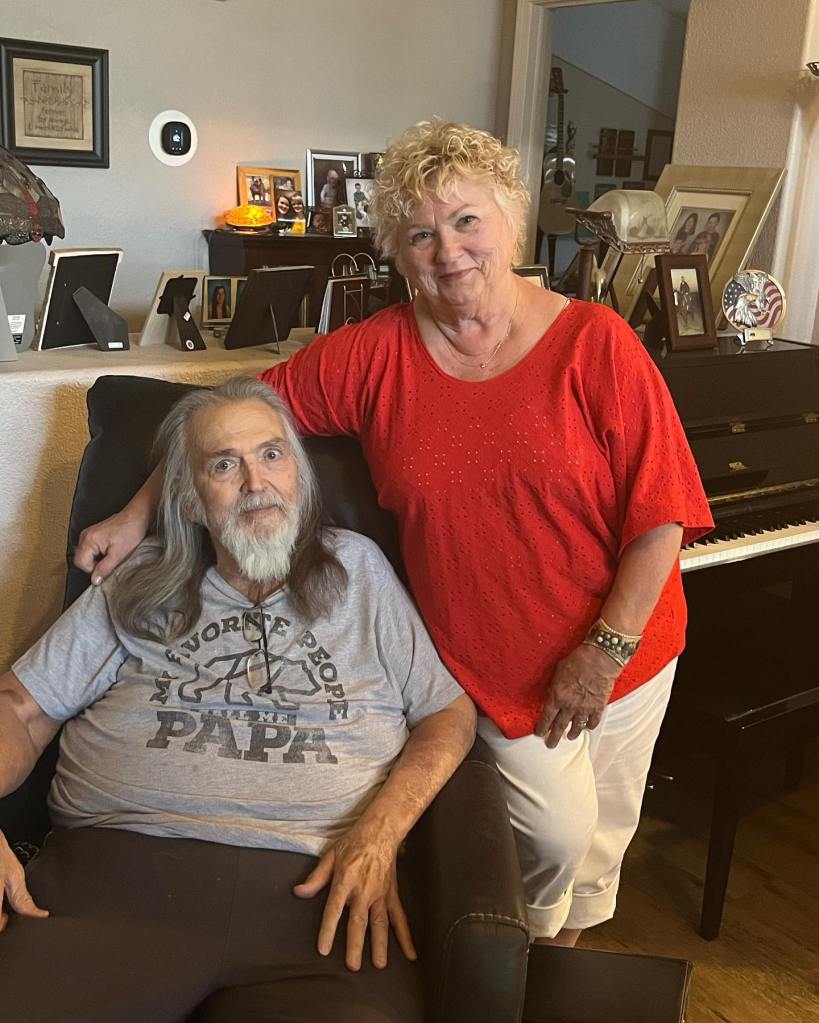
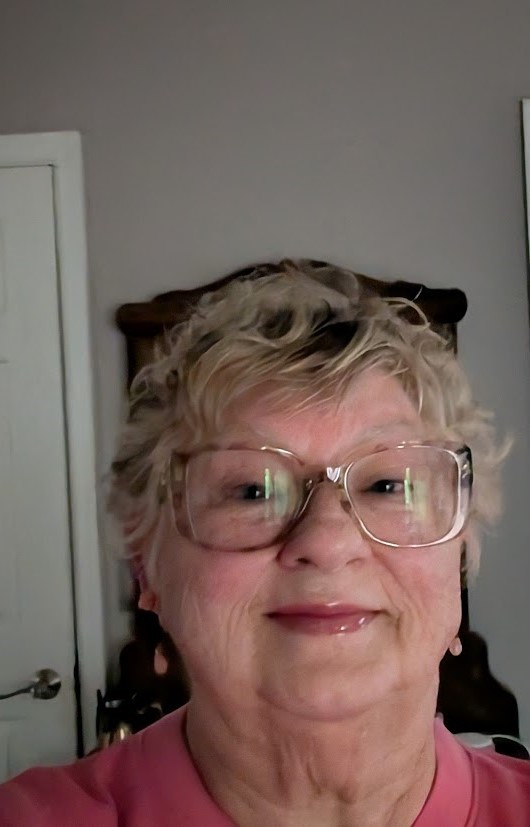
Some people say I look like Mom. Sometimes, when I’m dressing, I catch just a glimpse of that. In her later years, Mom got a perm every four months. Shortly before she died, my hair began to curl. At first, I blamed the anesthesia I got when I had my shoulder replaced in the spring of that year, but it kept getting curlier. Now, it seems to kink more by the day. It takes on a look that resembles my mom’s just after I’d arranged it before she began her day.
Without my ash-blonde highlights, my hair would look like Mom’s — almost white in the front, with a sprinkling of silver through the rest. I’m afraid to let it go because I’d scare myself every time I passed a mirror.
I’ve started blowing my hair straight.
I’ve gone to my jewelry armoire and taken out pieces that meant something to Mom. I have my great-great-grandmother’s wedding band, a tiny little yellow gold band with inset diamond chips, two of them missing, and Mom’s original engagement ring and band. My oldest great-niece wears her upgraded set from the 70’s. Mom’s eternity band fits my right hand. I wear it sometimes. I hold her gold bracelets in my hand to warm them. I can’t wear them until the clasps are repaired.
Most of Mom’s never-ending collection of costume jewelry was sold in the estate sale after I removed a few pieces and sets that I remembered from childhood, things that she continued to wear until her passing. A blue and light blue rhinestone brooch and earrings set, another with settings of various hues of gold, and her Christmas brooches are safely tucked away.
I have some of her dreamcatchers in the kitchen window, and I’m thinking about hanging the rest of them. She strung them in the apartment windows and on the arms of her Rollator, Dolly.
I often shower with Mom’s favorite fragrance, Pure Grace by Philosophy, which our dear friend Neil gave her for Christmas in 2019. Sometimes, I spritz with the half-bottle left of her Pure Grace body spray.
She dressed in coordinating pants and feminine tops, and when there was a special event, she made a spectacular new dress. She chose jewelry to match the outfit, whether she was dressed for a day at home or a special event. She looked terrific in royal blue. I’ve been wearing blue a lot lately.
I told my nail technician how Mom’s nails were so beautiful and that she even did them herself until her last year or so.
Then we discussed how the older ladies knew how to dress, apply makeup, and accessorize themselves with jewelry, even when they were only getting their toes done. I told her how Mom would get up every morning, do her hair and makeup, choosing which red lipstick to wear that day. She was never without red lipstick. Oh, she tried deep coral and fuschia and all shades in between, but Revlon Red was her standard.
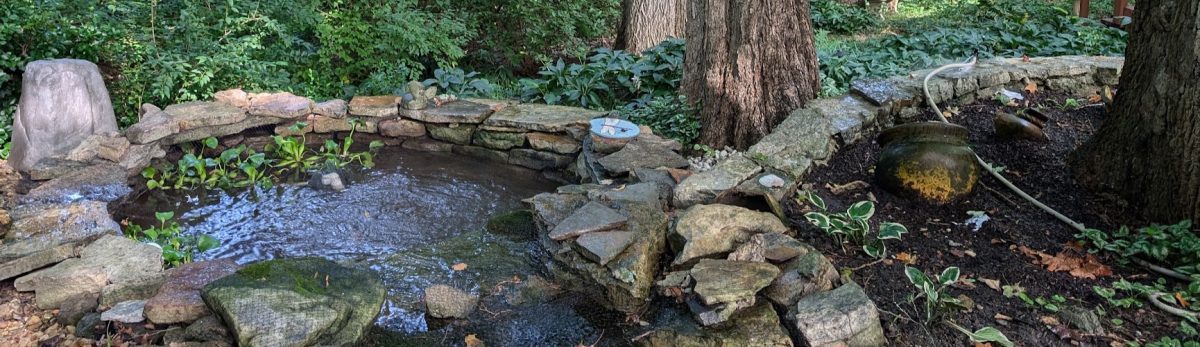
Mom had the most magnificent walking stick that she used before she had her knee surgery. I can’t remember where she got it, but I do remember that she told me. It was handmade by some man in Gainesville, I think, or maybe it was Cookeville. I don’t know where that treasure is, but I think of Mom every time I grab some sort of stick to walk the rock path downhill to my fish pond.
I think of Mom every time I see trout on a restaurant menu. She always ordered fish. I try to cook green beans like Mom’s, but they don’t taste the same. Mom made a banana cake every year for Christmas. She even baked one for my son Jade’s birthday. I’ve made banana cake, but not like Mom’s, using a recipe from my dad’s mother, Effie Blair. Mom’s actually tasted like Mammy Blair’s, and that was a hard thing to accomplish. I may try to bake one again.
Mama loved to sing and play the piano. She thought she and I sounded great together. I’d be the soprano, and she the alto. After years of asthma and inhalers, I am now the alto. I have never parted with a music box my mom bought for me, so I have an extensive collection. The one I wind most often is the one that plays Wind Beneath My Wings.
Mom was always so proud of me. If I sang at an event, she was there to quietly cheer me on. I played the lead, Sgt. Sarah Brown, in our high school’s production of Guys and Dolls. Mom and Dad had moved to Billings, Montana, to shepherd an old Baptist Church there. I tried to talk Mom and Dad into coming for the production, but they said they could only afford to go once and that they intended to be there for graduation. I wish I had insisted they come for Guys and Dolls.
I did so many things that Mom didn’t get a chance to do. She married at fourteen (almost fifteen) and gave birth to my brother Denny a year later at fifteen (nearly sixteen). She was eighteen when I was born. Her whole life was given freely to support Dad, facilitate his goals, and encourage him. She was somewhat militant in her role, especially as a pastor’s wife. She was never sorry for her early start, but she told me once she missed having girlfriends like I did.
Mom’s best girlfriend after she and Dad moved back to Tennessee was my Aunt Bessie, Dad’s youngest sister, nine years Mom’s junior. They talked every Saturday morning, sometimes for hours. My Aunt Bessie started to decline in the months after Mom was gone and died soon after. Things just weren’t the same.
We laughed a lot.Mom and Bessie
She did not neglect her education. She had graduated from 8th grade at thirteen, and when Mom and Dad married, she taught him to read. When he attended high school at Harrison-Chilhowee, she helped him with his homework. She studied and passed her GED exam. She studied alongside him at Tennessee Tech, Cumberland, and Belmont colleges. Meanwhile, she enrolled in night business classes, taking Denny or me with her, whichever one was available. Her first office job was at an insurance company in San Francisco. She commuted across the Golden Gate Bridge from Mill Valley, where we first lived, and later worked in several Sears locations in the West.
And when Denny and I were both out of the house, she owned her own business.
She was always an avid reader and kept up with news and current issues. I loaded up her Kindle with romances and literary novels. And God love her, she kept a diary.
I believe I was Mom’s best friend. I think she loved me more than she loved herself. But I never had a one-on-one relationship with her until my father died. She became my most vocal supporter, my most learned elder, and a girlfriend who loved to go on drives to pick up items I’d bought on Marketplace. Oh, the places we would go!
And the laughter. Every day, we found something to cause us to bend over, wipe joyful tears, or pee. Mom wore Depends, but there were times I didn’t make it to the bathroom.
I don’t wear red and don’t want to look like Mom. In personality, I have never been like Mom; I have always been much more like my daddy. Maybe it took us a while to bond one-on-one. And now I’m somehow empty without her next door.
Maybe you miss your mama, too.
***
Years ago, I was the assisting minister on Mother’s Day and wrote this prayer.
Father, we praise you on this special observance of Mother’s Day. We thank you for showing us your creative, nurturing, loving side, which we naturally associate with motherhood. We are reminded that while you do seem to bless our mothers abundantly with those special gifts, you offer those same gifts to all as we learn to live by your example.
We give you thanks for our mothers, and we know that the unconditional love they give us could only come from you. We ask your special watch over those soon-to-be mothers, and we beg your healing and comfort for those who struggle to conceive. We invite your wisdom and reconciliation for those who find themselves with children and aren’t truly ready to be mothers; in your wisdom, bring them to a true soul-blessing through whatever path you design. We are grateful for adopting mothers. We thank you for “stand-in” mothers, the ones who are just like mothers to us. We pray for your guidance for mothers in difficult situations, and we ask for consolation for those who have lost their mothers, whether through death or separation.
I am “the other” in the State of Tennessee. It hurts.
We were poor growing up. My mom always said we didn’t know we were inadequate and that we had fun anyway, and we did, but I felt it every time a school event required the purchase of equipment or special clothing.
In preparation for a school festival that involved every sixth grader rounding the auditorium in couples to dance to folk music, the girls were all told to wear a gathered (dirndl) skirt and white tennis shoes. I had it made for the gathered skirt. I had a closetful. But I didn’t have white tennis shoes, and I knew my mother would not go out of her way to get some for me. We just couldn’t afford them.
On a Saturday, when I walked downtown, I saw a big bin of white tennis shoes at Kuhn’s Dime Store. I knew they were women’s sizes, but I was sure I could dig through them enough to find a pair that almost fit. The shoes cost $1.00. When I got home, I asked Mom for a dollar. I told her I needed it for school. She didn’t say much; she just took a dollar from her beige clutch purse and handed it to me. I would take that dollar to Kuhn’s the following Saturday and get my shoes.
When I got to the square and hurried into the store, I noticed the bin was almost empty. There were no size fives or sixes. I found a size seven, and fortunately, the sales lady told me she would pay the tax from her pocket.
My outfit was complete, but Donna’s was not. Donna was a mousy little girl with glasses who never said two words aloud. When the teacher asked the girls to raise their hands if they didn’t have a dirndl skirt, Donna raised her hand halfway. Mrs. Robinson then wondered if someone could loan Donna a skirt for the show. No one volunteered, so I raised my hand and said I would bring it the next day.
I have never comprehended why Mom would have made me a solid brown cotton skirt, and I hated it. I asked Mom if it was okay if Donna kept it. I laid it out on my bed to remember to put it in a grocery sack to take the next day.
Dad glanced into the bedroom I shared with my brother and said, “Is that the skirt you’re taking to the girl at school?”
“Yes,” I said, “And I’m letting her keep it.”
“Isn’t that the skirt you’ve always disliked?” he asked.
“Yes. I’m glad to get rid of it.”
“Didn’t your teacher say you all should wear colorful skirts? Maybe you should consider giving Donna a prettier skirt she would love wearing after the show.”
I was ashamed. I knew what Dad was saying. When he left the room, I folded the brown skirt and put it in a drawer. My gathered skirts were in the small closet, hung by wooden clothespins and wire hangers wired together to hold more than one skirt.
I took down a red floral, folded it, and put it in a brown grocery bag. When I gave it to Donna the next day, I told her she could keep the skirt. All she whispered was, “Really?”
“Yes,” I answered. “I have plenty.”
My teacher had paired me with Steven Cantrell, a slight boy who seemed to weave when he walked and had a bit of trouble speaking. At times, his hands flopped around. Needless to say, he was not the most popular kid in the class. We didn’t talk much when practicing, but I was not shy about pulling his right hand over my right shoulder, grabbing his left hand, waving around in the air, and clasping it to meet the dance form. I could still feel the motion of his left hand, even when I held it tighter.
On the morning of the festival, I chose a blue flowered skirt and a white blouse with puffed sleeves and pearl buttons, both homemade by my mother. I pulled on two pairs of bobby socks and tied the three-sizes-too-large tennies as tightly as possible. The toes still had plenty of room, so my feet slid around a bit. I took my new shoes off and stuffed the toes with newspaper. Maybe this will do it, I thought.
My teacher told us how proud she was of our class in our colorful skirts and shirts. She said we had practiced the dance, so we knew it well, and our program would be great. We lined up for the auditorium, girl-boy, girl-boy.
I loved singing all the songs the music teacher chose for that particular day, but I couldn’t tell you now what we sang. But I could do that dance by heart today. “Put your little foot, put your little foot, put your little foot right down. To the left, step and turn. To the right, step and turn. To the front, step and turn. See how quickly we learn.”
Stephen caught up with me after the festival, and we walked back to the classroom for celebratory cookies and punch. He pointed his left hand to my feet and said, “Your feet aren’t really that big, are they?”
*
It hurt when my piano teacher, Mrs. Gwendolyn Gwaltney, kicked me out of her studio for telling her that John F. Kennedy was just as good as she was. I had to. She had just said that nobody in their right mind would vote for a Catholic for president. Indeed, my family was different in our corner of Lebanon, Tennessee, but we were not crazy. We supported JFK. I had to represent!
My dad got in trouble at Belmont College the week after the piano incident. He was in a music appreciation class taught by Dr. Helen Midkiff, a professional and well-recognized organist. She started the class by saying she did not think JFK had enough grey matter to be president. Dad’s friends and colleagues on both sides of him knew what was about to happen. They both pulled on Dad’s jacket and coat sleeves and shook heads. He stood up, lifted his briefcase from the floor, and said, “Dr. Midkiff, when you are ready to teach music, I’ll be back.”
Dad was called to the President’s office (the President of Belmont), where Dr. Gabhart told him his lack of respect might cause his expulsion. Dad acknowledged Dr. Gabhart’s statement, saying, “If I have to go, I’ll go.”
I’m unsure of the rest of the conversation, but Dad did not get expelled. He told me he visited Dr. Midkiff and apologized if she felt disrespected. It was one of those times he didn’t admit he was wrong. He suggested I call Mrs. Gwaltney and do the same. I went back to piano lessons that week.
*
After Dad graduated from Belmont College in June 1960, we would move across the country so that Dad could attend Golden Gate Baptist Theological Seminary. We made a four-day cross-country trip in our ’57 white Plymouth Belvedere to Mill Valley, California, pulling a small U-haul. Our Route 66 journey was educational and fun. We had no air conditioning, just this funny fan that fit in a window and blew air over a pan of water. Every time we stopped for gasoline, we refilled the water container. Wisely, we crossed the desert at night. It was the Summer of 1960.
We unloaded the few pieces of furniture and clothes we brought to the seminary’s married student housing. My brother Denny enrolled at Tamalpais High School, and I registered at Mill Valley Junior High.
I didn’t know what to think of teachers and students. I was an alien on an alternate planet. The school was new, but it had no cafeteria and no auditorium. We ate lunch that we brought from home in a courtyard on picnic tables or, if it rained, on our desks in our homeroom classroom. Every group activity took place in the courtyard. It appeared to me that all the students were white. There were few chances to really make friends.
One girl was kind to me. I don’t remember her name, but I remember she was in love with Cherry Vanilla lipstick. It was a Revlon shade discontinued decades ago. Today, I see a Cherry Vanilla from Lawless on the internet. There are even photos of Taylor-approved reds; one is Revlon’s Cherries in the Snow.
I’ll call her Cherry since I can’t remember her name. Cherry gave me a taste of her orange creamsicle that she bought from a small trailer in the courtyard. (Now we call those little stands kiosks.) My accent did not put her off. I’d never known anyone to talk about an accent until we moved to California. If you had a Southern accent, you were an Okie, a slur to name those who migrated to California during the Dust Bowl.
The music teacher chose me to sing a high soprano solo at the Christmas Choral Presentation, so named because we didn’t have an auditorium. The janitors helped the choir director roll a piano to each hall for our Christmas concert, and we sang our program while the other students listened from their classrooms.
I remember a section of that song I sang. No Candle Is There and No Fire.
…But the moon gave a radiance divine, and the stars an effulgence bright. And the only sound to be heard was the lowing of kine in the night. Then, the blowing of wind through the trees and the flapping of angels’ wings.
After the first two hall concerts, a girl several rows over in my homeroom stood and announced to the whole room, “Your accent really showed.”
A boy in front of me turned around in his seat and said, “I thought it was beautiful.” He had black curly hair and wore a red and black striped shirt.
The girl who shamed me continued to be a problem. She said, “That white stuff on your crackers is slimy. Is that what Okies eat all the time?” She referred to my cherished saltines, peanut butter, and marshmallow fluff sandwiches.
And later, “All your clothes look alike. I guess your mother makes them all from one pattern, huh?” Californians ended a lot of sentences with huh, but it didn’t turn the sentence into a question. It was more of a statement.
Most of the time, I just ignored her. But one time, she went too far. While we were waiting for the bus, I realized my sanitary pad might not make it all the way home. I told a bus rider, “Don’t let it leave without me. I’m going to the restroom.”
Bully Girl asked from two tables away, “Are you on your period or something?”
I told her no and hurried into the restroom stall. I quickly exchanged the pad with one in my book bag. I heard a noise and looked up. I saw the girl’s face as she was jumping down from the toilet in the next compartment.
When I finished and ran to the courtyard to my assigned bus table, she stood on one of the benches and said, “Yeah, she is.” Then she skipped across the courtyard and propped herself on her elbows in front of my face.
“You’re not feeling so perky, are you?” she asked. “Something is slowing you down, right? It’s that time of month, huh?”
I looked her in the eyes and said, loud enough for all to hear, “There is something seriously wrong with you. You need a psychiatrist.”
And that was the end of our relationship. It occurred to me that she was already getting help for some mental condition. I did not feel bad for her, but I didn’t feel exactly right.
I was lonely in Mill Valley. Every night, I listened to the fog horns in the Bay and felt lonelier. Sometimes, I sang Stranger On the Shore to myself.
Here I stand, watching the tides go out. So all alone and blue, just dreaming dreams of you...Why, oh, why, must I go on like this? Shall I just be a lonely Stranger On the Shore?
In November, my dad got a call from Temple Baptist Church in Pittsburg, California. We would move there during Christmas break, and I would attend Hillview Junior High starting the first day after break. At the time, Pittsburg was an industrial place named for Pittsburgh, PA, because the two cities shared steel and mining industries. The population at the time was about 20,000. Dad said he thought I would like Pittsburg. He said there were people of all colors in Pittsburg, a true melting pot, he called it.
In early December, I asked my Mill Valley math teacher to give me any quizzes or homework she had graded so I could take them to a new school. The first words out of her mouth were, “Oh, yeah, you’re the seminary kid. You know, we don’t like the seminary kids. They’re always leaving for points unknown.”
She handed me a folder of my work, and I said, “Thank you, Mrs. (Whoever),” and left.
My first class at Hillview was physical education, or “gym,” as most students said. We lined up in alphabetical order, sitting on the floor. The teacher passed out locker assignments on small pieces of paper. We were to find them, put our street clothes in them, and return to the lineup in our required gym suits.
When I opened my locker, I found someone else’s (from another class) clothes carefully folded inside. I went to the restroom, changed into my gym clothes, and returned to the lineup, leaving my first-day school outfit on a bench in the locker room.
When the teacher called our names, we were to give our locker numbers so she could put them in a chart in her roll call book.
“Well,” I answered when she called Diana Blair, “it’s 36, but my locker has done been possessed.”
I don’t know why I answered that, but the teacher and the whole class laughed.
“Diana, you’ve hit on something I’ve never heard,” she said, laughing some more. “We’ll get you another locker.”
From all the laughter, including the teacher’s, I knew I’d be okay in this new environment. These people were not put off. They were entertained. I laughed with them, feeling joy in the seventh grade for the first time.
I noticed there were few African Americans at Hillview. There were Asians, Filipinos, Hispanics who identified as Mexican, and many Italians. Someone told me the black students were at Central Junior High. Still segregated.
During roll call every day in gym, we answered “X” if we were menstruating so that no shower was required. No one cared. It was nothing to be ashamed of.
I met Dorothy Valenzuela, and we became fast friends. Dorothy taught me Filipino cooking. On my first day in gym class, I met Jean Snyder, my lifelong friend. I call her Ja, pronounced like Jay. We were Ja and Dee, or Dee and Ja. Sometime during the sixty-two years since, she became my sister, not just a friend. She still is.
I joined the choir, played with the jazz band, and sang with Jeannette Bartimioli in the talent show.
Don’t they know It’s the end of the world? It ended when I lost your love.
*
Hillview offered a summer school session during which we could take elective classes or make up for class failures. I learned to type and studied art. A ninth grader in art class called me an Okie. He taunted me, “What’s your favorite song, Wolverton Mountain?”
I said, “No,” feeling no great need to tell him my choice. I knew he was making fun of me, but I didn’t see why Wolverton Mountain should be such a bad thing.
When I arrived home, my dad was there. He stirred his instant coffee while I sipped red Kool-aid. I didn’t even bother to tell him about that Italian guy calling me an Okie. I just asked Dad to sing the song to me.
He picked up his guitar from the couch and said, “Okay, now, harmonize with me, Sis, on the chorus.”
They say don’t go on Wolverton Mountain If you’re looking for a wife ‘Cause Clifton Clowers has a pretty young daughter. He’s mighty handy with a gun and a knife.
Her tender lips are sweeter than honey And Wolverton Mountain protects her there. The bears and the birds tell Clifton Clowers If a stranger should enter there.
All of my dreams are on Wolverton Mountain. I want his daughter for my wife. I’ll take my chances and climb that mountain Though Clifton Clowers, he might take my life.
Her tender lips are sweeter than honey And Wolverton Mountain protects her there. The bears and the birds tell Clifton Clowers If a stranger should wander there.
I’m going up on Wolverton Mountain. It’s too lonesome down here below. It’s just not right to hide his daughter From the one who loves her so.
Her tender lips are sweeter than honey, And Wolverton Mountain protects her there. The bears and the birds tell Clifton Clowers If a stranger should wander there.
But I don’t care about Clifton Clowers. I’m gonna climb up on his mountain. I’m gonna take the girl I love. I don’t care about Clifton Clowers. I’m gonna climb up on his mountain. And I’ll get the one I love.
I still didn’t see anything off about Wolverton Mountain. It was a good story in a song. But I suspected the bully guy might not be a country music fan. At the least, he was ignorant about the South—and me. I wondered how he even knew about Wolverton Mountain.
*
Pittsburg High School was the genuine Melting Pot. The multitude of tones enthralled me, and I couldn’t help but stare. I also noticed that race, ethnicity, and color mattered.
Students from three schools fed PHS: St. Peter Martyr (almost exclusively Italians and Mexicans), Central Jr. High (where most Black kids attended), and Hillview (primarily white, some Filipinos and Mexicans, few Blacks).
I had all these different classmates, but kids of differing ethnicities usually found others of the same to hang with. My coloring was a bit rare: very white, blonde (helped along by Nice’N’Easy), and blue eyes. More than once, a classmate would stop me in the hall and ask if they could look at my eyes, even more so when I got blue contact lenses. My main categorization, though, was one of the Smart Kids.
I felt like the other, being so white and Smart, but I saw clearly that others were more other than me. For all of the Civil Rights Movement and living in the progressive State of California, we were still divided by race and origin.
My few Filipino and African American friendships were formative; we are still in touch. They probably don’t know how much they taught me then and how much they teach me now.
Race and origin never seemed more important to me than the race for Miss Pirateer, PHS’s version of Homecoming Queen. Clubs nominated girls, and the student body voted for several on one ticket. I’ll never forget my friend Ernie, who told me why I would not get a spot on the Miss Pirateer Court. He said, “Diana, you don’t have a big group behind you. You’re popular, but not real popular. You’re one of the smart ones, and they don’t have that many people in their group.”
Many years later, my choir teacher, Jack French, asked me to accompany him to a class reunion. I graduated in ’67 and was in town for our reunion, but he had been invited to the Class of 65’s event. We had a splendid time. He was eighty years old and enjoyed telling our tablemates and anyone who would listen that I was his all-time favorite student.
I told him about my favorite student in our choir. Her name was Jacqueline Griffin. She was gorgeous, black as the night, with a huge bosom that produced a low alto voice like I’d never encountered—and I still haven’t. She would open her mouth, and her message shook that choir room and boomed in the multi-purpose room. Sometimes, I wanted to stop singing to listen to Jackie. I asked him if he remembered Jackie. He did. We wondered together where she was and what she was doing.
We danced a little and reminisced about all the good singers at Pittsburg High School and the spectacular performance of the musical Guys and Dolls.
I asked him if Jackie had a part in Guys and Dolls. Neither of us could remember. It was a massive production with two sets of dancers, one dancing in NYC and the other in Havana. It seemed to me at the time that everybody at PHS was in Guys and Dolls. Thinking back, there were no Black speaking parts, but all the Havana dancers were people of color. All of the Hotbox Dolls in NYC were white. The yearbook supplement only gave two scant pages to the musical, and the participants are not listed, so it’s almost impossible to reassemble a cast.
My mind drifted back to our first musical in my junior year. The show’s name, which was written for youth, was Through the Hedge. It was about a boys’ school separated from a girls’ school by a hedge. The lead girl part was a student who sang, “Everybody goes through the hedge but me, and I know what they’re going through the hedge to see. Someday I’m gonna (do something or the other) and go through, too, And then I’ll have some fun just like the others do.”
I knew I’d get the lead of the girl student because no one else wanted it! However, there was an African American girl whose name I can’t remember who auditioned for the part of a teacher in love with another teacher at the boys’ school. Her name might have been Mary. I remember she was timid and had dark red hair. The song she had to sing was the teacher’s solo in the play. I don’t know why we had to sit to audition, but she took her wooden seat, held the sheet music in her hands, and began a slow, rich, soulful rendition, similar to Etta James. Her voice smacked me almost as much as Jackie’s.
“Now we’re together, together at last. Let’s live for each moment, forgetting the past.”
Mr. French stopped her and asked, with something of a smirk, “Now, do you really think she would sing this song that way?”
Mary nodded quietly and smoothed her skirt.
Mr. French said, “Thank you for auditioning.”
She walked into the wings of the stage.
I still see her face and feel the pit in my stomach that I felt then. I thought, “If she got the part, that teacher would sing that song that way.” I didn’t share my feelings. What a choice that would have been in 1966. I wish I could find her in the yearbook.
A regional newspaper posted a favorable review after the 1967 Guys and Dolls show. Whoever wrote that piece was astonished that a high school could turn out such an excellent production. I have a copy somewhere. It’s a shame we don’t have a better history of our showing of Guys and Dolls.
That night at the reunion, between dances and strolling around the room, Jack French told me he had demanded a recount for the 1967 Miss Pirateer Court. I had been sixth in the voting, and there were five on the Court. I told him my Ernie story. We laughed until we cried, but no one else at the table understood it. The Miss Pirateer in 1967 was a beautiful girl named Beryl Holmes, one of two African Americans on the court. The remaining three were Italian.
*
I am among the others today, especially in the South, but my minority brothers and sisters keep me going. We won’t be silent. We will continue to support each other and the many leaders who speak out. We find ourselves in good, solid company. We’re with Bishop Mariann Edgar Budde, who bravely spoke truth to power.
In the name of our God, I ask you to have mercy upon the people in our country. We’re scared now. The people who pick our crops and clean our office buildings, who labor in poultry farms and meatpacking plants, who wash the dishes after we eat in restaurants and work the night shifts in hospitals. They may not be citizens or have the proper documentation, but the vast majority of immigrants are not criminals. They pay taxes and are good neighbors. They are faithful members of our churches and mosques, synagogues, gurdwara, and temples. I ask you to have mercy, Mr. President, on those in our communities whose children fear that their parents will be taken away and that you help those who are fleeing war zones and persecution in their own lands to find compassion and welcome here.
Today, in 2025, I’m still among the others, but I see that all the different others are so much more other than I am. I pray, in my own way, for every person named in this Inaugural sermon.
I pray for all immigrants and their families who fear deportation and disruption to their lives.
I pray for my darker-skinned friends, colleagues, and neighbors. Their battle is far from over, and their struggle is mine. I’m still learning the history of Black Americans, things we did not learn in school. Black history is American history.
I’m praying for all those who lose jobs in the current administration’s purge of Federal agencies.
I didn’t watch the inauguration; I couldn’t watch the news at first, but I’m working on it. We need to be informed so that we can use our voices. We elders must support young people in their work for change.
I have decided to pray for President Trump daily. I’m going to call his name. I’ll pray for the administration and that its collective intentions and actions will serve mercy and justice. I know that such a change will require a conversion.
I’ll pray for courage for those who let their voices be heard in opposition to oppression and greed. I’ll pray for intelligent and peaceful protests.
I’ll ask my soul for enough love to go around, especially to my unlovable. We can’t hold on to hate; it’s too damaging, reckless, and unproductive. I’m going to meditate on lovingkindness.
Here’s Martin Luther King on hate:
Darkness cannot drive out darkness; only light can do that. Hate cannot drive out hate; only love can do that.
Hatred paralyzes life; love releases it. Hatred confuses life; love harmonizes it. Hatred darkens life; love illuminates it.
I have decided to stick to love…Hate is too great a burden to bear.
I’m a procrastinator. If I took one of those quizzes on Facebook, I’d register as ADHD. I registered as ADHD with a psychologist several years ago–as an adult! I’m great in the immediate. Just give me a human, friend, or animal problem, and I’ll get right to work on it immediately and see it through.
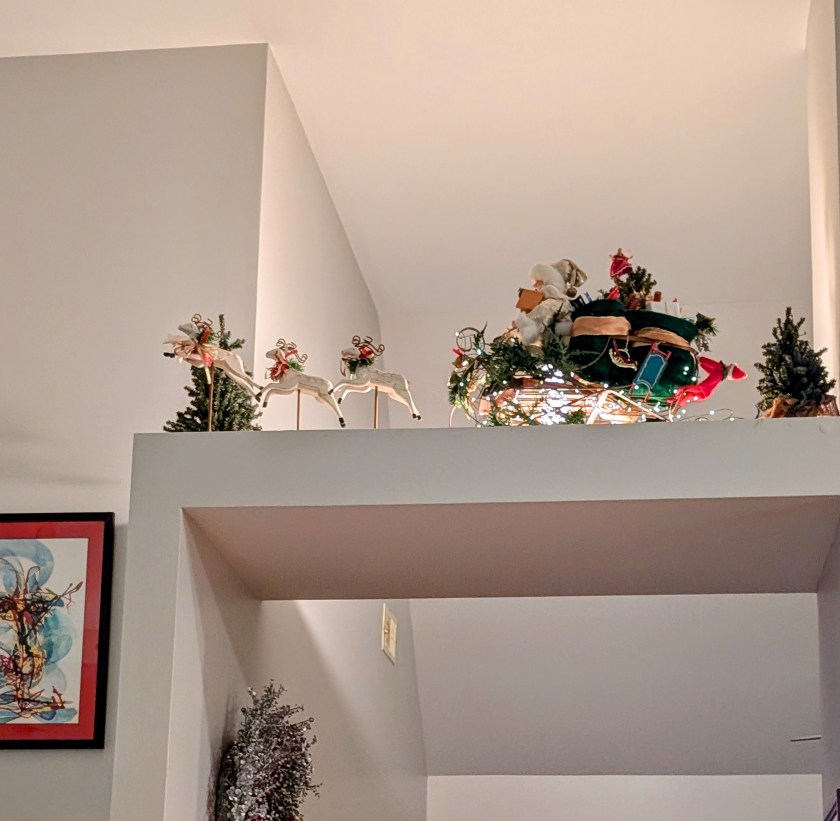
But–I couldn’t start decorating for Christmas because I had to get the boxes down from the attic. My fairy Fixer (let’s call her Brenna) got the boxes down a few days after Thanksgiving, which came late this year. She put up the trees, two of them, and helped me get started. I did most, but she, being over six feet tall, got a ladder from our storage and placed two beloved arrangements on our very high ledges.
One is a Santa with a sleigh, toys, and reindeer I put together twenty-six years ago. Every year, I update him a little. But she lit his sleigh, and it glowed every day for six hours until Christmas Eve. That evening, when I had company, it did not light.
Santa flying high!
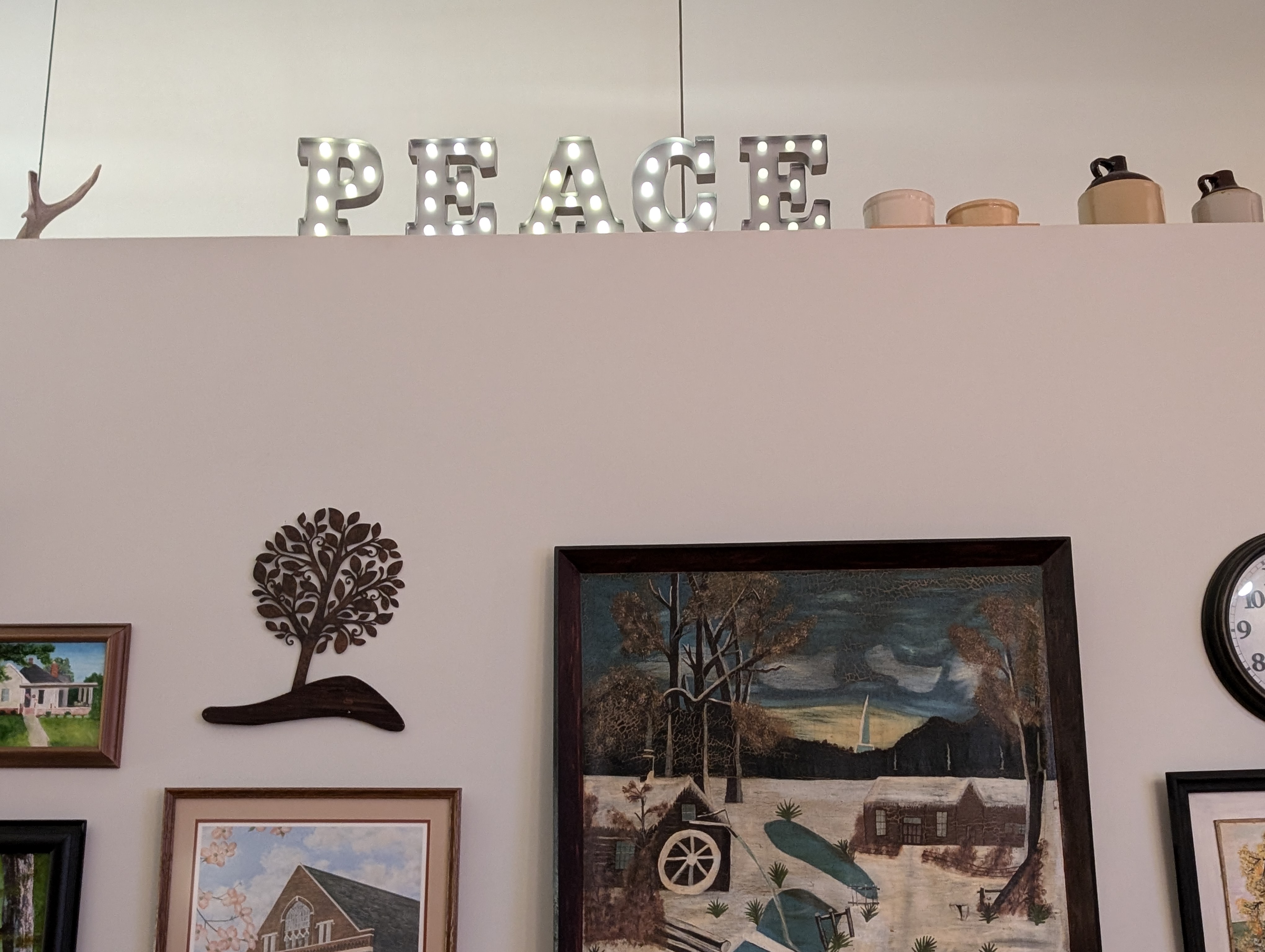
However, the lighted PEACE letters on the longest ledge held their prominent position well.
The rest of the decorations took a few days after Brenna’s help that first day. I found other things to do.
The outside decor was not outstanding, but it was there. And I still had the Christmas pumpkins in front of the mailbox. Someone on the NextDoor app just told me that deer love pumpkins, so yesterday, I smashed them in our backyard’s wildlife preserve. I hope I can watch them eat. How do you call a deer?
The Christmas Pumpkins
I wish someone could have been here to help me smash them!
Mama’s Silver Tree
No one even tried to make The Grinch sing and dance.
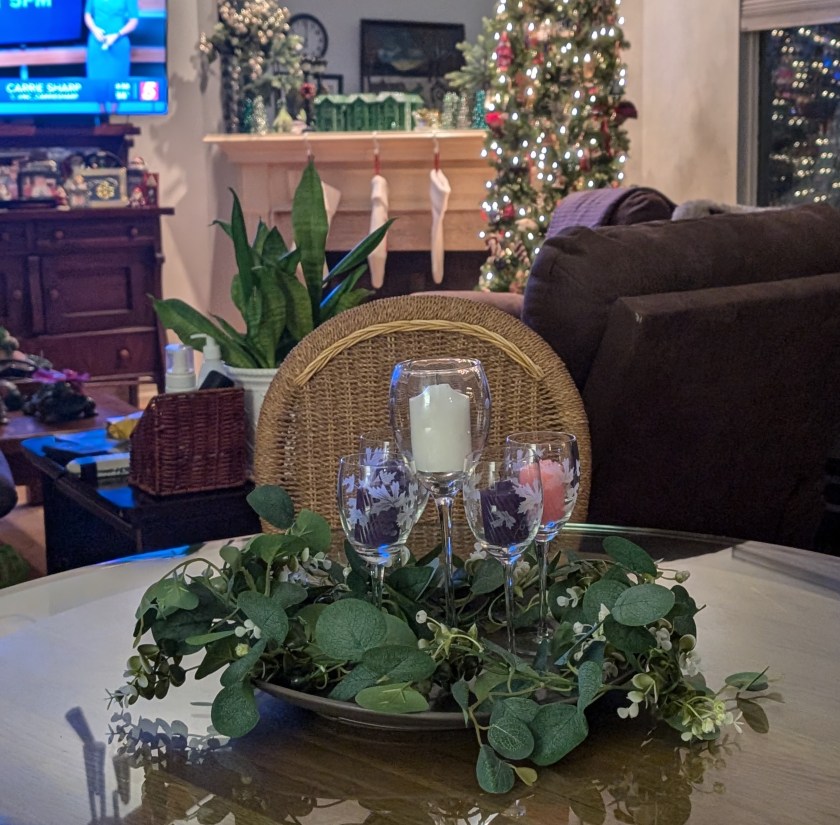
The Wineglass Advent Wreath still shines today. Some of us say Christmas isn’t over until The Epiphany arrives on January 6th.
The Wineglass Advent Wreath still shines today.
Our family Christmas was on Saturday, December 21. We took presents for the grands and enjoyed each other’s company. We missed the kids and grands in Montana and hope to all be together one Christmas.
The Eve was a highlight. Our guests included our next-door neighbor, V.B. and her son Jacob, three of the John Grahams, and brother Jerry Wong. Christmas Eve is a time for having people in who aren’t celebrating somewhere else. We had a scrumptious dinner (if I do say so myself), told tales, and laughed!
Christmas Day was laid back with Jerry. He and I took some of last night’s dinner to two special temporarily laid-up friends and packed up what I call his food bag for his trip home on Thursday. When we got home, he serenaded me on his portable keyboard.
All of the above is boring. I know that. I’ve been absent from the blog for several months, but I’m making my readers a New Year’s promise to write more often. Actually, I’ve been writing–but I’ve been unable to finish a piece for this place. I have drafts, so stay tuned for My American Native Heritage Month or Of Okies and Hillbillies. But first, you’ll have to get through AFTER CHRISTMAS.
Can you read the sign on the fence? It appears to be quite weathered and faded, but with a closer look, you might be able to decipher the important information it holds. Perhaps it offers some safety guidelines, warnings to keep out, or even instructions relevant to the area beyond the fence. Pay attention to any symbols or markings that could provide additional context, as they might reveal a story or message that is not immediately obvious.
The above paragraph provided by AI. The sign says:
It hasn’t been too long since sales clerks, pharmacists, and service people began explaining things to me that need no explanation. When I checked out at my favorite thrift store on Tuesday, I forgot to ask for my Seniors’ Day discount. When I turned around on my way out and said, “Oh, wait, I’m a Senior,” the young woman said, “Oh, I already gave you the discount!” When I glanced at my receipt, there it was, the 30% discount.”
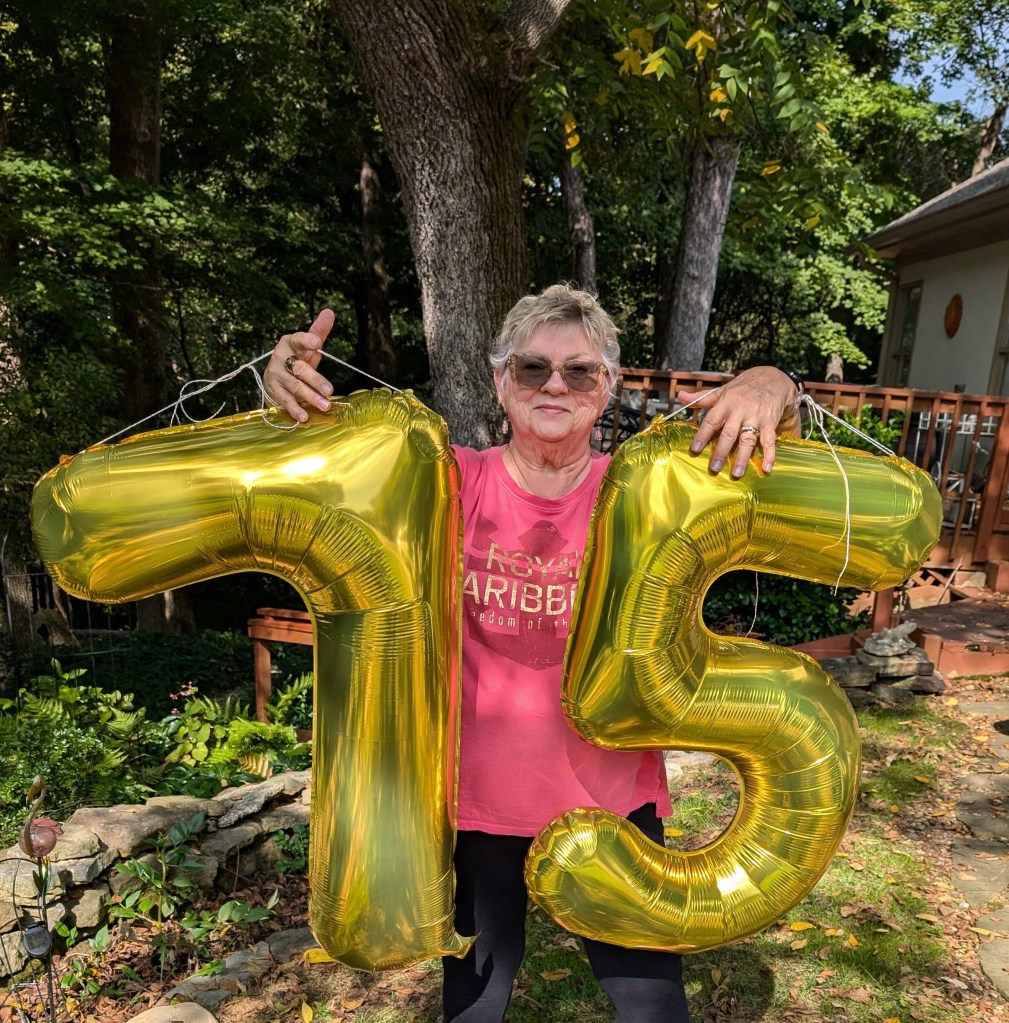
I am seventy-five years old. I’m not in love with it. I just don’t know what to do with it.
Oh, people still tell me I look younger than seventy-five, but the guy at the nail salon said he thought I looked more like sixty-five. He thinks that’s a whole lot better?
Now seventy-five, I estimate that at least three-quarters of my life is gone. If I lived to be my father’s age when he passed, I would only have fourteen years, or if I lived as long as my mother, eighteen years.
I can’t seem to get to the question I need to ask myself, “What will you do with these, [gulp], remaining years?” I get stuck on what if I only live to be 80. Then I am so sad, I cannot find any other questions.
I don’t want to leave this precious, troubled, wonderful, chaotic, green, climate-threatened, beautiful, war-torn world. I want to see change in my well-loved country: less hate, less hunger, less killing. My children and grandchildren would be fine without me, but I’m not finished looking at them, cheering them on, and loving them with this unequaled passion that began when the first infant sounds pushed from my body.
Most of the time, the questions arise when I feed my fish in the early mornings. I sit on the rock wall of the pond and gaze through a dense thicket separating our house from a busy thoroughfare. I note the birdsongs; I hear Cardinals order “Beer, beer, beer” and “Chip, chip, chip!” House finches cheep and warble a trill. Robins peek and tut before announcing, “Pretty, pretty, pretty.” Crows caw and caw louder to warn of a present hawk. Sometimes owls call to each other across the trees.
I am scared, weak, and afraid of the quick passing of time—something most people would never see in me.
I never imagined seventy-five, but the digits are mine. I don’t want to return to my twenties, or anything like that. I just want to be…for longer.
Okay, I’m ready for the question. What will I do to max out my days, months, and years? Or as Mary Oliver says, “What will [I] do with [the rest of] this wild and precious life?”
I’m working on my answers. They’re endless, so I know I must begin the tasks before I finish the list.
I plan to exhaust this endless love inside me, even though I know Love always creates more love. I’ll watch and listen until I need to sleep. Lookout, Beauty, I’m going to catch you and hold you in the Light. And Joy? I’ll choose you every day, even those when you seem far away. If I can’t reach you, I’ll make you.
Watch me, World. Slow down, and let me hug you every day.
Maybe forgetfulness is part of healing. I know it’s related to grief.
I didn’t remember Mom on June 24, the day she died two years ago, but I had a restless, sad week. I thought I was anxious about the debate between, you know, Him and Him.
The debate passed, and I was a bit nonplussed by the performance of both Hims. Good Lord. However, after that day, I was still uneasy and lethargic.
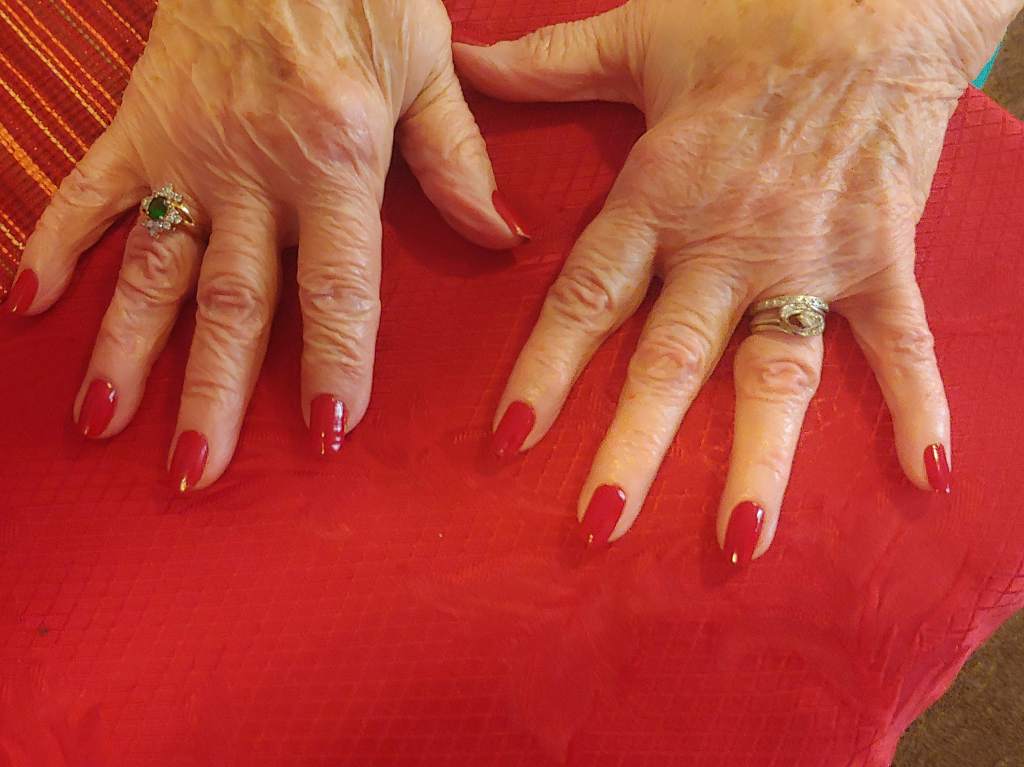
Friday, I went to the nail salon so Wii could put that powder stuff on my nails. I’m growing nails out under those shells, and I think this week will be my chance to go au naturale. I’m going to the salon where I took Dad three weeks before he died and Mom three weeks before she passed. It took me almost two years to get back there. I just went anywhere I hadn’t been with Mom or Dad.
When Wii began to speak, it came to me. June 24 had come and gone, and I hadn’t remembered that Mom died on that day two years ago. I grieved for a few minutes. I was surprised that the date hadn’t come to me. I think about her almost daily. But it had arrived in the form of almost a week of depression. My condition is better named Sorrow.
The body and the mind managed the grief. After the week had passed, I felt a small healing, and now I can laugh at some of the predicaments Mom and I got into. There were so many.
I’d started this blog piece three weeks ago, and now I felt I could write.
***
In April, my dentist and I decided I might need a gum graft. This is where the surgeon excises live gum tissue from somewhere in somebody’s mouth and then “plants” it in receding gums. It’s not a delightful procedure, but I endured it well with the help of whatever stuff they used to sedate me.
After the first look at my lower front teeth post-surgery, the doctor told me that after the new gum tissue had settled in, I might also need a frenectomy. Another dental surgery, whereby the little thing that holds the bottom lip to the gums is clipped. Yay for me.
I said, “Goody.” This procedure is scheduled for July 24.
I had a frenectomy when I was nineteen years old, living in Lewistown, Montana, with my folks, working for radio station KXLO. My dentist was Dr. Harry Ziolowski, known to most of us as Dr. Z, a man who weighed at least 400 pounds. I liked him but wondered how he could get close enough to work on my teeth. He always attended to my mouth with gentleness and efficiency. And he was funny.
The day Dr. Ziolowski clipped the frenum, I drove myself to the office. He numbed me up, and it didn’t take long. Dr. Z had just received a new kind of bandage for such a task. He explained that this material would feel like three big pieces of bubblegum inside my lower lip. He pressed it to the double incision and told me to pretend I had a wad of chew in there.
I tried to laugh, but he stopped me.
“No, don’t laugh. You can’t pull on that bandage. It’s supposed to settle in against where I did the work.”
Dr. Z had already prescribed some painkillers, and I had picked them up before the appointment. I headed to the restroom to clean up my bloody face and popped two of them before I drove home.
I was drowsy, but I knew Mom had not been feeling well when she went to work, so I fixed the Littles hot dogs, canned chili, and potatoes. Our Littles were the three Wong boys that we were fostering. They were happy to eat as soon as they came in from school.
“What in the world is wrong with your mouth?” Johnny Wong, the youngest at age nine, asked.
“Had surrrrzhy,” I said.
“What’s surrrzhy?” Jerry asked.
Johnny answered in a low tone, “They cut something out.”
“Her tongue?” Jerry asked.
Johnny huffed. “No, probably a tooth.”
I didn’t bother to correct him. I just wanted to get that bottle of ketchup on the table and make it to my bed. The numbing was wearing off.
Jimmy didn’t acknowledge his brothers’ conversation. He just said, “Good, Dinah,” as he pushed a large piece of chili-laced hot dog into his mouth.
“Oo eyes puh disses in dihwahher,” I said, turning toward the hall to my room.
I didn’t hear Mom come in. My mother was plagued with migraines, and I knew the worst of this one was on its way when she left for the bank. She was seeing an aura. I assumed she would go to bed early after talking to the boys and saying goodnight. She always read to them, but maybe not that evening, and Dad was away from home for some educational reason. She did go to bed, I found out.
At about midnight, I woke in terror with a giant bubble still attached to my mouth but lying on my pillow. I screamed and jumped away from the bed. Blood from this melon-sized balloon spattered over the whole room, pink bedspread, white ruffled pillows, and the walls. I grabbed a pillow and held it against my face. Mom was in front of the bathroom by the time I got there.
“What’s wrong? What’s happened?” she asked.
“I tink my buhbuhguh boke,” I answered, muffled by the pillow.
“Good grief. I don’t know what you’re saying, but we better call Dr. Z. And go get a towel.”
I grabbed a green hand towel from the bathroom and left the pillow in the tub, then weaved and wobbled back to Mom’s bedroom, helped her lie down with the princess phone, and propped two pillows behind her back. I was right. She was in the middle of a migraine.
I could hear the phone ringing.
“No answer,” she said. She hung up. She dialed again. It rang and rang, and finally, Dr. Z answered.
“This is Ethel Blair,” she told him. “Something’s wrong with Diana’s mouth. There’s blood everywhere.”
“Okay. Okay,” he said, half asleep. “Meet me at the office.”
“Alright,” she said to him and to me, “Honey, put some clothes on.”
I grabbed a yellow sweatshirt and a pair of wheat-colored jeans from the chair where I’d left them and staggered down the hall and through the kitchen to the garage. I jumped when I realized Mom was behind me. She was wearing her bank uniform skirt, a blue chenille cotton robe tied around her waist over her pajama top, and red fuzzy house slippers.
“I’m in better shape than you are. Get in the car.”
I was in my seat by the time she made it to the driver’s side, holding onto our co-owned sixty-six Mustang. She backed out of the garage and handed me a brown grocery bag.
“Here, hold that in case I vomit,” she said.
We knew we’d probably make it to the doctor’s office before he did, as he and his family lived farther out of town.
We sat in the car in the dark. Mom held onto the steering wheel. After a few minutes, she said, “He’s not coming. I bet he fell asleep.”
There was a phone booth between Dr. Z’s place and the Dairy Dip.
“I doh cah him,” I said. “Do oo how caynzh? Doh hab pursss.”
Mom grabbed the paper bag and heaved. She leaned back against the seat, sighed, and said, “While you do that, I’ll throw this away.” Then she handed me her purse. I lifted her wallet and was glad to see she had a zippered pouch full of coins. I took it with me as I made my drunken way to the phone booth.
I knew his phone number. I dialed.
“Ethel? Is that you?” he asked.
“Dr. Z, ‘s Dinah. Dat baddash bust.”
“Oh no,” he answered. “I thought I was dreaming when your mom called. I’ll be there as soon as I can. I’m sorry.”
“‘Tay,” I said.
Mom had driven across the parking lot to the Dairy Dip. She was hurling into their big garbage can.
“Ma!” I called. “I tumih.”
I was beginning to gain control of myself, although I’m sure I staggered a little across the lot to the Dairy Dip trash can. I held Mom. She turned and said she thought she was feeling a little better.
“Oo dit ih duh sigh, an I dwibe,” I said. I pushed her into the passenger seat and rounded the Mustang, balancing myself against the vehicle with my left side.
She looked comfortable in the car. “Is he coming?” she asked.
I nodded my head.
“I’ll just stay here,” she said.
I drove slowly over a couple of bumps between the lots and parked as close to the door as I could.
“Whah if oo bahf?” I looked in the back seat. Nothing there to throw up in. I got out and opened the trunk. There was one of Dad’s leather book bags. It was sturdy. I emptied the books, papers, pens, paper clips, and whatever else was in the bag. I handed the bag to Mom and saw Dr. Z’s big truck with its bed cover-camper shell coming down the road.
I leaned against the car and waited for him to park and get out. He was wearing yellow and brown striped cotton pajamas, a matching plaid robe, and a bowler hat.
“Oh, Diana, I’m so sorry. Come on in here. Where’s Ethel?”
“Ih duh cah,” I said. “Siht. My-way.”
“Oh, gosh, I remember she gets migraines. Let me get her out of this car.”
He ran to the vehicle and opened the door.
“Ethel,” he said, “You can’t stay out here in the dark. Let me help you inside, and I can give you something to calm this old headache. “
Never mind me, I thought, moving the towel to a dry place.
Mom held his forearm with both arms, Dad’s book bag dangling from her left, as he carefully ushered her up the steps to the door. I held the wrought iron banister, glad to be a bit more with it than an hour ago.
“Diana, go on back,” Dr. Z said as he turned on the hall lights with his right hand and held onto Mom with his left. “Ethel, can you curl up on this sofa? I can give you a shot of Valium. I think it would help.”
Mom nodded. The sofa was a red velvet Victorian loveseat. It looked odd compared to the rest of the chairs in the room. Mom scrunched her knees up on the sofa as Dr. Z pushed her into place. She looked like she belonged on the short couch.
“I’m going to give your mother something for that headache,” he said, rambling around in the hall closet.
I climbed into the dental chair in the back room. It was dark.
I heard Dr. Z say, “Ethel, I’m going to pull your sleeve up. I normally give Valium in the buttocks, but I’d have to move you.”
Footsteps in the hall.
Dr. Z turned on the task light. I was nearly blinded.
“Where’s Rev. Blair?” he asked me as he prepared a tray.
“Pihwins,” I said through clenched teeth.
“Ah, Billings. I bet he’s at the State Teachers’ Conference. I thought it might be in Great Falls this year.”
“Es,” I answered. “Oo dib Ma sot?” I wrapped the white towel he gave me over my chest and under my chin. still holding the bloody towel against my mouth.
“Yes,” he said, “She should be feeling better in a few minutes. Okay, now, open up. Just a little. “
I opened my mouth and pulled down my lower lip.
“Oh my God, this is a mess,” he said. “That stuff…It’s not supposed to do THAT.”
He paused for a minute or two.
“After I numb you up, I’ll pull this bandage out and temporarily replace it with a stack of gauze. Then I’ll get you to hold it. You can be my assistant.”
“Here comes the numbing,” he said as he pushed the needle into several points on my lower gums. I remember seeing stars alternating with pitch black.
“Now, while that’s setting up, I’ll get that stuff out of there. Open just a little more.”
He lifted some instruments from the tray and started gently pulling on the rubbery mess. I held the gauze against my cheek.
“Okay, it’s almost out. Give me the gauze.”
He pressed it between my lips and my gums. “Hold that pretty tight,” he said. This was a bigger wad than the bubblegum.
“Oh, good lord,” he said, dumping the messy lump from his other hand onto a stack of paper bibs, which he carried to the waste can in the hall, along with my bath towel.
Blood ran from my mouth and filled the gauze. I kept holding. He gave me a second stack and left the first on the tray.
On his way back into the room, Dr. Z said, “Diana, I may have to cauterize this thing. You just keep holding for a minute.”
He went into a storage room across the hall and started grabbing equipment.
I didn’t care. I just wanted the whole thing over with.
I heard a thud closely followed by, “Oh, no, Ethel.”
I jumped from the chair, still holding the gauze, and followed Dr. Z.
Mom was on the floor, and this big man was going to try to put her back on the sofa.
“No, no,” I yelled. “Eeb huh oh tuh foohr.”
I rushed around the two of them, pulled a cushion out of a side chair, and pushed it under her head.
“You get back in there, young lady,” he said. “You’re going to cause that mouth to bleed.”
Like it’s not already bleeding, I thought.
He was back in the closet in a couple of moments, and called out to me, “I’m getting her a blanket and a towel in case she vomits.”
“See otay?” I asked.
“She’s good. She’s just sleeping.”
That’s what they say when somebody dies, I thought, and I got up and down the hall again.
“Mom, Mom,” I said, leaning over her on my knees. “Tan oo heeh me?”
“Yes, Honey,” she mumbled. “I hear you. I’m okay.” She put her forearm over her eyes.
Dr. Z. pulled me up and said, “Come on, let’s go.”
He followed me to the exam room. I climbed back into the chair.
“Leaning you back,” he said. “I’m going to stop that bleeding now.”
“I’m going to put this over your face,” he said, “and then you just let me lift your lip off the place, and it will only take a minute.”
Something heavy lay across the top half of my head. Dr. Z. pulled my bottom lip out and started to remove the heavy gauze. I instinctively put my hand to my chin, thinking I would help him, I guess.
“No, no,” he shouted. “Get your hand back!”
I immediately heard a small sizzling. Then the smell hit me.
“Uhhhhhhgg,” I said and shivered.
“One more time,” he said as he touched the wound again. It did not hurt, but I heard it, and I smelled it.
“I doh be siht,” I said and wretched.
Dr. Z. fanned me with something, probably a magazine, and said quietly, “One last small one, and we’re done.”
He probed the third time and fanned me again.
“Wait, wait, wait just a minute.”
I did…wait. And then I threw up. All the blood I’d swallowed all night, and for all I knew, all my insides.
Dr. Z. helped me out of the chair. I stepped into the bathroom. I’d wet my bloodied jeans, and my yellow sweatshirt was a sickly-looking brown. There was blood in my hair and on my white tenny-runners that would never come clean.
“Diana,” he called. “You may want to shower yourself off before you go home. Is there anyone that can pick you up?”
“I tan dwibe,” I said. “I doh hab kwobes.” I hadn’t known there was a shower.
“You can wrap up in my bathrobe. It’s still clean.”
I opened the door. He was a mess, standing there holding out his bathrobe. “I’m going to throw your towel away. Is that alright?”
“Es.”
“How about your clothes?”
“No. I hab to tate dem ho.” Even in my sad condition, I wanted to save my favorite jeans and sweatshirt.
“I’ll find a bag or something,” he said.
“I nee tet oh Ma,” I said.
“I just did. She’s fine. Get yourself cleaned up a little.” He opened the door to his office and led me to his personal bathroom in the corner.
How about that? I thought. Corner bathroom with a corner shower.
“All I got is Lifebuoy. There’s a towel and face cloth on the sink,” he said. “Leave your clothes in the shower,” he said. “You can get the mess tomorrow.”
“Now,” he said, “I’m going to close my office door, and you can lock the bathroom door if you want.”
I closed the door, locked it, and turned the water on in the shower. I pulled the sticky sweatshirt over my head and unzipped the jeans. I decided to rinse them out. It took me longer to give the clothes a bath than my shower. I wondered what LifeBuoy hair would look like in the morning.
It took both Dr. Z and me to get Mom in the car. She was fairly limp.
“You sure you’re okay to drive?” he asked.
“Es,” I said. (I had a big gauze wad in my mouth.)
When we pulled into the garage, I realized I was not okay to get Mom into the house by myself. I was uncomfortable waking a neighbor at that hour of the morning. I leaned her seat back as far as it would go and went into the house to get blankets. She wouldn’t need a pillow, but I would.
The boys were all sound asleep.
I tucked a red bedspread around Mom, scrunched up in the back seat, and pulled a blanket over myself, still in Dr. Z’s bathrobe. I hope those boys set their alarm, I thought. I smelled Lifebuoy soap.
Diana is a helper. I’m not talking about me, Diana, but the other Diana. We call her Diana, and I answer to Di. She has been our housemate for almost a year. I have permission to write this story.
We tell people Diana’s our Resident Aging Consultant or the Adult Caregiver, and sometimes, well, just our friend. She’s nestled in our house’s lower level (walk-out basement). She shares the space with many plants and my corner office-of-sorts, still in disarray from moving to this house over a year ago. She agrees that we are making progress, though.
When her daughter became ill and was hospitalized after Baby James arrived, Diana was away for several weeks. We missed her, but we knew she was perfect to stand in for Mama and help Daddy.
James is her first grandbaby, and she has poured out all her love.
Now she’s here. She misses that baby but says she is ready to be home. She’s baked muffins, re-potted plants, and helped with my messy corner. She also maintains the hot tub and takes me on shopping runs, even taking my Amazon returns to the UPS store. She has always done dishes and cleaned in the kitchen. She even cooked most of my son’s birthday dinner last night. I did put those artichokes in the Crockpot, which is the very best way to cook them, in case you didn’t know. I also chose the recipes Baked Orzo with Seafood and Ricotta Cake with raspberries.
It’s uncanny how Diana can simultaneously side with Dave and me in a discussion, and it’s delightful that the three of us laugh about that and almost everything else.
Our sweet friend downstairs is a recovering alcoholic. She is learning to live a good life with integrity and grace, but aren’t we all? Perhaps her background gives her a one-up in caregiving. The job she took leave to care for James (I really want to call him Jack) is CNA (Certified Nursing Assistant) in a memory care ward at the assisted living facility just a half-mile down the road.
Her time with us is anything but boring and, most of the time, a lot of fun, and I know that the days and nights she spent with her grandson are etched on her heart with gratitude.
But now, her most interesting, rewarding, and funny moments must be those at the Cloverland Assisted Living Community memory care level. She said I could share her stories if I changed the names, something about HIPAA. (If you don’t know HIPAA, you haven’t visited a doctor’s office in several years.) I’ll use nicknames, and I’ll choose ones close to what the staff calls them.
The first patient I heard about was Tootie-two-step, the last two words describing how she walks. She’s a practiced thief, picking up anything loose and sometimes moving it to unsuspected places. If it’s food, she eats it. Sometimes, she even eats something that is not food. Someone on staff always calls after her, “Tootie, Tootie, you give that to me!”
Sheila never knows what she wants. She might yell, “Help! I want popcorn,” and then not eat a bite. She might ask to go to bed, but when Diana starts to help her into nightclothes, she cries and says, “I don’t want to go to bed.” When she asks for water, she frequently dumps it on the floor.
Nancy Ann is sinister and only talks mean. Diana thinks she picked up a malevolent spirit as a nurse with Doctors Without Borders. Nancy Ann’s mother lives upstairs in the assisted living section. She is not mean at all, and she frequently visits and brings pastries.
One resident’s husband visits daily and neatly arranges his wife’s room, even color-coding her clothes. He’s vocal and picky about everything. No one is fond of him, but he seems not to worry when Diana’s working. It’s like he says, “Diana’s got this.”
Kitty is teensy-tiny with an acerbic sense of humor. When her assistant helps her dress, she says, “Oh boy, now we’re having fun.” One day, Diana told her, “I like your bird shirt.” Kitty answered, “Yeah, we’re all gonna fly away.”
Mr. Bernardi was a restaurateur. His daughter is often belligerent and hostile when she visits and doesn’t believe that he gets sexual with the staff and other residents.
Napoleon is always pissed off, maybe because he’s tiny? Guitar Joe can’t remember what he can sing or play. The Keebler Elf’s husband visits every day. His nickname is Grumpy, but he and his wife are not demanding. Mrs. Elf gives hugs.
Ron, the Chicago cop, will take his tray, put it on the rolling cart in the hall, and then say he did not get dinner. He often gets another plate. He also asks questions like “Where is my checkbook? What is this place? Why am I here?” and tells whoever is close, “Listen, that person [he points] told me I could go across the street any time I want, so I’ll be leaving here tomorrow.”
If he did get loose to go across the street, he’d be in John and Vicky’s (son and daughter-in-law) driveway. It wouldn’t be the first time a resident has appeared in front of their house since the center was built a couple of years ago.
I’ve told my sons I do not want to live with them and that if I can’t care for myself, they should just install me at Cloverland Park. I mean, it’s right across the street from John and Vicky’s house. Jade and Anjie, Darrin and Dana, and the others could make a brief stop when they come this way. All the kids could meet up at John and Vicky’s and discuss Grammingo before visiting!
Diana, the provider of help, help, and help, says there’s no way I will live at Cloverland Park.
Last Tuesday, when I was having my morning coffee, a wave of relief washed over me like Gulf water easing white sand around a buried shell. I felt somehow cleansed.
I said to myself, “I am now really retired. What will I do?”
A line from Mary Oliver’s poem came to mind. “Tell me, what is it you plan to do with your one wild and precious life?”
When the awareness of retirement really hit, my mind recouped the last fourteen years. For twelve of those, we cared for my parents. The last one-and-a-half began with Mom’s death at the end of June 2022 and questions about our next move. Actually, the possibility of moving began much earlier. Mom was in favor of downsizing, too. We were no longer able to care for The Compound as we wanted and as needed, and hiring enough help was prohibitive and highly unlikely. It was not a difficult decision.
So we started getting ready. We thought we’d list the place in Spring 2023, in time for a new family to find our lovely spot and get moved in before school started. I admit I procrastinated, but my dear friend Cathy and I cleaned out garages large enough to house eight vehicles with room left over. We sold some and gave away more, passing down furniture and ancestral pieces to our children, my brother, and his family. Our estate sale left us in worse shape than before the sale! I can’t tell you who manages a good estate sale, but I can quickly let you know which company not to choose. Seriously, just ask me.
We browsed realty listings in anticipation, and one house kept catching my eye. It went off the market, and we thought, oh well, we missed that one. Mysteriously, it came back a month later at a much lower price. When two of our children saw the same listing for The Cottage (it seems they were looking, too), they each said, in so many words, “This is your house.” We fiddled, diddled, and bought a house before listing The Compound. Our dear realtor friend Karen was with us every step of the way. We closed on The Cottage on September 22, 2022, and began the relocation process, leaving a few pieces of furniture and decor for staging and passing down more antiques to our children and cousins.
I can confirm that two homes build a recipe for stress, and our two-properties situation lasted almost a year. For three seasons, I cleaned, mowed, and weeded. Dave knocked down weeds and cleaned up the edges of driveways, sidewalks, and flower beds. He watered, thanking the Universe when the rain came. The brutal winter meant ensuring we had no busted pipes at either place.
Karen listed the house in November 2022. There was plenty of activity at The Compound, but no takers. We knew it would take the right buyer for the place. There was that persistent possibility of eight bedrooms, three kitchens, six bathrooms, and three (maybe four) living areas. Not everybody could fit into that situation.
We dropped the price a few times, realizing that the market had slowed, and it still seemed that the people who needed it most could not afford it. Investors, of course, wanted to lowball.
We both watched finances. There was no scraping by, but the upkeep on The Compound was expensive. There were improvements we wanted to make at the new house that we had lovingly named The Cottage. They had to wait for the sale.
Dave, my steady partner, kept us on the right path. Unpacking the basement waited like a stalking bobcat, but necessity called for the consistent care of The Compound, all the while trying to be a good wife and feeling the weight of Mom’s death underneath all the hoo-roar.
We came near to closing with a family wishing for space for an au pair and frequent visits by family from Japan, only to have the deal fall through a couple weeks before signing. Our hearts fell for a while, but along came a woman who said she wanted to house parents, in-laws, and her best friend’s grandmother, providing caregivers 24/7 when needed. She planned significant renovations, she said, including adding gas-powered whole-house generators. She loved the grounds, especially the muscadine vines, blackberries, and strawberries. She told me to leave the wildflower garden to seed for next year’s spring. She bought the staging furniture and decor. It all felt right.
So, how do we fill our time now? Well, currently, we blow and pick up leaves every day. The cottage is in a woodland setting in the middle of a 1980s planned development. No one would imagine the number of leaves we manage. Looking at the front of the house, you wouldn’t suspect the designated wildlife area that is our backyard. There are trees at least one hundred years old, and they shed their leaves in fall and winter. It seems they never stop.
I spend more time with Dixie, my spoiled Shihtzu/Poodle mix. She is a Shi-poo. I cook dinner most days, enough for lunch leftovers, and breakfast a few times. I check and post on Facebook. I’m trying to get comfortable with Instagram.
It seems Dave and I see more physicians these days. It’s not abnormal. I mean, we are eighty-one (next week) and seventy-four. We have at least one or two appointments each week, and each one can shoot the whole day. Then, there are the maintenance people for the HVAC, irrigation, plumbing, and other household fixers.
My routine is not yet stable. I plan to plan.
Every once in a while, I drive by The Compound. It looks ragged and a bit abandoned. No one lives there. No improvements have begun. Nobody cuts the grass until it’s hard to mow.
I don’t feel sad. I’m surprised that I don’t. I just feel such deep love and respect for that glorious setting. The Compound not only housed more than a few bodies, but also fed the souls of those who passed through the doors. The memories will last forever.
There are a bunch of videos online of people fighting through tangled vines and groin-high weeds to find a lawn and, usually, a house. Sometimes, they work on public property, mowing around poles, signs, and speed bumps and humps. Sometimes, they’re even working for nothing! The videos are delightful and somewhat therapeutic.
I probably spend too much of my time watching YouTube.
Trying to love two women is like a ball and chain. Sometimes the pleasure ain’t worth the strain….
Lord, ain’t that the truth. What we’ve got right now is two houses, and sometimes the reason doesn’t seem to justify the strain of two old people trying to take care of two places.
Dad died. Mom died. Dave and I are getting older by the day. We knew we could not maintain The Compound with its possibility of eight bedrooms, three kitchens, or maybe two distinct households. Or perhaps three, and at one time, four, but here we are….
We were so close to closing on The Compound on the ravine. A young family wanted the property to afford space for an au pair and extended family for visits that sometimes last months. They were enamored with the grounds: the wildflower gardens where butterflies, bees, and birds feasted; the twenty-five varieties of daylilies and iris; the shade gardens of violets, trillium, and ginger; the formal foundation plantings of small, round nandina, Happy Returns lilies, and varieties of buttercups and tulips; the shade mounds of ferns and hostas. They made sure I would not destroy the charm of all these flowers.
It all seemed perfect until almost the last minute. There was a problem with financing that could not be overcome.
So now, in upper-90-degree highs, we are mowing, weeding, trimming, and cleaning all these beds and meadows. It’s so hot. We begin at 7:00 A.M. or so and work until it’s just too hot to do much more. This morning, we worked longer than we should have. Our friend who was helping us almost passed out. Dave was headed toward heat stroke. From now on, our friend will work inside. The house needs a good cleaning.
Trying to love two women, you can’t please yourself.
At best it’s only half good, you just can’t stock two shelves.
Yeah, well, one can try. We took inventory today of our cleaning products. Our cleaner prefers a special kind of mop. We got it. We also have every cleaning product known to man, much more than our cleaner can use. We’ll share them after the whole Compound is sparkling.
Trying to love two women Is tearing me apart. One has my money, the other has my heart.
My goal right now is to take pieces of my favorite plants to the new house. New, huh, we’ve been at the new place for almost ten months. The shade gardens here sometimes feel neglected. August is not the best time to plant, but it’s hard to kill iris or daylilies.
We knew selling the Compound would mean finding an extremely unique family to make that big old rambling place their own. We also knew we’d have to maintain it until those people came our way. Our realtor continues to work it daily.
Several people pray over it every day. God love them.
You know, I knew a man once who tried to love two women. It didn’t work for him. (Actually, my numbers could be wrong. There may have been more than two, but who’s counting?) I know I’m glad Dave and I only have two houses.
Trying to love two women Is like a ball and chain, Trying to love two women is like a ball and chain,
Sometimes the pleasure ain’t worth the pain. It’s a long, hard grind, and it tires your mind.









 On the Ravine