If you don’t like the weather today…

We’re pressure-washing the porch rails today. Last Sunday we might have used the pressure washer to de-ice the driveways.

January 24. Cabin fever, ah, yes. This sickness will make a girl jump up on the tables at the local Pizza Hut and cut loose a wild frug. I didn’t have cabin fever last week, but I do remember it from my winters in Montana.  We don’t usually get a socked-in amount of snow here in Nashville, but last weekend, oh boy! I loved it–just like I’ve loved the sunshine and warm temperatures this week.

But there are some people on the other side of that opinion. Okay, go ahead, all you weather-haters. “Snowed in!” Yell it–like Edwin Starr singing “War!” back in 1970.

SNOWED IN! Huh, yeah, Good God, y’all, What is it good for? Absolutely nothing.

Now hear my opinion. Here’s what snowed in is good for:

JCSleddingSledding. Christmas gifts for the local grands were four-foot $10 plastic sleds (I’m sure they were made in China). The boys got blue and Carly got hot pink. We put the sleds on the porch instead of under the tree. Our Christmas this year sported 70-degree temperatures. Jaxton ran around yelling, “Come, look! I got a swed! I got a swed!” (He’s three.)196

Jameson and Carly took on the hill above their front yard. Jameson’s blue wonder eventually cracked when he hit a bump.

Reading. I confess I haven’t done much reading during these snow days, but if I could stay awake in the afternoons, I could knock a few off my list. Instead of reading, I’ve been….

Napping. Oh, how cozy it is to bundle up on the sofa. If you have cats, gather them around you. We only have an outside cat and he’s not quite tame enough to cuddle. However, he has enjoyed curling up in the rocker on the porch.

Movies. Or binge-watching a series. I finished the first season of The #1 Ladies Detective Agency at no charge and was disappointed to see that Season 2 was not On Demand. I guess I’ll have to rent or buy. This HBO production is based on Alexander McCall Smith’s books about a female sleuth in Botswana. Don’t expect a lot of violence and kinky sex, just culture, scenery, and sweetness (except for, uh, the mambas.)

Projects. I am famous for having almost as many projects stacked up as I do book titles, but today, I have two less! I painted a picture frame. I’m trying to take a page from one of my daughters-in-law and get all the frames in the house one color.

This is Mom’s grandmother, Ada Shoemake. 2016-01-24 14.54.30She was a hoss of a tiny woman, revered by both sides of my mother and father’s family. She looks so much better in black.

And these are the Pizza Hut chairs I 2016-01-24 14.53.44painted and upholstered for The Cellar. Bought these two years ago for $10 each, or was it $5?

Cleaning. (I was led to this topic by the mention of “projects.”) We are fortunate around the Compound to have bi-weekly housekeeping help for the regular stuff, but there is always something deeper that needs attention. I cleaned off three-quarters of my desk, does that count? Wait, wait, I also dusted the shelves beside the TV in The Cellar. Wow. By the time I make my way around the other book “wall,” the ones I just cleaned will be ready for another swipe.

Eating. Soups, for sure. Chili, beef stew, New England clam chowder, vegetable soup. There’s always something on the stove. And then everybody gathers around one table, sort of like Blue Blood’s Reagan family at Sunday night supper. (Or maybe they spread out on chairs, couches, blankets, and pillows in front of the TV.)

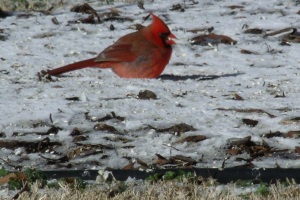
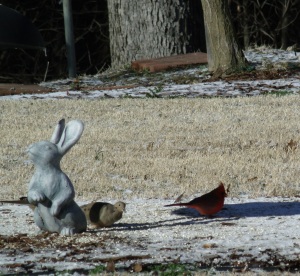
Birdwatching. The cardinals adore the snow. They are all over the branches and at the feeders. 2016-01-24 07.06.45This morning, I trained my eye on a red-headed woodpecker working his way up a tall elm rooted in The Ravine. My peripheral view included chickadees, more redbirds, purple finches, house wrens, and…a robin! I don’t think I’ve ever seen a robin in the snow.

Get outside. Walk in the snow. I recommend you wear boots. We don’t buy a lot of snow boots here in the South, but if you have boots for rain, they’ll work. Or if you have everyday boots that you don’t mind pushing through the powder (hard powder by now), use those. I surveyed the ravine while out with Murphy.2016-01-22 15.51.26

Always have your camera handy–or your phone, and don’t forget to take the dog with you. 2016-01-22 15.33.59Murphy loves the snow. She digs in with her face and plows.

Help a neighbor–or be helped. A post by Heather Corum Powell on our neighborhood Facebook page on Friday reminded me. “If anyone on Hilson has chocolate chips, I’ll make the cookies!” She got the chips, made the cookies, and then started delivery for those too far away to walk to get them. Since Dave and I are, ahem, watching the sugar, we asked her if she could take them to a single mom, or maybe a senior who can’t get out. Frankly, I didn’t feel that good being so altruistic and I’m a bit jealous of some old codger grinning over my cookies, if you know what I mean. <Sigh.> At least I know I did the right thing.

About that soup. If you’re like me, you always have an extra bowl (or pot, in my case) of soup. Since my neighbors have already foundered on my multiple pots of turkey soup this year, I haven’t reached out with the grub. Now I’m reminded that I need to.

The “be-helped” part. I’ve been a single mother in my past, and fortunate enough to know enough willing helpers to write at least fifty different stories. Every once in a while, I think of some of these people, and I write a note, but not nearly as often as I should. (Maybe some note-writing would be good during this in-house episode.)

If I were without Dave, I would not be able to drive the van up the driveway hill. I know that any one of the five closest neighbors would heed my call. First I’d try Saleh because he wants to help the most. Then Don–He’s the most vocal about my soup. Then I’d go for Steve. Maybe I should try Steve first. He’s from Upstate NY. Then Patrick or Chris since they’re younger, and therefore braver, than the rest.

Neighbors have volunteered all kinds of help on our Facebook page, not to mention the most helpful posts about street conditions from those who’ve been out. (See, there is some good in Facebook.) I feel inadequate to help. Dave did shovel all around the house, paths in both driveways, the ramp, and around the back doors, but I wouldn’t allow him to try the same thing for another house.  We have become the older ones. Note I did not say “elderly.”

My dad is always saying, “Let me do what I can, and then help me.” I think we should translate that to “I’ll do what I can, and then, if I need help, I’ll ask for it.” My second goal would be to always think of something we could do for somebody. I think I’m about to put on another pot of soup.

Sure hope Dave gets the porch rails blasted and they dry enough for me to caulk and paint tomorrow. This good weather is only going to last three days, they say. That means on Tuesday or Wednesday, I’ll be looking for things to do inside–and there may not be any snow to play in!

Mary Oliver First SnowSo here’s something to do that requires nothing but attention: Poetry. Yes, I know that is reading, but it’s almost, well, not–at least for me. I am fond of Mary Oliver (who isn’t?) so I’ve taken out all of her books that I have on a shelf and I carry them with me, upstairs and down. Here is just a little bit of a poem that stayed with me from last weekend.

Look it up. Read the whole thing. First Snow. You’ll be ready for it next time you get snowed in.


Day 18–Granny Ada’s Birthday!

My tiny great-grandmother, Ada Shoemake, was a hoss.
Her husband Johnny died young, and she remarried a man from the community. But she decided right away that she’d made a mistake and she didn’t live with him. I really don’t know if she ever got a divorce. She raised her kids by herself. She never had a haircut, wore a gingham-checked bonnet and a hand-sewn, button-front long-sleeved dress, and laced-up leather shoes. “Hand-sewn” means the whole dress was made with a needle and thread. She had one pattern. She kept her own garden and animals, and she slept with a shotgun beside her bed.

She was born on August 18, 1891. 2014-08-19 07.16.33

August 18 has always been something of a seminal date for me. I can always count on August 18 for an extra dose of quirkiness during my birthday month, and it’s always been a good day to make a decision or start a project. I always notice that date when it comes up in a novel. The first book that comes to mind is The Bridges of Madison County. I don’t remember what happened on that date, but there was somethingm important. Every person I’ve ever known who was born on Granny Ada’s birthday has been a bit, well, wild. I must not name names.

I did not choose the eighteenth day of my birthday month to plant one hundred fifty iris roots. The date chose me. Mom and I planned to make a jaunt to an orchard about an hour away to bring back Gala and Granny Smith apples.

Dad took the fifty-foot line of bearded varieties out of the ground last week. I convinced him to leave the clumps just a foot from where they were planted so that we could keep the colors half-way straight. I thought my job was to divide the clumps and drop the new plantings where they were to be seated, something I could do a little at a time over the next three or four days.

Dad divided them before I could get there. I sorted through the piles for the best roots and started dropping them. We reviewed the pattern of planting.

“See how I’ve got these laid out in triangles?” I asked.

He nodded, just about half-way. “You better stay out here with me. I won’t do it right if you don’t. I’ll make a big mess.”

“Dad, I can’t stay here all day,” I said. “I’ve got so much to do on the butterfly bed. I’ll cut the flags back and place them where you need to plant.”

“When I get this done, I’m going to put those red hot poker plants into that bed.” He nodded at a twelve by five-foot plowed and bordered spot where he’d had cosmos, zinnias, and marigolds this year.

He planted the first six iris bulbs, which are technically not bulbs at all but rhizomes. Long, thin roots stuck up in the air, a couple were too deep in the ground, and some weren’t in the ground at all.

“Uh, Dad,” I said, “I think maybe you should start cutting the flags back and I’ll plant.”

“Good idea.” He sat on the bank edge of the bed and tried to get his big fingers into my scissors handles. “This won’t work. I’ve got to go get something I can cut with.” He ambled down to his garage and came back with some huge bolt cutters.

“That ought to do it,” I said.

He picked up one rhizome at a time and cut the blades back, letting the long leaves fall back into the bed. I kept poking irises into the ground and tamping them down with my spade. The ground was too well-tilled for me to scoot across it on the ground, so I stood and bent. When I mopped sweat from my eyes for about the tenth time, I excused myself to get a headband and a drink. I called Mom and told her we’d plan to go to the apple orchard after her orthopedist appointment Tuesday. She thought that was a good idea.

I came back to the iris bed with a sweatband under my visor, a jug of iced tea with a straw, and a bandanna tucked into my left pocket.

“Dad, you know, it’s going to be difficult to pick up all these blades if you cut them into the bed.”

“Yeah, but it’s a lot easier for me to cut them and let them fall there.”

“Well, somebody is going to have to get into the bed with a wheelbarrow, and then pick them out of the loose dirt.”

When he didn’t answer, I said, “You know what? I think you should go ahead and work on those poker plants, and I’ll just work on these as much as possible today. I’ll just let this be my project.”

“Okay.” I took note of the delight in his voice.

About noon, I went inside to my couch recliner in The Cellar and flopped out in front of the fan. “Gotta rest,” I told Dave. He was working on some shelves for the pantry area. “Gotta cool off. Then I’m going back outside.”

“You better stay in for a couple hours. It’s too hot for you to be out there.”

“Yeah,” I mumbled, “I guess you’re right. I’ll throw some lunch together.”

“What are you cooking?”

“There’s some fajita meat in the refrigerator. I thought I could fry up some of those sweet green peppers and some onions and we could eat it rolled up in a tortilla with some fresh tomato on it.”

“That sounds good. You want me to go upstairs and get the meat?”

“Oh, the meat’s down here in this frig, but you could bring down some shredded cheese and an onion. And a couple tortillas.”

The aroma of that cooking mixture was divine, and Dave said so.

“Hey,” I said, “would you call Mom and ask her if they want some of this? It’s late, they’ve probably already eaten, but let’s ask anyway.”

They did, so Dave ran over to the apartment with a small casserole dish and more tortillas.

My courage returned when I had eaten, so I headed back outside and finished the row. I packaged up the remaining tubors, more than I’d just planted, and numbered them as they’d been dug up. At least we’ll have some shot at identifying the color and name. There’s a guy two streets over who wants irises! I cleaned up the piles of trimmings, dumped it all, and gathered up tools.

“I can’t sit down anywhere,” I told Dave. “I’m too dirty. I have to get in the shower.”

Yep, I was dirty, and I was tired. In the South, we call that kind of tired, “tard.”

Everyone who knows my mother and knew Granny Ada says Ethel Shoemake Blair is just like her Granny Ada. The word they generally use is “feisty.” My great-niece, Everley Diane Drew, was born on August 18th.Everley's FirstDayK She turned five this year, the fiery little redhead, and she started kindergarten on her birthday. The people who might be inclined to include “feisty” in their vocabulary would say Everley is feisty.

No one has ever said I’m like my great-Granny Ada, and when I finished that line of irises, I wasn’t feeling anything like feisty. But I knew I’d picked a good day to start–and finish–a project. And I was pretty sure I exhibited strong signs of hoss-dom, even if I could barely walk to the bathroom.


Always We Begin Again–Happy 2014

I jumped from my chair when something hit the window beside my desk. A cardinal…on the pavement of the patio. And as quickly as my feet brushed the floor, a Cooper’s hawk snagged the wounded redbird and took to the sky. I breathed jagged ins and outs. My heart sped.
 GEDSC DIGITAL CAMERA

“This is nature,” I told myself. But it’s the piece of nature that I do not love. It’s been several days now, and I still semi-shudder at the thought of that few seconds.
GEDSC DIGITAL CAMERA

I have watched the hawks swoop upon the back yard for months. What I expected was that one of the doves who gleans the leavings from the feeders would be swept away, one of these birds that my bird-hunting Uncle Hugh Lee would never fire upon. “The dove is the Bird of Peace,” he said. “You don’t kill a Bird of Peace.”

The first year on the ravine, we installed birdfeeders to mimic the layout of the yard at our former home. When our expected yellow finches did not arrive, we changed the seed and the feeders, and greedy blackbirds descended in flocks. We learned that blackbirds do not like safflower seeds, but everybody else does, so we changed the menu again and welcomed cardinals, woodpeckers, chickadees, purple finches, and all the common varieties of wrens and sparrows. Doves gathered under the feeders to clean up. For three years, we had Lonesome. Who knows what happened to his partner, maybe a hawk. And now, who knows what happened to Lonesome. The doves now congregate in even numbers.

So much of our life here has been tied to the animals. The first two years, there was the skulk of foxes in the ravine. Lots of foxes, including two litters of pups, three in one and five in the other. One of the yearlings nested under the ramp to the porch on the side of the house, always taking leave before the humans might interfere. We watched them dig for moles and bury food for future meals.They caught pieces of hotdogs in mid-air that the neighbor tossed to them in the summer dusk. We noticed that, while they were off the ground, they were snapping up fireflies. When we returned to The Compound following some evening outing, the headlights caught the eyes of little heads peeking up over the ravine banks. It seemed that they’d been waiting up for us.

The raccoons showed themselves almost immediately. There were three kits that trailed after a waddly-wooly mama when she came to the yard to scout for food leavings, and then a hulking old fellow, biggest raccoon I’d ever seen, completely silver, that we did not see again after that first year. One evening, Dave and I watched a raccoon scale one of the tall trees, probably fifty feet, to rest in a crook between two of the top branches. We figured he was a young one.

The feral calico cat came the first year. We are such creative and original thinkers that we named her Kitty. We watched her stand off a fox one afternoon between our yard and the neighbor’s. She crouched to the ground and backed the vixen up with a threatening feline crawl, until the foxy lady acknowledged Kitty’s superiority by turning white-tipped tail to run. Kitty and I became so close that sometimes she would allow me within fifteen feet of her, then she was gone. No, I mean really gone–for two years. One spring morning, I heard her calling for breakfast from beneath my bathroom window, sitting kitty-pretty as if we’d had tea the afternoon before. She hung around for a year after our Welcome Back and then something caught her, or caught her eye, the something probably akin to a better living arrangement.

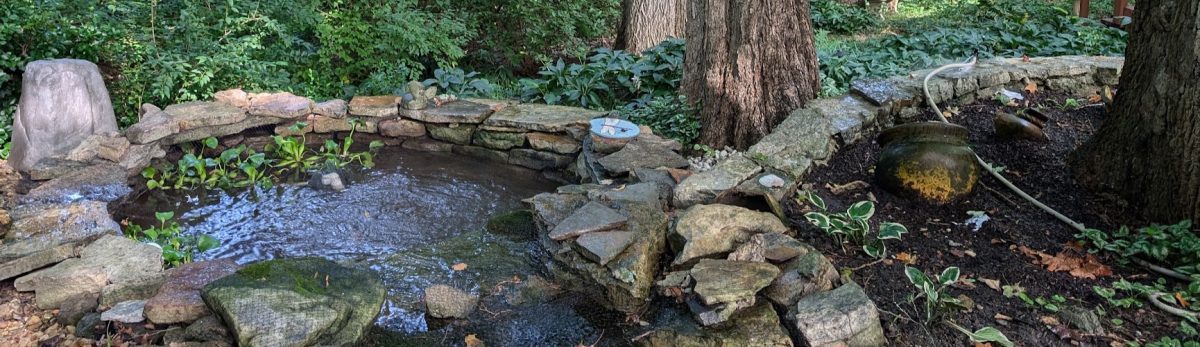
We found companionship living on the banks of this old gulch that we call The Ravine. My eighty-something-year-old dad, Grandpa, frequented the ravine by propping a tall ladder’s base against a big tree. He said if he missed a rung on the way down, he’d just slide.
“What about the trip back up?” I asked.
“I hold on with both hands,” he said.
Grandpa dug through the tangles of brush and vine to judiciously remove the deadliest tree-chokers. We laid out something of a feeding station so that we could better watch the comings and goings of our new friends. Grandpa and Grandma keep the blinds wide open in their upstairs den so that they don’t miss the squirrels’ antics in the tall trees on the west side.

One season brought a doe and two spotted fawns. They bedded down in the across-the-street neighbors’ back yard. When Mama left, the twins stayed, mowing down roses, morning glories, and turnip greens. And then they were gone, we guessed to join the protected herd two miles away at the agricultural center.

The community of foxes scattered. After a few weeks, we saw sarcoptic mange on the few young males remaining. It’s the same mange that dogs get. We read up on the disease, especially in foxes, and bought injectible Ivermectin to shoot into treats. It was a long shot, according to all the literature, but we tried to save them.

Once the foxes were gone, rabbits appeared. One little bunny hopped around on the porch just in time for Easter.

Last spring, we watched a fat old mama raccoon stagger across the back yard at 6:00 A.M. like a drunk coming off an all-nighter. She climbed the steps to Grandpa and Grandma’s apartment, hopped onto the rail nearest the wall, shinnied up the porch column, and disappeared. We’d suspected squirrels in their attic space and had already called a carpenter to further seal in the eaves on the porch. We never thought about a nesting raccoon. Before Trevor, our construction guy, finished the work that might seal a creature in, he toured the attic space and pronounced it empty–and very clean.

Groundhogs greeted us early on, without damage, until they discovered just how good Grandpa’s produce tastes at its youngest and most tender. He named them, set live traps, and somebody (Dave or daughter-in-law Vicky, that tiny little hoss of a woman) hauled them, one by one–Fatso, Big Boy, Chubby, and all the others–to the spacious agricultural center property. All reports indicate that they hunkered down and belly-scrambled to the care and prosperity of the burgeoning Ag Center Clan. But last year, new-to-the-compound Gordo foiled us all, despite numerous attempts to move him to a better neighborhood for groundhogs. In late fall, neighbors sighted Gordo pinned to the ground by a coyote in their back yard, but we expect him back.  The neighbor showered the coyote with a hail of BB’s and when the tormenter loosened his grip, the un-injured Gordo made fast to the safety of the ravine. In April or May, we’ll all be complaining about the havoc among the gardens, both flower and vegetable. Gordo adores morning glories and cosmos, squash and Blue Lake bunch beans.

The intersection of human animals and their less domesticated relatives in the kingdom is a delicate point of balance. Every movement by either man or beast, any aid from the higher-ups in the food chain, and any modification made to the combined home turf informs and directs change for each individual. The great naturalist John Muir said it best, “When we tug at a single thing in nature, we find it attached to the rest of the world.”

We feed the songbirds, and a hawk makes dinner of the prettiest one. We clear the vines that threaten to deaden the trees that anchor and define the ravine, and the vixens label us as too familiar. We feed the raccoons to deter them from the garbage cans, and they take up residence in the attic of the apartment. We seal them out and put them back in their place, the place we invited them from when we first fed them.

We continually re-evaluate our relationships to these animals, some who gathered here before someone thought of building brick ranch-style homes alone this great ditch, and others because someone did.

The thermometer read 12 degrees this morning–in the sun. The purple finches and chickadees flitted and darted between the almost-empty feeders. The doves, in their puffiest winter coats, gleaned whatever spill they could find.
GEDSC DIGITAL CAMERA

The supremely beautiful cardinals, male and female, orange beaks shining, took turns with the remaining small pieces of bread Grandma and Grandpa tossed from their balcony porch yesterday. The usually-present squirrels stayed in their warm beds. After I finished my third cup of coffee, I layered up to fill the feeders, and when I came back inside to the warmth of The Cellar, I ordered another fifty pound bag of safflower seed.


Maybe the coyote was just passing through. Maybe a family of foxes will birth babies here again. Maybe the hawk sightings will be fewer. Maybe Kitty will return for a twelve-month stint. Maybe Gordo will decide he really doesn’t like morning glories, after all.

Happy New Year~from all of us here On the Ravine.


GEDSC DIGITAL CAMERA


Outwitted and Incensed

Yesterday, I contemplated the day’s accomplishments. I couldn’t come up with much that was productive. The most energy I expended was chasing that #$%!!! groundhog, that gluttonous rodent who considers the morning glories around the birdfeeders his woodchuck feast. I am not enjoying this particular ravine resident.

I looked to Ask.com for the answers this morning. The questions were there, but let me re-do the answers. Those who follow me in the quest for groundhog truth need my accumulated knowledge.

What does a groundhog eat? Look, he is a ground “HOG”. He eats anything. Everything. He is especially fond of what you don’t want him to eat. I saw “Groundhogs are primarily vegetarians with an occasional bug thrown in.” The “occasional bug” must be rare. I’ve seen no reduction in the horde of mosquitoes this year. I do reject the groundhog’s pure vegetarianism, though, because I’ve seen him eat spaghetti. Bolognese. I didn’t care about the pasta but I was so surprised that I changed his name from Chubs to Gordo. I was trying for Italian but Gordo also loves tacos.

What will a groundhog eat? Twenty times his weight in morning glories, cosmos, cantaloupe, watermelon, green beans, et cetera, et cetera, et cetera. This animal burrows all winter, only coming out when it’s time to announce the coming of spring on February 2. I’m losing sleep trying to find a way to stop his ravaging and Gordo will curl up and snore all winter. He prepares for this long sleep in the quiet and safe ravine by bulking up at Diana’s Diner.

What does a groundhog do during the day? What??? Have you been listening? He re-landscapes my back yard. Gordo excels at the pruning process. He’s just a little greedy in his choices of prunees. In the lush lower gardens, Gordo ignores the abundance of weeds in favor of the dahlias, rejects out-of-control mint for rudbeckia, and turns up his nose at enough crape myrtle suckers to fill two wheelbarrows to decimate just one blue delphinium.

One of the answers made me laugh out loud. “One way to keep groundhogs away is to spread peppermint oil on whatever you want them to stay away from. You could also plant peppermint plants to keep them away.” Obviously, this person has never been terrorized by mint runners.

Then there was, “Epsom salts placed near or around the runs will keep  the groundhog away.” A white three-quarters of an acre in the winter might be okay, but Punksutawney Gordo doesn’t dine in cold weather. Maybe I could throw up a few striped umbrellas, lay out some Barbie beach towels, and call it a beach.

Here’s another. “Sprinkle cayenne pepper where the groundhog is unwanted” and “You can mix 1 tablespoon of hot sauce with 1 gallon of water and then put it in a sprayer and spray all around your plants”. Another har-de-har echoes around the room. There is not enough cayenne at Kroger to discourage Gordo and until Tabasco signs me for a contract, I bettersave my money for Buffalo wing sauce.

And the last answer in this category began with “Ground hogs have no respect for your garden plants.” This insightful writer wanted me to  “Make sure humans and animals, preferably large ones, frequent the area.” Dave and I are both short but we’re a bit round so I declare that, today, we can be considered “large ones” but when I saw that the large animals we should engage include coyotoes, bobcats, and pit bulls, I promised Murphy we’d pass on this suggestion.

How do you get rid of groundhogs? Until Gordo, Grandpa enjoyed success in live-trapping Gordo’s relatives. Dave is experienced with loading the fur-filled trap into the pickup for a short ride to the State of Tennessee Agricultural Center, home to unwanted critters from miles around. Daughter-in-law Vicky let us in on her destination for two dozen chipmunks and one of Gordo’s distant relatives.One day this week, we cut through the ag center on our way home from downtown.

“There’s where we let the groundhogs loose,” Dave said, pointing to some rolling hills of trees and pasture.

“What if somebody sees you?” I asked.

“Then we just open the door, shove him out, and drive like hell,” he said.

“There’s a ten mile per hour speed limit in here,” I said.

“It’s never happened yet,” he said.

So far, Gordo has avoided the apple-baited snare. Meanwhile, I keep hope alive. I beat on the window, yell, and chase him to the big ditch.

He’s too fast for me. There’s no way I’ll catch him on foot.

Turnip Greens

Last Tuesday, I put up turnip greens, mainly to save Mom from doing it. Mom has been an expert canner and freezer in her time, but her time for that sort of homemaking is over. Unfortunately—no, wait—Fortunately, Dad’s time for gardening is not over. So from the end of May through the first part of November, he announces at cocktail hour: “I’m going to have a mess of green beans tomorrow” or “Did you see the sweet potatoes I dug?” or “Looks like there are more butternut squash”.
On Sunday, it was “I’m going to have a big load of turnip greens tomorrow.” And he did.

The station/assembly line.

I love me some turnip greens, but I don’t want turnip greens that have stems in them and I don’t want to grit my teeth on sand, ever, when I chomp down on their bitter goodness. Those picky preferences of mine make my turnip green preservation experience a bona fide chore and since the details of the event are so recent, I thought I would share my foolproof method with you. Don’t stop reading because you hate greens. You may have to take on this project some day; it’s amazing what we’ll do for our kids—or our parents.
My Aunt Ogile said you ought to cook your turnip greens with fatback before freezing but not to add salt because that will make them tough. I just wilt mine, plain, trusting the advice of several reliable websites. It makes me happy to offer you my easy, shortened process. Please read through the entire set of instructions prior to embarkation.

HOW TO FREEZE TURNIP GREENS by Dinah
1. Set up your turnip green station. You will need a big mess of turnip greens, paring knife, clean sink with stopper, container for stems and other non-turnip green items, in-sink clean dish drain (forget the colander, you can’t get enough in one of those), and a pan for trimmed greens. Running water helps. Setting up for this official, assembly-line-type operation sort of cements your commitment to the project.

The work-in-process.

2. Dump your greens on the counter (maybe on a big paper bag); you’re going to work off the stack. Be sure to get out your largest kettle so that you can marvel appropriately at how that huge pile of greenery, when wilted down, barely covers the bottom of the big pan.

3. Cut out all the big stems. Since you’re going to be lifting leaf by leaf (oh, yes, you are), toss out all the grass and dogwood leaves you find nestled between these turnip tops. (Note: It is possible you won’t have any dogwood leaves. Our turnip patch is just a couple of feet away from an old white dogwood whose leaves turn brown and fall just about time for the first picking of greens.)

What I threw away.

After you have been trimming for, oh, twenty minutes, you’ll want music. I heartily recommend rotating twenty-minute shifts of classic country and R & B soul. You really don’t need anything too dance-worthy as that makes you get too frisky with the paring knife. I suppose you’re wondering why I didn’t tell you to put the music on before you get started trimming. Well, I have found that I need a few minutes of quiet to get my routine, and my rhythm, established. It’s a bit like trying to find a driving destination while the radio is on. Got to turn that thing down!
4. As you strip the leaves, throw them in the sink. Go ahead and start the cold water. You’re going to need a lot of water. You can turn off the water when it gets about, um, four to six inches from the counter top. If you don’t have a ruler handy, four to six inches would be the approximate width of the very largest turnip plant leaf in your stack—if you have a good crop this year.

5. When the sink looks full enough of greens and water, stick your hands in and swish, swish, swish. Do not splash, splash, splash or you and the kitchen will look like you and your bathroom after a happy toddler’s bath.

6. In the middle of one of the latter swishes, lift a layer of greens out with two hands and lay them in the clean dish drain. Repeat until the sink is empty of greens.

7. Now—look in the sink! See all that dirt and sand? Amazing! So, pull the plug and wash the sink.

8. (a) Put the plug back in the sink and start the cold water. (b) Start layering all the just-washed greens into the sink (yes, again). [Somewhere in this step is a good time to rotate your music selection!]

9. Go to #3 and continue through #8. (Yes, we are going to wash these wretched pieces of greenery again.)

10. When you have washed the trimmed leaves—and the sink—three times, go to #8 and complete (a) but don’t do (b). Let the sink fill with water. Now, this is tricky because you don’t want to put too much in nor too little. Check out the next step so that you have some idea of how much you need. (Woman up! There are some decisions that I cannot make for you.)

11. Do not go to #9. NOTE-ALARM-ATTENTION: If you get lost here, you could be washing turnip greens until the Lord comes to take us Home.

12. Take the thrice-washed greens and gently layer them into the sink of water. Barely—barely, I say—move the greens around with your hands. You can’t call this a swish. It’s more like the wake of a toy aircraft carrier.

13. Dry your hands. You’re going to let the greens soak for twenty minutes. The idea here is to let whatever grit might still be present to drift to the bottom of the sink. [There is ample time to change from George Jones to Aretha here. I hope you can find “Pink Cadillac” because it would not hurt to get your dancing done at this point. Oh, wait, the real name of the song is “Freeway of Love”. I bet you could find it by “Pink Cadillac”, though.]

14. Look at your counter. Are there more unattended greens lying there? Okay, then don’t think you have time for a nap. You could, however, down three PBR’s or a half-magnum of Chardonnay. Only your own experience will tell you if you need refreshment and what kind.

15. After the twenty-minute respite, gently lift (but do not swish) the greens from the water and place them in your big old pot (hereinafter referred to as your “BOP”). Go ahead and set it on the stove. Do not turn on the flame. Just let the BOP rest there.

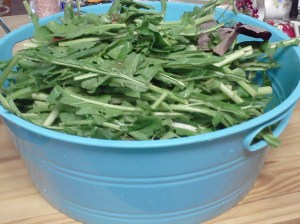
My BOP of greens.

16. Now, without whining, go to #2 and repeat through #6 for the remaining pile. You only have to do the repeat until all the greens are washed and in the BOP.

17. You may wonder what to do since the BOP is already full, even overflowing. Just keep stuffing. Push ‘em down, push ‘em down, wayyyyyyy down.

18. Add four or five inches of water to the pan. No, I do not know how you are expected to measure since the BOP is not see-through. Just put some water in, force the lid on, and put your project on the burner—on High.

19. When you hear the water boiling in those greens (“glug, blop, s-s-s-s-s-s-s-s-b-b-b-b-b”), give it five minutes and take a big metal spoon and poke the greens down. They’re going to start getting smaller…

20. Repeat the poke-down into the boiling water until all the turnip greens are dark and limp. NOTE: If, at any time, you hear only a s-s-s-s-s-s-s, that means your BOP is out of water and your greens are s-s-s-s-sticking, as in “pre-burning”. Add some water! If you are so numb from your refreshing adult beverage (allowed and even encouraged in #13) that you fail to note the first signs of sticking and start to smell burning greens, you’re s-s-s-s-screwed. Throw out the whole thing. This prophetic warning should scare you into paying attention because you will feel poorly when your labor just to get to this point is declared vain.

Take your big spoon and root around in there to make sure they all got the message. Hopefully, there will be enough of the wilted turnip tops to cover the bottom of the pan and, unless you’re working with a non-stick pan, the bottom you do see will not be black. Yes, they really do shrink down that much. No, they’re not exactly dissolving before your very eyes. They’re just getting smaller.

21. Turn the stove off. Clean up the kitchen. You’ll have plenty of time because the greens have to be cool before you put them into bags. Don’t, however, leave this cleaning task until tomorrow. You need a week to appreciate the reminder of this achievement.

22. When the greens are cool, drain them. Oh yeah, this is where a colander comes in handy. You might even be able to use a large tea-strainer for what remains of that huge pile on the counter that you started with.

23. Stuff them into freezer bags, press the air out, and lay them flat to freeze.

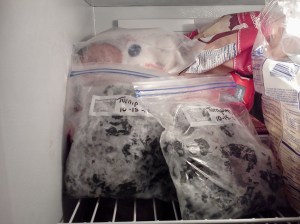
I got two quarts out of that. Two quarts. Two meals. Two flat, frozen one-quart squares of turnip greens.

What I got.

Don’t think you’re being original if you started hunting Southern home-cooking restaurants after just reading the directions for freezing your greens, but don’t think you can compost the big pile of turnip greens on the counter and no one will know. You’ll know—and you’ll remember that I told you every homemaker wannabe needs this experience at least one time.
Now that I’m an expert, I’ve settled on Cracker Barrel and it’s possible there is a Cracker Barrel near you. I could drive 120 miles, eat country cooking for an hour, and come back home in the time it took me to put up two quarts of turnip greens and clean the kitchen. In fact, I’d still have twenty minutes to spare for a quick nap.
There’s just one little problem with abandoning home-freezing. I could never convince Dad not to grow those turnip greens—or squash—or eggplant—or peppers—or corn—or green beans…
Maybe I would never even try.