Irritation and Ablation

Some things irritate me so much I feel skin pulling loose from my bones. This is an asthma story. It may bore you. I’m sorry it’s so long. Don’t let it irritate you.

I’ve visited allergists and specialists so many times. When I was in high school–Go, Pirates!– my mother took me to my doctor because I kept breaking out in hives. One time, the cause seemed to be canned ham. (Remember canned ham? In my younger years, I sent one to every friend or family funeral.) Next, it was green beans from a can. Really?

The doctor(s) finally concluded it was, indeed, a food allergy, but could never pin it to one food. Maybe it was something used in the canning process of meat and vegetables.

Looking back, I wonder if it could have been stress. The doctors asked my mother if I was upset about anything. She said no. She didn’t ask if my algebra teacher, Sullenberg, could have finally irritated me so much that I developed red bumps all over, from my scalp to the soles of my feet.

The hives case seemed to just go away when I moved from 11th grade to 12th grade and no longer had to deal with the mathematical chaos in my brain. No algebra, no geometry, no calculus, and, thank the heavens, no trigonometry, even though the recommendation for academic students was to study trigonometry. Or was it calculus?

As a young mother, I was a magnet for contact dermatitis, the kind that peels off layers until there’s blood. On my physician’s advice, I was to wear gloves all the time, especially when peeling potatoes or changing the bed linens. (Yes, really.) I’d already begun to wear brightly colored latex when washing dishes, so I grabbed them every time I touched root vegetables or washed the sheets. But my hands were still so raw that the FBI could not have lifted a thumbprint.

The next doctor advised that I was probably reacting to the wet latex when moisture leaked through the lining of the gloves. He ordered some neoprene gloves. They were vast and magical, lined with a knit cotton and wouldn’t let anything seep through to my hands, but I couldn’t master changing sheets or peeling a spud.

He also sent me to the radiologist to have X-ray treatments on my palms and the inside of my fingers twice a week. Those were the cure. I never had contact dermatitis again after ten treatments. Now, AI tells me that X-ray is not the first-line treatment for contact dermatitis and is even considered to be highly ineffective.

Then, one day much later, the hives reappeared. The doctor gave me Valium that I took once a day, every day, even through my pregnancy with my second son and a couple of years after, until the experts decided we really shouldn’t be taking Valium.

The hives were gone, really gone, until my sons were in fifth and eighth grades and I was in a marriage gone to Hades and smoking like I was already in hell. I kept telling my doctor that Valium did the trick some years before, and he said, “Oh, I bet it did!” (He wouldn’t let me take even a smidgen of Valium.)

This time it was Elavil, but I was only to take it when I felt hives coming on. It worked, but it also knocked me out for two or three hours, which was highly unpopular in my profession. That would have been the case in any sort of work, I would guess.

More than once, my assistant would knock on my door to check on me, only to find me with a throw pillow under my head on the desk, bleary-eyed and drooling. I learned later that Elavil is an antidepressant sometimes given for headaches. My mother suffered from migraine headaches and was prescribed Elavil in the 1960s.

Years later, after the second divorce and marriage to Dave, I contracted a virulent case of bronchitis. I coughed and wheezed for weeks, until a doctor I worked with said, “Diana, you’ve got asthma.”

I said, “Surely not, at my age.”

He assured me that he’d seen several cases of adult asthma and referred me to a pulmonary specialist at Vanderbilt, one Elizabeth Willers.

“Yes,” she said, “this is cough variant asthma. The first thing we need to do is send you to ASAP to find your allergies.” ASAP is the Allergy, Sinus, and Asthma Program, operated by Vanderbilt.

I said, “I don’t think I’m allergic to anything.”

Dr. Willers answered, “You’re allergic to something or you wouldn’t have asthma.”

The testing involved tiny pricks on the inside of my arms with various allergens. After testing, I reviewed my results with a Nurse Practitioner.

“Good news and bad news,” the woman said. “The closest you come to an allergic reaction on this test is cat hair, and your reaction was not very high on that, certainly not high enough to be called an allergy.”

“Cat hair,” I said. “I’m not close to any cats.”

She nodded. “So you’re not allergic to anything. But you are highly irritated by a lot of things.”

I sighed and told her, “You have no idea.”

*

It was back to Dr. Willers, who was surprised by the results.

She said, “So you may be allergic to something that we can’t test for. The main task at hand is to treat you for asthma. She prescribed a new medication called Advair, a small disk-inhaler filled with two kinds of medicines combined.

Advair did a strange thing. It made me cough worse. Dr. Willers changed it to something else, then something else, and something else, and treated me for a couple of years until I had to make traffic and parking easier. Willers was leaving Vanderbilt, too, and she gave me a recommendation.

Laura Hunt was, and is, a fantastic specialist at a Vanderbilt-associated clinic at Williamson Medical Center, about fifteen miles away. (The traffic and parking were so much better! Hunt was not her last name then, but she got married. Now I can’t remember her other name.) She and I clicked right away, and we charmed each other with humorous stories. She was fun.

Dr. Hunt ordered some serious testing and, sure enough, I had asthma. For some reason, she wanted to try Advair again. Once again, the cough became severe.

“Why didn’t you tell me you’d tried Advair before?” she asked. “I’m supposed to make you well, and I’ve actually given my patient something to make her feel worse!”

We sampled every inhaler known to medicine, some I’d already taken, until Alvesco seemed to help more than anything else. I took it for years. Dr. Hunt also ordered a nebulizer, several rescue inhalers, Singulair, Zyrtec, and Asmanex, some of which I was already taking. And I got to experience that rapturous asthma test every other year. I flunked that test time after time.

The cough would reappear. Prednisone would kick it in the butt, but oh, the joys of steroids, and in a month or two, I would start coughing again. I was in and out of the clinic so often, I knew every employee by name, even following their marriages, births, divorces, and children.

I decided I needed to find a pulmonary specialist closer to home. All of my physicians (and my mother’s and father’s) except for Dr. Hunt practiced at St. Thomas West. It seemed logical to have them all in one place. Dr. Hunt agreed with me, citing having my parents’ physicians and mine at one place, given they’d moved in with us recently. I was managing their health and mine.

*

My primary care doctor’s nurse sent a referral to St. Thomas Pulmonary Group and handed me a card with the appointment date. I wasn’t sure which physician at the group I’d be seeing, but the nurse told me I’d be seeing one of the new ones.

At the pulmonary desk, the receptionist said, “You’ll be seeing one of our new physicians, Dr. Willers.”

“Elizabeth Willers?” I asked.

“Yes, she is not a newly credentialed doctor,” she said. “She comes to us from Vanderbilt.”

I did not tell her that I already knew Dr. Willers, but I thought, “What a full circle.”

When Dr. Willers came into the room, she said, “Long time, no see.”

“They told you I was with you a few years over at Vanderbilt, didn’t they?”

“Yes,” she said, “but I think I would have remembered you in a few minutes. I remember your voice. Weren’t you the one who told the ASAP nurse you were irritated by many things?”

We both started laughing. She asked me if I was doing well on the current medications.

“Okay,” I said. “Just okay. I’m still coughing.”

“And you’re taking everything we can give you,” she said. “How often are you using your ProAir?”

“Maybe once or twice a week,” I said, “but I don’t have acute attacks when I can’t breathe. I have coughing attacks that last for months, it seems, until I take some Prednisone. I hate that stuff.”

“Prednisone is a double-edged sword,” she said. “It works, and pretty fast, on these conditions we prescribe it for, but there are those side effects.”

“Yes,” I said, “sometimes nothing else helps.”

“Diana, if you ever feel like you need a tapered regimen of Prednisone, just call in. By now, you know when you need it. Just call and I’ll send in a prescription.”

“Okay, are we going to do anything else?”

“I would think about keeping that nebulizer close. Use it twice or three times a day when the coughing starts to get worse. Let’s set you up to see me in three months. Do you need some Prednisone today?”

“Yes,” I said, not admitting that I wanted to keep it on hand for the worst fits.

She said she was happy to see me, that I had been one of her first patients, and was looking forward to working with me. I told her I was delighted to see her again, too.

On my second visit with Dr. Willers, I told her, “I’m coughing constantly. I’m exhausted.”

She leaned back against the sink and informed me of a new biologic to treat asthma where no allergies are positive. She said she had heard really good things about this treatment for eosinophilic asthma. She referred me to an allergist who would determine what kind of asthma I had and if he would recommend Fasenra, a relatively new biologic administered in an injection every other month.

The allergist confirmed my situation with eosinophils and prescribed the biologic. If you’re not on Medicare, you can give the injection yourself via a pre-measured pen, but since Medicare thinks I’m old and decrepit and incapable, I have to go to an infusion center.

After the first injection, I stopped coughing. I only saw this allergist one time. When the nurse at the center told me that my prescription would run out in a couple of months, I called his office. No one answered the phone. There was no message. No message, no letter, no nothing.

I called Dr. Willers’s office to get a referral. I received no reply to the message I left, so I called the office again a week later and then the week after that, and finally spoke with the office manager.

“He closed his practice,” she said, “and has gone to work at the VA hospital.”

“What do I do?” I asked. “Could someone at your office refer me? My prescription is about to end.”

I don’t remember her exact explanation, but the answer was that you need to see your provider.

“I don’t have an appointment with Dr. Willers until two months after my prescription is null.”

I knew how difficult it was to get an appointment with the St. Thomas Pulmonary Clinic. I said, “I guess I’ll just miss a couple of months.”

She answered, “For your next appointment, you will see a new doctor. Dr. Willers has left our practice. Let me see who I put you with.”

I stood there looking both ways for Sunday. I’m sure my mouth was open.

“You will receive a letter this week,” she said. “Ah, here you are. You’re going to see Dr. Ashley Clark. Is that okay?”

“I guess so,” I said.

“And, I’ll put you on the list in case someone else cancels.”

I think I thanked her.

*

After a little over a year in the practice, Elizabeth Willers had left St. Thomas Pulmonary. She didn’t know where she was going, but the practice allowed her to compile an email list. I received the letter announcing her departure and also invited those who wished to stay in touch to send an email to a dedicated address. I sent a fun note, but I haven’t heard from her.

I think she was trying to make a decision about retirement.

“Meanwhile,” as Stephen Colbert says, I went to a routine checkup with my primary care doctor.

When I told Dr. B the story, she said, “Oh yeah, Dr. T went to the VA. I wonder why he did that. Well, we can get you a new allergist.”

She typed a little on her laptop, “Oh, let’s see if we can get Keegan. He’s not accepting new patients, but let me go to my office. I’ll call him.”

Dr. B re-entered the room, carrying her laptop. “We got him,” she said.
“They’ll call you and make the appointment.”

Yeah, I thought, they’ll call me.

Well, they did, and I saw him the following week. I talked to him about my prescription, and we talked about my asthma and the coughing. I was disappointed that he didn’t do something different for a biologic.

*

My new physician for breathing is Ashley Clark. I like her as much as I did Dr. Willers. She’s shared some laughs, especially about my journey to get a new set of Fasenra injections. I laughed with her, even though I told her it wasn’t funny.

I also asked her why the Fasenra didn’t seem to be working as well as it did the first few months.

“Maybe we should switch you to another biologic,” she said. “There are a bunch of them out there. I’m going to see if we can start you on Dupixent.”

*

Can you count the number of irritations in this story? I could, but it might join the “many things” I mentioned to the ASAP nurse.

Today, I’m irritated that it took me so long to write this epistle. There really is no need to add to my irritation list. The world is full of them these days.

***
Memorial Day

This is the second year we honor my brother, Denny. He was named for our Uncle Dennis Smallwood, who was killed on Iwo Jima. Today, we memorialize all those who died in service to their country.

Back in 1967, my brother’s number was up. Yes, young men’s lives were auctioned off by chance. But Denny held a religious deferment as he declared he would be a Christian minister.

Some months passed, and my father initiated a severe conversation with his son. Was he serious about becoming a minister? If not, was he being truthful with the Draft Board? Denny joined the Marine Corps.

I held nothing in my mind as to what each of them thought at the time. I wonder now if Dad ever regretted that conversation or if Denny would have reacted differently had Dad not challenged him.

Here was a guy who gave all of his body and mind in Vietnam and came home to deal with that loss. He built a radio station there and had a show. He counted bodies. He sent out endless letters as a public relations soldier. He led his men on countless patrols, and too often, he returned to base without some of them. And while he was out in the jungle-like terrain, the U.S. Military sprayed a killer defoliant. It was called Agent Orange. Denny got some of it.

Back at home, he was sent to Hawaii and then Arizona to serve as a recruiter. I never understood how he could do that. One time, when he was telling stories, he asked me, “Can you imagine being so scared that you literally climbed into your helmet? That’s what all of us felt.” It’s still a mystery to me why anyone would volunteer when there was a good chance they’d wind up in horrible conditions with guns pointed at them.

After he left the Corps, Denny suffered physically and sometimes mentally. He met periodically with a psychiatrist.

Denny was poisoned by his own country. He developed tumors in his back. He was born with only one kidney, and that one failed. He developed 5-minute seizures. I know his wife, Bev, could furnish a longer list. He spent half of his life in a wheelchair, one he could maneuver around in. In the end, he developed cancer of the esophagus, and it was untreatable.

The Veterans Hospital in Reno was semi-good to Denny. Often, they sent him to other, more suitable hospitals for treatment not available at the VA. Bev fought the bureaucracy with bear-like fervor to get him the care he needed–and deserved. She was strapped to help load him and his chair into an ill-fitted van, put him in his chair, help him to the toilet and back, and act as his 24/7 caregiver. Was she able? Not entirely, but she did it anyway.

A few months before Denny made the choice to discontinue dialysis and die, the VA declared him 100% disabled.

It took dying to get it done. Today, my brother is on my mind. He gave all.

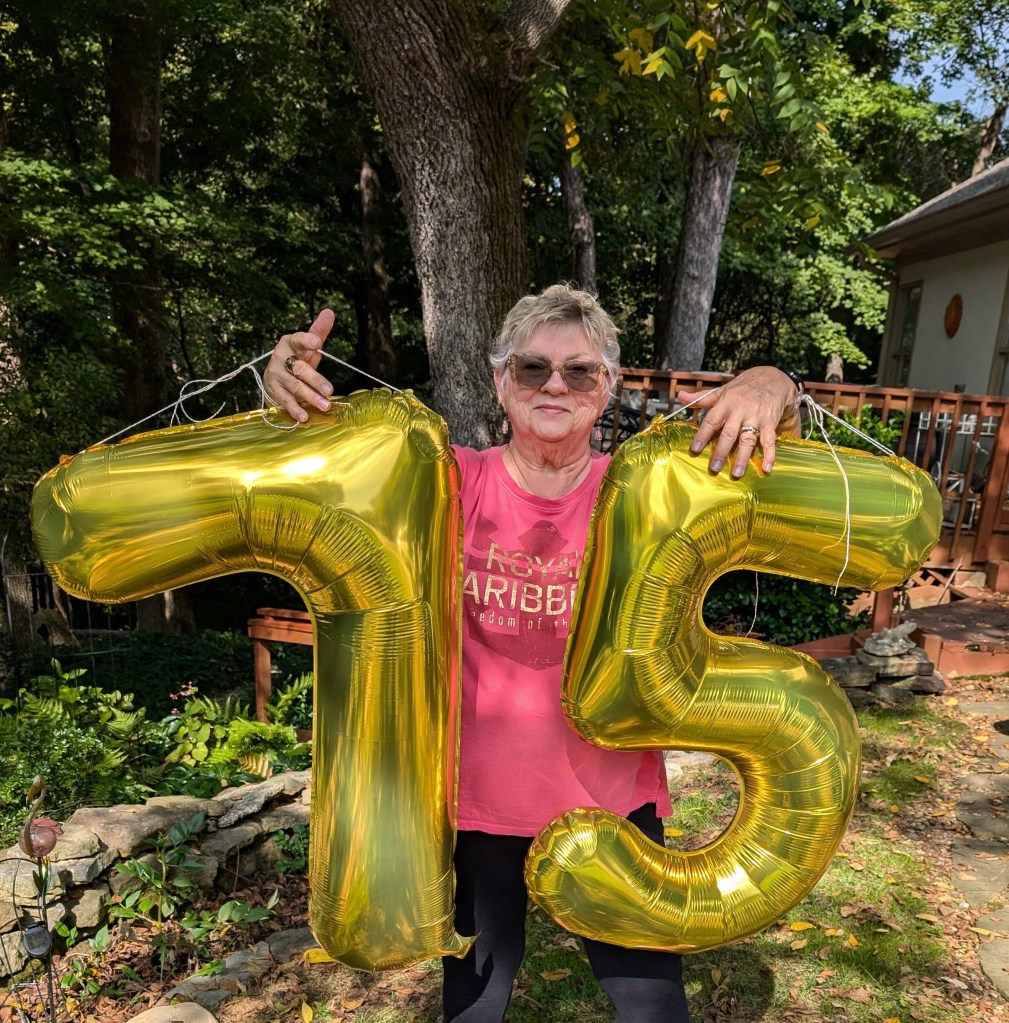
75

It hasn’t been too long since sales clerks, pharmacists, and service people began explaining things to me that need no explanation. When I checked out at my favorite thrift store on Tuesday, I forgot to ask for my Seniors’ Day discount. When I turned around on my way out and said, “Oh, wait, I’m a Senior,” the young woman said, “Oh, I already gave you the discount!” When I glanced at my receipt, there it was, the 30% discount.”

I am seventy-five years old. I’m not in love with it. I just don’t know what to do with it.

Oh, people still tell me I look younger than seventy-five, but the guy at the nail salon said he thought I looked more like sixty-five. He thinks that’s a whole lot better?

Now seventy-five, I estimate that at least three-quarters of my life is gone. If I lived to be my father’s age when he passed, I would only have fourteen years, or if I lived as long as my mother, eighteen years.

I can’t seem to get to the question I need to ask myself, “What will you do with these, [gulp], remaining years?” I get stuck on what if I only live to be 80. Then I am so sad, I cannot find any other questions.

I don’t want to leave this precious, troubled, wonderful, chaotic, green, climate-threatened, beautiful, war-torn world. I want to see change in my well-loved country: less hate, less hunger, less killing. My children and grandchildren would be fine without me, but I’m not finished looking at them, cheering them on, and loving them with this unequaled passion that began when the first infant sounds pushed from my body.

Most of the time, the questions arise when I feed my fish in the early mornings. I sit on the rock wall of the pond and gaze through a dense thicket separating our house from a busy thoroughfare. I note the birdsongs; I hear Cardinals order “Beer, beer, beer” and “Chip, chip, chip!” House finches cheep and warble a trill. Robins peek and tut before announcing, “Pretty, pretty, pretty.” Crows caw and caw louder to warn of a present hawk. Sometimes owls call to each other across the trees.

I am scared, weak, and afraid of the quick passing of time—something most people would never see in me.

I never imagined seventy-five, but the digits are mine. I don’t want to return to my twenties, or anything like that. I just want to be…for longer.

Okay, I’m ready for the question. What will I do to max out my days, months, and years? Or as Mary Oliver says, “What will [I] do with [the rest of] this wild and precious life?”

I’m working on my answers. They’re endless, so I know I must begin the tasks before I finish the list.

I plan to exhaust this endless love inside me, even though I know Love always creates more love. I’ll watch and listen until I need to sleep. Lookout, Beauty, I’m going to catch you and hold you in the Light. And Joy? I’ll choose you every day, even those when you seem far away. If I can’t reach you, I’ll make you.

Watch me, World. Slow down, and let me hug you every day.

Grafting and Healing Gahhhh

Maybe forgetfulness is part of healing. I know it’s related to grief.

I didn’t remember Mom on June 24, the day she died two years ago, but I had a restless, sad week. I thought I was anxious about the debate between, you know, Him and Him.

The debate passed, and I was a bit nonplussed by the performance of both Hims. Good Lord. However, after that day, I was still uneasy and lethargic.

Friday, I went to the nail salon so Wii could put that powder stuff on my nails. I’m growing nails out under those shells, and I think this week will be my chance to go au naturale. I’m going to the salon where I took Dad three weeks before he died and Mom three weeks before she passed. It took me almost two years to get back there. I just went anywhere I hadn’t been with Mom or Dad.

When Wii began to speak, it came to me. June 24 had come and gone, and I hadn’t remembered that Mom died on that day two years ago. I grieved for a few minutes. I was surprised that the date hadn’t come to me. I think about her almost daily. But it had arrived in the form of almost a week of depression. My condition is better named Sorrow.

The body and the mind managed the grief. After the week had passed, I felt a small healing, and now I can laugh at some of the predicaments Mom and I got into. There were so many.

I’d started this blog piece three weeks ago, and now I felt I could write.

***

In April, my dentist and I decided I might need a gum graft. This is where the surgeon excises live gum tissue from somewhere in somebody’s mouth and then “plants” it in receding gums. It’s not a delightful procedure, but I endured it well with the help of whatever stuff they used to sedate me.

After the first look at my lower front teeth post-surgery, the doctor told me that after the new gum tissue had settled in, I might also need a frenectomy. Another dental surgery, whereby the little thing that holds the bottom lip to the gums is clipped. Yay for me.

I said, “Goody.” This procedure is scheduled for July 24.

I had a frenectomy when I was nineteen years old, living in Lewistown, Montana, with my folks, working for radio station KXLO. My dentist was Dr. Harry Ziolowski, known to most of us as Dr. Z, a man who weighed at least 400 pounds. I liked him but wondered how he could get close enough to work on my teeth. He always attended to my mouth with gentleness and efficiency. And he was funny.

The day Dr. Ziolowski clipped the frenum, I drove myself to the office. He numbed me up, and it didn’t take long. Dr. Z had just received a new kind of bandage for such a task. He explained that this material would feel like three big pieces of bubblegum inside my lower lip. He pressed it to the double incision and told me to pretend I had a wad of chew in there.

I tried to laugh, but he stopped me.

“No, don’t laugh. You can’t pull on that bandage. It’s supposed to settle in against where I did the work.”

Dr. Z had already prescribed some painkillers, and I had picked them up before the appointment. I headed to the restroom to clean up my bloody face and popped two of them before I drove home.

I was drowsy, but I knew Mom had not been feeling well when she went to work, so I fixed the Littles hot dogs, canned chili, and potatoes. Our Littles were the three Wong boys that we were fostering. They were happy to eat as soon as they came in from school.

“What in the world is wrong with your mouth?” Johnny Wong, the youngest at age nine, asked.

“Had surrrrzhy,” I said.

“What’s surrrzhy?” Jerry asked.

Johnny answered in a low tone, “They cut something out.”

“Her tongue?” Jerry asked.

Johnny huffed. “No, probably a tooth.”

I didn’t bother to correct him. I just wanted to get that bottle of ketchup on the table and make it to my bed. The numbing was wearing off.

Jimmy didn’t acknowledge his brothers’ conversation. He just said, “Good, Dinah,” as he pushed a large piece of chili-laced hot dog into his mouth.

“Oo eyes puh disses in dihwahher,” I said, turning toward the hall to my room.

I didn’t hear Mom come in. My mother was plagued with migraines, and I knew the worst of this one was on its way when she left for the bank. She was seeing an aura. I assumed she would go to bed early after talking to the boys and saying goodnight. She always read to them, but maybe not that evening, and Dad was away from home for some educational reason. She did go to bed, I found out.

At about midnight, I woke in terror with a giant bubble still attached to my mouth but lying on my pillow. I screamed and jumped away from the bed. Blood from this melon-sized balloon spattered over the whole room, pink bedspread, white ruffled pillows, and the walls. I grabbed a pillow and held it against my face. Mom was in front of the bathroom by the time I got there.

“What’s wrong? What’s happened?” she asked.

“I tink my buhbuhguh boke,” I answered, muffled by the pillow.

“Good grief. I don’t know what you’re saying, but we better call Dr. Z. And go get a towel.”

I grabbed a green hand towel from the bathroom and left the pillow in the tub, then weaved and wobbled back to Mom’s bedroom, helped her lie down with the princess phone, and propped two pillows behind her back. I was right. She was in the middle of a migraine.

I could hear the phone ringing.

“No answer,” she said. She hung up. She dialed again. It rang and rang, and finally, Dr. Z answered.

“This is Ethel Blair,” she told him. “Something’s wrong with Diana’s mouth. There’s blood everywhere.”

“Okay. Okay,” he said, half asleep. “Meet me at the office.”

“Alright,” she said to him and to me, “Honey, put some clothes on.”

I grabbed a yellow sweatshirt and a pair of wheat-colored jeans from the chair where I’d left them and staggered down the hall and through the kitchen to the garage. I jumped when I realized Mom was behind me. She was wearing her bank uniform skirt, a blue chenille cotton robe tied around her waist over her pajama top, and red fuzzy house slippers.

“You on’t hah tuh doh wif me, Ma,” I said. “You toh tick.”

“I’m in better shape than you are. Get in the car.”

I was in my seat by the time she made it to the driver’s side, holding onto our co-owned sixty-six Mustang. She backed out of the garage and handed me a brown grocery bag.

“Here, hold that in case I vomit,” she said.

We knew we’d probably make it to the doctor’s office before he did, as he and his family lived farther out of town.

We sat in the car in the dark. Mom held onto the steering wheel. After a few minutes, she said, “He’s not coming. I bet he fell asleep.”

There was a phone booth between Dr. Z’s place and the Dairy Dip.

“I doh cah him,” I said. “Do oo how caynzh? Doh hab pursss.”

Mom grabbed the paper bag and heaved. She leaned back against the seat, sighed, and said, “While you do that, I’ll throw this away.” Then she handed me her purse. I lifted her wallet and was glad to see she had a zippered pouch full of coins. I took it with me as I made my drunken way to the phone booth.

I knew his phone number. I dialed.

“Ethel? Is that you?” he asked.

“Dr. Z, ‘s Dinah. Dat baddash bust.”

“Oh no,” he answered. “I thought I was dreaming when your mom called. I’ll be there as soon as I can. I’m sorry.”

“‘Tay,” I said.

Mom had driven across the parking lot to the Dairy Dip. She was hurling into their big garbage can.

“Ma!” I called. “I tumih.”

I was beginning to gain control of myself, although I’m sure I staggered a little across the lot to the Dairy Dip trash can. I held Mom. She turned and said she thought she was feeling a little better.

“Oo dit ih duh sigh, an I dwibe,” I said. I pushed her into the passenger seat and rounded the Mustang, balancing myself against the vehicle with my left side.

She looked comfortable in the car. “Is he coming?” she asked.

I nodded my head.

“I’ll just stay here,” she said.

I drove slowly over a couple of bumps between the lots and parked as close to the door as I could.

“Whah if oo bahf?” I looked in the back seat. Nothing there to throw up in. I got out and opened the trunk. There was one of Dad’s leather book bags. It was sturdy. I emptied the books, papers, pens, paper clips, and whatever else was in the bag. I handed the bag to Mom and saw Dr. Z’s big truck with its bed cover-camper shell coming down the road.

I leaned against the car and waited for him to park and get out. He was wearing yellow and brown striped cotton pajamas, a matching plaid robe, and a bowler hat.

“Oh, Diana, I’m so sorry. Come on in here. Where’s Ethel?”

“Ih duh cah,” I said. “Siht. My-way.”

“Oh, gosh, I remember she gets migraines. Let me get her out of this car.”

He ran to the vehicle and opened the door.

“Ethel,” he said, “You can’t stay out here in the dark. Let me help you inside, and I can give you something to calm this old headache. “

Never mind me, I thought, moving the towel to a dry place.

Mom held his forearm with both arms, Dad’s book bag dangling from her left, as he carefully ushered her up the steps to the door. I held the wrought iron banister, glad to be a bit more with it than an hour ago.

“Diana, go on back,” Dr. Z said as he turned on the hall lights with his right hand and held onto Mom with his left. “Ethel, can you curl up on this sofa? I can give you a shot of Valium. I think it would help.”

Mom nodded. The sofa was a red velvet Victorian loveseat. It looked odd compared to the rest of the chairs in the room. Mom scrunched her knees up on the sofa as Dr. Z pushed her into place. She looked like she belonged on the short couch.

“I’m going to give your mother something for that headache,” he said, rambling around in the hall closet.

I climbed into the dental chair in the back room. It was dark.

I heard Dr. Z say, “Ethel, I’m going to pull your sleeve up. I normally give Valium in the buttocks, but I’d have to move you.”

Footsteps in the hall.

Dr. Z turned on the task light. I was nearly blinded.

“Where’s Rev. Blair?” he asked me as he prepared a tray.

“Pihwins,” I said through clenched teeth.

“Ah, Billings. I bet he’s at the State Teachers’ Conference. I thought it might be in Great Falls this year.”

“Es,” I answered. “Oo dib Ma sot?” I wrapped the white towel he gave me over my chest and under my chin. still holding the bloody towel against my mouth.

“Yes,” he said, “She should be feeling better in a few minutes. Okay, now, open up. Just a little. “

I opened my mouth and pulled down my lower lip.

“Oh my God, this is a mess,” he said. “That stuff…It’s not supposed to do THAT.”

He paused for a minute or two.

“After I numb you up, I’ll pull this bandage out and temporarily replace it with a stack of gauze. Then I’ll get you to hold it. You can be my assistant.”

“Here comes the numbing,” he said as he pushed the needle into several points on my lower gums. I remember seeing stars alternating with pitch black.

“Now, while that’s setting up, I’ll get that stuff out of there. Open just a little more.”

He lifted some instruments from the tray and started gently pulling on the rubbery mess. I held the gauze against my cheek.

“Okay, it’s almost out. Give me the gauze.”

He pressed it between my lips and my gums. “Hold that pretty tight,” he said. This was a bigger wad than the bubblegum.

“Oh, good lord,” he said, dumping the messy lump from his other hand onto a stack of paper bibs, which he carried to the waste can in the hall, along with my bath towel.

Blood ran from my mouth and filled the gauze. I kept holding. He gave me a second stack and left the first on the tray.

On his way back into the room, Dr. Z said, “Diana, I may have to cauterize this thing. You just keep holding for a minute.”

He went into a storage room across the hall and started grabbing equipment.

I didn’t care. I just wanted the whole thing over with.

I heard a thud closely followed by, “Oh, no, Ethel.”

I jumped from the chair, still holding the gauze, and followed Dr. Z.

Mom was on the floor, and this big man was going to try to put her back on the sofa.

“No, no,” I yelled. “Eeb huh oh tuh foohr.”

I rushed around the two of them, pulled a cushion out of a side chair, and pushed it under her head.

“You get back in there, young lady,” he said. “You’re going to cause that mouth to bleed.”

Like it’s not already bleeding, I thought.

He was back in the closet in a couple of moments, and called out to me, “I’m getting her a blanket and a towel in case she vomits.”

“See otay?” I asked.

“She’s good. She’s just sleeping.”

That’s what they say when somebody dies, I thought, and I got up and down the hall again.

“Mom, Mom,” I said, leaning over her on my knees. “Tan oo heeh me?”

“Yes, Honey,” she mumbled. “I hear you. I’m okay.” She put her forearm over her eyes.

Dr. Z. pulled me up and said, “Come on, let’s go.”

He followed me to the exam room. I climbed back into the chair.

“Leaning you back,” he said. “I’m going to stop that bleeding now.”

“I’m going to put this over your face,” he said, “and then you just let me lift your lip off the place, and it will only take a minute.”

Something heavy lay across the top half of my head.  Dr. Z. pulled my bottom lip out and started to remove the heavy gauze. I instinctively put my hand to my chin, thinking I would help him, I guess.

“No, no,” he shouted. “Get your hand back!”

I immediately heard a small sizzling. Then the smell hit me.

“Uhhhhhhgg,” I said and shivered.

“One more time,” he said as he touched the wound again. It did not hurt, but I heard it, and I smelled it.

“I doh be siht,” I said and wretched.

Dr. Z. fanned me with something, probably a magazine, and said quietly, “One last small one, and we’re done.”

He probed the third time and fanned me again.

“Wait, wait, wait just a minute.”

I did…wait. And then I threw up. All the blood I’d swallowed all night, and for all I knew, all my insides.

Dr. Z. helped me out of the chair. I stepped into the bathroom. I’d wet my bloodied jeans, and my yellow sweatshirt was a sickly-looking brown. There was blood in my hair and on my white tenny-runners that would never come clean.

“Diana,” he called. “You may want to shower yourself off before you go home. Is there anyone that can pick you up?”

“I tan dwibe,” I said. “I doh hab kwobes.” I hadn’t known there was a shower.

“You can wrap up in my bathrobe. It’s still clean.”

I opened the door. He was a mess, standing there holding out his bathrobe. “I’m going to throw your towel away. Is that alright?”

“Es.”

“How about your clothes?”

“No. I hab to tate dem ho.” Even in my sad condition, I wanted to save my favorite jeans and sweatshirt.

“I’ll find a bag or something,” he said.

“I nee tet oh Ma,” I said.

“I just did. She’s fine. Get yourself cleaned up a little.” He opened the door to his office and led me to his personal bathroom in the corner.

How about that? I thought. Corner bathroom with a corner shower.

“All I got is Lifebuoy. There’s a towel and face cloth on the sink,” he said. “Leave your clothes in the shower,” he said. “You can get the mess tomorrow.”

“Now,” he said, “I’m going to close my office door, and you can lock the bathroom door if you want.”

I closed the door, locked it, and turned the water on in the shower. I pulled the sticky sweatshirt over my head and unzipped the jeans. I decided to rinse them out. It took me longer to give the clothes a bath than my shower. I wondered what LifeBuoy hair would look like in the morning.

It took both Dr. Z and me to get Mom in the car. She was fairly limp.

“You sure you’re okay to drive?” he asked.

“Es,” I said. (I had a big gauze wad in my mouth.)

When we pulled into the garage, I realized I was not okay to get Mom into the house by myself. I was uncomfortable waking a neighbor at that hour of the morning. I leaned her seat back as far as it would go and went into the house to get blankets. She wouldn’t need a pillow, but I would.

The boys were all sound asleep.

I tucked a red bedspread around Mom, scrunched up in the back seat, and pulled a blanket over myself, still in Dr. Z’s bathrobe. I hope those boys set their alarm, I thought. I smelled Lifebuoy soap.  

***

***

The Fox

I saw a fox yesterday morning! He (or she–I couldn’t tell) sauntered across the back patio, turned his head to look at me, and trotted across the neighbor’s lawn and under his carport. He was a youngster, hadn’t gained all of the red coat he’ll sport in a few months. But the tip of his tail was white.

We haven’t seen foxes on the property in years now. The first year we lived here on the ravine we counted sixteen, eight of those babies born to two mamas. We watched them play from the window in Mom and Dad’s den. Mom would call, “Dad says come over here. The foxes are out.”

He loved the foxes. He was miserable and depressed that first year here from the farm, and what saved him the next spring were the foxes and his garden.

One sunny day, one of the mothers brought all eight kits up from the ravine to the south lawn. These two vixens seemed to babysit for each other. One of the kits aggravated this mother-in-charge so much that she finally smacked him into a somersault. He didn’t seem to be hurt, but he did stop jumping all over her. Dad laughed. “I guess she straightened him out!” Our six-year-old grandson said, “They look like little grey dogs!”

Too soon, the foxes grew into young red dogs who scampered around the back of the property and watched our every move. Very often, we’d see little heads pop up from the ravine to check us out when our own grandkits rolled a ball or staged races in the back yard. They kept Dad company from a short distance while he worked in the garden. Sometimes we’d hear him talking to them and they seemed to listen. At night, when driving in to the garage, shiny eyes appeared in precise formation along the bank.

And then they were gone.

At the time, I wondered if they left because Dad cleaned out too much of their cover from the ravine. Clearing the banks was his favorite thing to do next to growing his huge vegetable garden. I also saw somewhere that if a fox is sick, the others move away from him. Then I read some good wildlife research that said foxes only live communally when raising young. When the kits are ready to hunt alone, the skulk breaks up and each one goes his separate way. That made more sense.

Dad asked about them several times a week. “Have you seen any of the foxes?”

We did see two scraggly yearlings and researched treatment for sarcoptic mange in red foxes. On a trip to the co-op, I purchased injectible Ivermectin and began to lace bait. This is not a simple thing to do as the medication kills the mange mites but does not kill the eggs. So the Ivermectin has to be given consistently over a long period of time.

One of the two seemed to improve and the end of the second year, the only fox we saw was a very sick one not long for this world.

I told Dad, “Maybe they’ll come back and raise another family.”

I’m hoping the one I saw yesterday homesteads somewhere in the ravine.

Tuesday, November 19, was the first-year anniversary of Dad’s passing. I thought about it every day during the prior week, but it did not cross my mind until afternoon of the actual day, while driving to an appointment for cortisone injections in my knees.

I remembered taking Dad to the orthopedist at St. Thomas to look at his knees. I knew there would be no surgery, but Dad wanted to ask for replacements for his deteriorating joints. I even had the nurse put a sticky note reminder on Dad’s chart. “Dr. Shell, please note that Dad (Mr. Blair) has scleroderma.”

Dr. Shell is a loving doctor. He never mentioned the scleroderma but said, “Ernie, we don’t want to do any surgery, because I think it would just be too hard on you.”

Dad answered, “You’re the doctor,” and agreed to the cortisone shots. After a couple days, Dad said they didn’t help at all.

*

I was early for my appointment so I pulled in a shady parking lot off Woodmont Avenue close to the hospital.

“So what do I feel?” I asked myself. If someone had asked, “HOW do you feel?” the answer would have been “Okay” or “Fine, thank you, and you?” But what I really felt was a hard ball of emptiness in my middle, an insistent necessity to remember, and a full-body strangeness I could not identify. Perhaps it was just a self-protective disconnect.

I’ve tried to do what Dad asked. We moved my writing place from The Cellar to Dad’s study, not a small job. My new place is now labeled The Study. I’ve made it through all of the books, sorting boxes into Sell, ThriftSmart, Give-to ____, and Keep. A bookseller carted off 500. I’ve browsed through fifty-plus years of well-filed sermons, pulling out those with special meaning. A dear friend who teaches a men’s group wants the rest. We’re giving him the file cabinets, too. He’ll need to bring his big truck.

*

After a few minutes, I entered traffic to St. Thomas and parked three levels down in the basement. It’s the Heart section. The other parking levels are Star and Clover. I always park in the Heart section so I’m sure to remember where I parked.

I was still early but the nurse came to get me right away, deposited me in a room, and asked if I needed shorts or could I pull my skinny pants legs above my knees. I took the navy blue disposable shorts and laughed out loud when I pulled them on and climbed on the stool to the exam table.

I was overcome with grief so suddenly. In the room alone, I remembered the three weeks of absolutely mania in this hospital. On the third day, Dad turned combative and kicked an ultra-sound technician. He had to be restrained. He disowned me for allowing such treatment. I remembered trying to get him to eat. All he wanted was either a brownie or chocolate cake. Doctors and nurses alike brought him chocolate somethings. He finished none of it except for an entire brownie one day that a nurse brought from home. I remembered how he popped his heart monitor sensors as soon as the nurse who had reconnected them left the room. He took his clothes off and scooted down the bed several times a day. He begged me to give him “a shot to end all this.”

There was so much craziness managed as best they could by the well-trained, caring staff. I was so hopeful that my father would get out of this world soon, but it took a while.

*

Jonathan, the Physician Assistant, is talkative. He always has something topical to relate the moment he walks into the room. He shook my hand and patted my shoulder.

“How are you today? I mean, really.”

I started to cry. “I’m sorry,” I said. “Today is the first anniversary of my dad’s passing.”

He patted my shoulder some more. “Ah, that’s rough. Go ahead and cry. There’s nobody here but me and you.” He handed me a box of tissues.

“This is the same room where Dr. Shell saw Dad.” I explained that just being in the hospital triggered my emotion. He said he could understand, especially, you know, being this same room. Then he told me about his father’s passing. I think he said it was three years ago and that he still remembers. He said he feels something on the anniversary date but he doesn’t weep. His father was wracked with dementia for almost three years.

I said I was grateful that Dad’s three years prior to his death weren’t like that. I said three weeks was plenty. Jonathan said his dad wasn’t mean or combative and that three weeks of that would be plenty for anybody.

I noticed I had stopped crying. Jonathan said, “Well, should we get going on these injections?”

I thanked Jonathan when he left the room. I hope he knew that I was grateful for much more than the medication.

I thought about keeping my paper shorts. That made me laugh and I tossed them into the trash, left for check-out, and scheduled another appointment in February.

For some reason, I got off the elevator at the Clover level, two floors up from where I parked the van. When the elevator door closed, I started crying.

I plopped my purse on a bench in the hallway and sat beside it. A woman came by and asked, “Are you alright?”

“Yes, I’m okay. Thanks for asking.”

Then a woman pushing an old man in a wheelchair stopped beside the bench. “Honey, is there anything I can do for you?”

“No. Is that your dad?”

He grinned and answered for her. “Yes, I am. She has to do so much for me she probably wishes I wasn’t.”

She just shook her head and smiled.

“My father died a year ago today,” I said.

“Oh, dahlin’, you just cry all you want. Do you have a Kleenex in that big old bag?”

“I do.” I pulled out tissues and wiped my eyes.

The woman bent over and hugged me. She smelled of musk and vanilla.

“Okay, you gonna be okay, fine even. Now we got to get on up to the sixth floor.”

I thanked her and she said she knew I’d do the same for her.

When I got to the van, I remembered I needed to pick up prescriptions at the pharmacy. I re-applied mascara, eyebrow pencil, and tinted lip balm. I decided I looked fairly presentable.

*

I still feel the unnameable strangeness. Maybe it’s grief, or stress, or a bit of depression, I don’t know. No need to try to get rid of it but just live into it, as a pastor friend says I must.

I feel grateful for those people who “live into” my grief and comfort me.

My father’s spirit wafts over and through The Compound, this odd old place where we live, the house, grounds, and ravine. His presence permeates The Study. A chickadee hops around on the Rose’o’Sharon bush outside the window. Squirrels bury walnuts in the spot where the foxes played. This room is peace. My mind is quiet.

And yesterday morning, I saw a fox.

***

ROAR: wRiting On the Ravine

I started this blog in 2009 with the intent to document what I knew was a major change in our lives—mine and Dave’s, Mom and Dad’s. I knew we had committed to a job that could be described as “challenging”. Most of what I’ve posted here is directly related to multi-generational relationships, caretaking, or the natural lives of the creatures that live and visit here.

I’ve not said too much about my writing life. It’s time to work that into the story.

I hope to assemble a collection of the On the Ravine writings for a memoir—someday—but right now I’m writing a novel. I’ve been writing a novel for over six years, so it would not be a surprise that I’m much closer to finishing said work than I was six years ago, or even four years ago when we claimed this spot On the Ravine.

During the time that I have been working on the novel, I’ve been in four different writing groups. About two years ago, I found “The One”, “The Fit”. There are five of us, one leading, mentoring, and teaching the other four of us. We each started with a novel, mine the furthest along since, after all, I had written the thing three times already. We are five talented, smart, experienced, and wonderfully supportive women—and we know it. I also know that I am incredibly lucky to have found this group. I’d rather miss a party than to absent myself from our Monday night reading and critique sessions.

So why now? Why talk about the writing?

For one thing, I feel the need to explain the decreasing frequency of my postings. I have plenty to write about without bringing up my wannabe-isms, and I do make notes and journal entries about hospitals, gardens, and wild animals. You won’t believe this, but in the middle of that last sentence, I jumped to my window to make sure that I was really looking at a hawk under one of the bird feeders. It was, indeed, a Cooper’s Hawk—and he wasn’t there for the safflower seeds.

I started a piece on what happens when all the ravine residents get sick at the same time, a recent experience. I wrote a few paragraphs on the title “Comings and Goings” about a dear old friend’s passing the same week in January that grandson Jaxton was born. I made an account of a pharmacy clinic visit with Dad. I jotted a few lines to remind myself of several funny scenes from an overnight visit from Jameson and Carly. I may yet publish the hilarious story of the strawberry cake I made for Vicky’s birthday. Given some dedicated time, either one of those pieces could be posted.

I find that the story I am telling in long form just takes over. It leaves any personal accounts in unfinished condition while all spare energy is directed toward what happens to my make-believers, the characters; these are true friends of mine for some seven years. I go to sleep with them on my mind and I wake wondering what they’re up to. They invade my favorite TV shows and I think about them even when I am not writing but staring out the window which, any writer will tell you, is also writing.

There are other renderings about ravine life that will wait for months, or years, to be published. I avoid complaining about the weightiness of responsibility. I don’t mention the fear of the time when my parents will leave me, something else that is closer than it was four years ago. I do write about some of the more difficult issues, even the painful ones, but you don’t see those stories—yet. The words are only spoken, quietly, when I share these experiences with Dave or my closest friends, until it is more appropriate to include a broader range of readers.

There is another, not frivolous at all, reason to say “I’m writing”. This responsibility to my parents, my other family, and my husband, combined with the commitment to writing, creates a need for more hours than I can count on. I hold frequent sessions with myself devoted to developing a better routine, wasting less time, doing a better job of this and that. In the competing pulls and pushes, every whatever-sized thing is much larger than I ever imagined and something gets left out or dismissed.

It is difficult, and sometimes downright useless, to try to explain why I can’t often meet for lunch, and maybe not even for coffee. I’ve lost friends by my inability to explain, and by their inexperience and lack of understanding. There is no blame in my heart; I see what I might look like from the other side.

My husband keeps on trying, helping, doing, being, and there are those persons of soul-kinship who understand, and if they happen to not understand, they accept. It would be grammatically incorrect to say “They BE” but that’s what they do. They just be—with me, for me, around me. “They just be” seems so much stronger than “they just are”.

I won’t be talking about details of the novel or specific writing concerns, but I cannot help describing the feelings I got this weekend at the Celebration of Southern Literature in Chattanooga. There I was, not just close enough to touch, but sometimes actually touching writers like Dorothy Allison (Bastard Out of Carolina), Lee Smith (what didn’t she write), Arthur Golden (Memoirs of a Geisha), Jill McCorkle (Going Away Shoes), Maurice Manning (Bucolics), Randall Kenan (The Fire This Time), Allan Gurganus (Oldest Living Confederate Widow Tells All), Bobbie Ann Mason (Elvis Presley)… They talked about their work, they read from their stories and poems and plays. That list I just wrote—they’re just the ones that popped into my head as I sat here. There were so many more.

I toggled between two opposing responses: “I am a storyteller” and “Who am I to think I could possibly write?” Tony Earley was at the conference, too. (Jim the Boy, Somehow Form a Family, The Blue Star) At another event several years ago, Tony told us that he doubts his ability every time he sits down to write. I’m so glad he said that, and even happier that I remember it.

I like to summon him up from time to time, this Tony Earley.