Irritation and Ablation

Some things irritate me so much I feel skin pulling loose from my bones. This is an asthma story. It may bore you. I’m sorry it’s so long. Don’t let it irritate you.

I’ve visited allergists and specialists so many times. When I was in high school–Go, Pirates!– my mother took me to my doctor because I kept breaking out in hives. One time, the cause seemed to be canned ham. (Remember canned ham? In my younger years, I sent one to every friend or family funeral.) Next, it was green beans from a can. Really?

The doctor(s) finally concluded it was, indeed, a food allergy, but could never pin it to one food. Maybe it was something used in the canning process of meat and vegetables.

Looking back, I wonder if it could have been stress. The doctors asked my mother if I was upset about anything. She said no. She didn’t ask if my algebra teacher, Sullenberg, could have finally irritated me so much that I developed red bumps all over, from my scalp to the soles of my feet.

The hives case seemed to just go away when I moved from 11th grade to 12th grade and no longer had to deal with the mathematical chaos in my brain. No algebra, no geometry, no calculus, and, thank the heavens, no trigonometry, even though the recommendation for academic students was to study trigonometry. Or was it calculus?

As a young mother, I was a magnet for contact dermatitis, the kind that peels off layers until there’s blood. On my physician’s advice, I was to wear gloves all the time, especially when peeling potatoes or changing the bed linens. (Yes, really.) I’d already begun to wear brightly colored latex when washing dishes, so I grabbed them every time I touched root vegetables or washed the sheets. But my hands were still so raw that the FBI could not have lifted a thumbprint.

The next doctor advised that I was probably reacting to the wet latex when moisture leaked through the lining of the gloves. He ordered some neoprene gloves. They were vast and magical, lined with a knit cotton and wouldn’t let anything seep through to my hands, but I couldn’t master changing sheets or peeling a spud.

He also sent me to the radiologist to have X-ray treatments on my palms and the inside of my fingers twice a week. Those were the cure. I never had contact dermatitis again after ten treatments. Now, AI tells me that X-ray is not the first-line treatment for contact dermatitis and is even considered to be highly ineffective.

Then, one day much later, the hives reappeared. The doctor gave me Valium that I took once a day, every day, even through my pregnancy with my second son and a couple of years after, until the experts decided we really shouldn’t be taking Valium.

The hives were gone, really gone, until my sons were in fifth and eighth grades and I was in a marriage gone to Hades and smoking like I was already in hell. I kept telling my doctor that Valium did the trick some years before, and he said, “Oh, I bet it did!” (He wouldn’t let me take even a smidgen of Valium.)

This time it was Elavil, but I was only to take it when I felt hives coming on. It worked, but it also knocked me out for two or three hours, which was highly unpopular in my profession. That would have been the case in any sort of work, I would guess.

More than once, my assistant would knock on my door to check on me, only to find me with a throw pillow under my head on the desk, bleary-eyed and drooling. I learned later that Elavil is an antidepressant sometimes given for headaches. My mother suffered from migraine headaches and was prescribed Elavil in the 1960s.

Years later, after the second divorce and marriage to Dave, I contracted a virulent case of bronchitis. I coughed and wheezed for weeks, until a doctor I worked with said, “Diana, you’ve got asthma.”

I said, “Surely not, at my age.”

He assured me that he’d seen several cases of adult asthma and referred me to a pulmonary specialist at Vanderbilt, one Elizabeth Willers.

“Yes,” she said, “this is cough variant asthma. The first thing we need to do is send you to ASAP to find your allergies.” ASAP is the Allergy, Sinus, and Asthma Program, operated by Vanderbilt.

I said, “I don’t think I’m allergic to anything.”

Dr. Willers answered, “You’re allergic to something or you wouldn’t have asthma.”

The testing involved tiny pricks on the inside of my arms with various allergens. After testing, I reviewed my results with a Nurse Practitioner.

“Good news and bad news,” the woman said. “The closest you come to an allergic reaction on this test is cat hair, and your reaction was not very high on that, certainly not high enough to be called an allergy.”

“Cat hair,” I said. “I’m not close to any cats.”

She nodded. “So you’re not allergic to anything. But you are highly irritated by a lot of things.”

I sighed and told her, “You have no idea.”

*

It was back to Dr. Willers, who was surprised by the results.

She said, “So you may be allergic to something that we can’t test for. The main task at hand is to treat you for asthma. She prescribed a new medication called Advair, a small disk-inhaler filled with two kinds of medicines combined.

Advair did a strange thing. It made me cough worse. Dr. Willers changed it to something else, then something else, and something else, and treated me for a couple of years until I had to make traffic and parking easier. Willers was leaving Vanderbilt, too, and she gave me a recommendation.

Laura Hunt was, and is, a fantastic specialist at a Vanderbilt-associated clinic at Williamson Medical Center, about fifteen miles away. (The traffic and parking were so much better! Hunt was not her last name then, but she got married. Now I can’t remember her other name.) She and I clicked right away, and we charmed each other with humorous stories. She was fun.

Dr. Hunt ordered some serious testing and, sure enough, I had asthma. For some reason, she wanted to try Advair again. Once again, the cough became severe.

“Why didn’t you tell me you’d tried Advair before?” she asked. “I’m supposed to make you well, and I’ve actually given my patient something to make her feel worse!”

We sampled every inhaler known to medicine, some I’d already taken, until Alvesco seemed to help more than anything else. I took it for years. Dr. Hunt also ordered a nebulizer, several rescue inhalers, Singulair, Zyrtec, and Asmanex, some of which I was already taking. And I got to experience that rapturous asthma test every other year. I flunked that test time after time.

The cough would reappear. Prednisone would kick it in the butt, but oh, the joys of steroids, and in a month or two, I would start coughing again. I was in and out of the clinic so often, I knew every employee by name, even following their marriages, births, divorces, and children.

I decided I needed to find a pulmonary specialist closer to home. All of my physicians (and my mother’s and father’s) except for Dr. Hunt practiced at St. Thomas West. It seemed logical to have them all in one place. Dr. Hunt agreed with me, citing having my parents’ physicians and mine at one place, given they’d moved in with us recently. I was managing their health and mine.

*

My primary care doctor’s nurse sent a referral to St. Thomas Pulmonary Group and handed me a card with the appointment date. I wasn’t sure which physician at the group I’d be seeing, but the nurse told me I’d be seeing one of the new ones.

At the pulmonary desk, the receptionist said, “You’ll be seeing one of our new physicians, Dr. Willers.”

“Elizabeth Willers?” I asked.

“Yes, she is not a newly credentialed doctor,” she said. “She comes to us from Vanderbilt.”

I did not tell her that I already knew Dr. Willers, but I thought, “What a full circle.”

When Dr. Willers came into the room, she said, “Long time, no see.”

“They told you I was with you a few years over at Vanderbilt, didn’t they?”

“Yes,” she said, “but I think I would have remembered you in a few minutes. I remember your voice. Weren’t you the one who told the ASAP nurse you were irritated by many things?”

We both started laughing. She asked me if I was doing well on the current medications.

“Okay,” I said. “Just okay. I’m still coughing.”

“And you’re taking everything we can give you,” she said. “How often are you using your ProAir?”

“Maybe once or twice a week,” I said, “but I don’t have acute attacks when I can’t breathe. I have coughing attacks that last for months, it seems, until I take some Prednisone. I hate that stuff.”

“Prednisone is a double-edged sword,” she said. “It works, and pretty fast, on these conditions we prescribe it for, but there are those side effects.”

“Yes,” I said, “sometimes nothing else helps.”

“Diana, if you ever feel like you need a tapered regimen of Prednisone, just call in. By now, you know when you need it. Just call and I’ll send in a prescription.”

“Okay, are we going to do anything else?”

“I would think about keeping that nebulizer close. Use it twice or three times a day when the coughing starts to get worse. Let’s set you up to see me in three months. Do you need some Prednisone today?”

“Yes,” I said, not admitting that I wanted to keep it on hand for the worst fits.

She said she was happy to see me, that I had been one of her first patients, and was looking forward to working with me. I told her I was delighted to see her again, too.

On my second visit with Dr. Willers, I told her, “I’m coughing constantly. I’m exhausted.”

She leaned back against the sink and informed me of a new biologic to treat asthma where no allergies are positive. She said she had heard really good things about this treatment for eosinophilic asthma. She referred me to an allergist who would determine what kind of asthma I had and if he would recommend Fasenra, a relatively new biologic administered in an injection every other month.

The allergist confirmed my situation with eosinophils and prescribed the biologic. If you’re not on Medicare, you can give the injection yourself via a pre-measured pen, but since Medicare thinks I’m old and decrepit and incapable, I have to go to an infusion center.

After the first injection, I stopped coughing. I only saw this allergist one time. When the nurse at the center told me that my prescription would run out in a couple of months, I called his office. No one answered the phone. There was no message. No message, no letter, no nothing.

I called Dr. Willers’s office to get a referral. I received no reply to the message I left, so I called the office again a week later and then the week after that, and finally spoke with the office manager.

“He closed his practice,” she said, “and has gone to work at the VA hospital.”

“What do I do?” I asked. “Could someone at your office refer me? My prescription is about to end.”

I don’t remember her exact explanation, but the answer was that you need to see your provider.

“I don’t have an appointment with Dr. Willers until two months after my prescription is null.”

I knew how difficult it was to get an appointment with the St. Thomas Pulmonary Clinic. I said, “I guess I’ll just miss a couple of months.”

She answered, “For your next appointment, you will see a new doctor. Dr. Willers has left our practice. Let me see who I put you with.”

I stood there looking both ways for Sunday. I’m sure my mouth was open.

“You will receive a letter this week,” she said. “Ah, here you are. You’re going to see Dr. Ashley Clark. Is that okay?”

“I guess so,” I said.

“And, I’ll put you on the list in case someone else cancels.”

I think I thanked her.

*

After a little over a year in the practice, Elizabeth Willers had left St. Thomas Pulmonary. She didn’t know where she was going, but the practice allowed her to compile an email list. I received the letter announcing her departure and also invited those who wished to stay in touch to send an email to a dedicated address. I sent a fun note, but I haven’t heard from her.

I think she was trying to make a decision about retirement.

“Meanwhile,” as Stephen Colbert says, I went to a routine checkup with my primary care doctor.

When I told Dr. B the story, she said, “Oh yeah, Dr. T went to the VA. I wonder why he did that. Well, we can get you a new allergist.”

She typed a little on her laptop, “Oh, let’s see if we can get Keegan. He’s not accepting new patients, but let me go to my office. I’ll call him.”

Dr. B re-entered the room, carrying her laptop. “We got him,” she said.
“They’ll call you and make the appointment.”

Yeah, I thought, they’ll call me.

Well, they did, and I saw him the following week. I talked to him about my prescription, and we talked about my asthma and the coughing. I was disappointed that he didn’t do something different for a biologic.

*

My new physician for breathing is Ashley Clark. I like her as much as I did Dr. Willers. She’s shared some laughs, especially about my journey to get a new set of Fasenra injections. I laughed with her, even though I told her it wasn’t funny.

I also asked her why the Fasenra didn’t seem to be working as well as it did the first few months.

“Maybe we should switch you to another biologic,” she said. “There are a bunch of them out there. I’m going to see if we can start you on Dupixent.”

*

Can you count the number of irritations in this story? I could, but it might join the “many things” I mentioned to the ASAP nurse.

Today, I’m irritated that it took me so long to write this epistle. There really is no need to add to my irritation list. The world is full of them these days.

***
Memorial Day

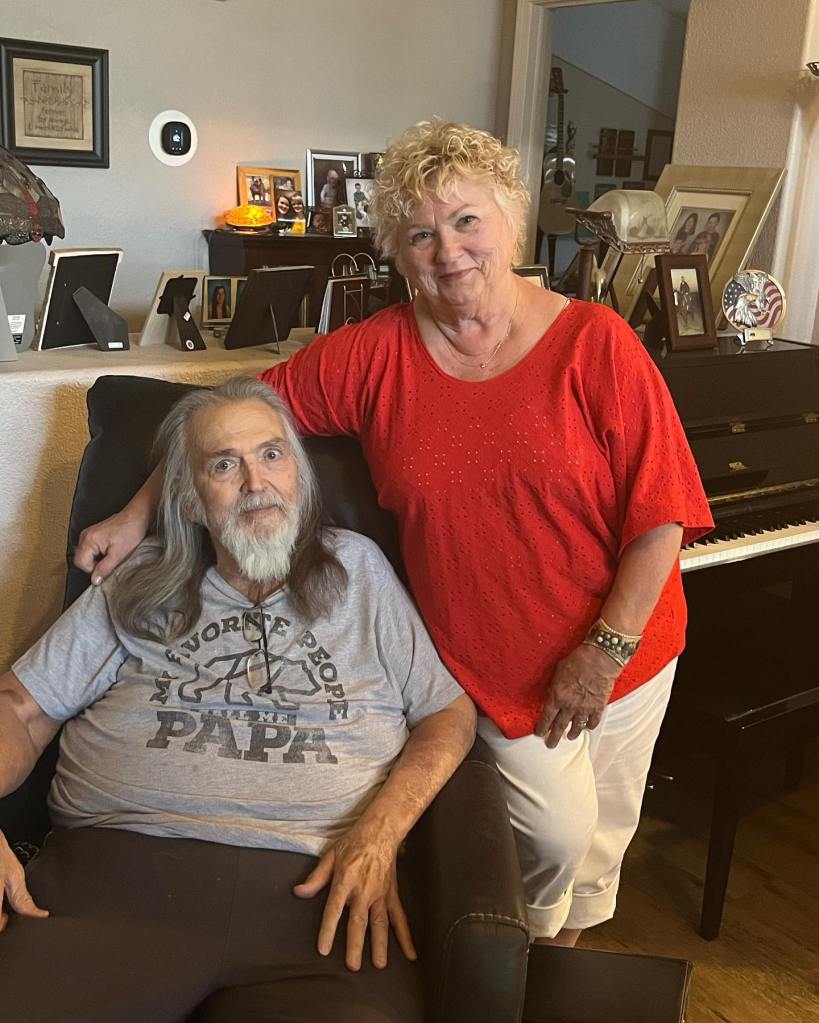
This is the second year we honor my brother, Denny. He was named for our Uncle Dennis Smallwood, who was killed on Iwo Jima. Today, we memorialize all those who died in service to their country.

Back in 1967, my brother’s number was up. Yes, young men’s lives were auctioned off by chance. But Denny held a religious deferment as he declared he would be a Christian minister.

Some months passed, and my father initiated a severe conversation with his son. Was he serious about becoming a minister? If not, was he being truthful with the Draft Board? Denny joined the Marine Corps.

I held nothing in my mind as to what each of them thought at the time. I wonder now if Dad ever regretted that conversation or if Denny would have reacted differently had Dad not challenged him.

Here was a guy who gave all of his body and mind in Vietnam and came home to deal with that loss. He built a radio station there and had a show. He counted bodies. He sent out endless letters as a public relations soldier. He led his men on countless patrols, and too often, he returned to base without some of them. And while he was out in the jungle-like terrain, the U.S. Military sprayed a killer defoliant. It was called Agent Orange. Denny got some of it.

Back at home, he was sent to Hawaii and then Arizona to serve as a recruiter. I never understood how he could do that. One time, when he was telling stories, he asked me, “Can you imagine being so scared that you literally climbed into your helmet? That’s what all of us felt.” It’s still a mystery to me why anyone would volunteer when there was a good chance they’d wind up in horrible conditions with guns pointed at them.

After he left the Corps, Denny suffered physically and sometimes mentally. He met periodically with a psychiatrist.

Denny was poisoned by his own country. He developed tumors in his back. He was born with only one kidney, and that one failed. He developed 5-minute seizures. I know his wife, Bev, could furnish a longer list. He spent half of his life in a wheelchair, one he could maneuver around in. In the end, he developed cancer of the esophagus, and it was untreatable.

The Veterans Hospital in Reno was semi-good to Denny. Often, they sent him to other, more suitable hospitals for treatment not available at the VA. Bev fought the bureaucracy with bear-like fervor to get him the care he needed–and deserved. She was strapped to help load him and his chair into an ill-fitted van, put him in his chair, help him to the toilet and back, and act as his 24/7 caregiver. Was she able? Not entirely, but she did it anyway.

A few months before Denny made the choice to discontinue dialysis and die, the VA declared him 100% disabled.

It took dying to get it done. Today, my brother is on my mind. He gave all.

Day 2: Not as bad.

It’s not over, but it is better. The fever is gone. The body aches have subsided for the most part. The headache is much improved, although the full, foggy head is still around. I’m eating broccoli salad for breakfast. Now to get the coughing to subside.

I was already having some trouble with my asthma, warranting a visit with the pulmonologist week before last. I had a televisit with my primary care physician yesterday. We talked mainly about the anti-viral drug. It has several side effects that I don’t like. She prescribed it, and if the symptoms should suddenly worsen, I’ll take it later today. I feel like my body can deal with this mild case.

The pulmonologist had a few better ideas. Use the nebulizer. Use the rescue inhaler. Lie on my belly for 30 minutes several times during the day. Evidently, that helps the lung tissue on the back. Huh. And then she told me to take some Vitamin D, some zinc, and Vitamin C. Increase the aspirin dosage to 325.

I think about all those people who had a real case of this cruel virus, so bad that millions died. I’m in the compromised bunch, and I am so thankful that President Trump spurred a quick development of the vaccine.

I’ll do everything they tell me to do. No one told me not to work, so it’s back to packing (and unpacking) a few more things.

From the Compound On the Ravine to…

A Cottage…

On a (Smaller) Ravine.

We didn’t intend to move this soon after Mom’s passing, but then this house popped up and three other family members and our realtor saw it just about the time Dave and I saw it (they were searching) and everybody thought it was the perfect house for us!

It was quite the deal but we closed on September 19, and now we’re packing and moving. Packing and moving are now “quite the deal” since we are not taking everything and there is an estate sale in November. Staging the house for sale and preparing for an estate sale are two entirely different things that shouldn’t happen simultaneously.

But we’re known for some chaos.

We’ll tell you more later. There’s so much more to say.

Waiting for Wild Horses

I am healing in this most gracious Airbnb in Fernley, Nevada. My brother lives here, but we hadn’t seen each other in three years. I brought some of Mom’s ashes. Denny says they’ll be buried with him.

I’m not sure what kind of restoration I need, but I think I’m receiving it here. I haven’t wept yet, but I’ve wandered around in some sort of a brain fog for weeks, and sometimes I can see a black hole on the right side of my body. The hole travels with me when I’m walking.

Toni, my host, lives in this 1100-square-foot house on a tiny plot of land here in the desert, but she is a Master Gardener, so she has a front lawn and back and flowers everywhere. She offers her master bedroom as a rest for the weary, a quiet oasis where love abounds and healing is possible. She is a joyful provider of shortbread cookies, muffins, and so many goodies I can’t name them all. She runs a not-for-profit (a real one that makes no money) to feed about eighty seniors in this small town. She used to cast movies and videos with some big names, and I bet she was good at it, but she seems so happy with this life of hers that her grace is contagious.

The kitchen is a bright, cool place to be in the mornings. I open the back door for more light and (dry) air. The same little lizard suns on the privacy fence every day. There is a wide easement beyond that fence where wild horses and one donkey appear every morning. I haven’t seen them yet, but I’ve been watching. One time a few years ago, I saw some wild horses on the drive from Reno to Fernley.

So many familiar reminders have appeared since I arrived. I saw a woman in the grocery store with a huge windcatcher tattoo wrapped around her arm, just like one of the seven Mom attached to her walker handles. At Toni’s house, little things keep popping up: a small, decorative screen door like one I bought (and don’t know if I even still have it), the flour sack towels, a hat that is so much like one that Dad wore in the garden (it took my breath away), a bird print outdoor pillow that is the same fabric I have folded up in a drawer, the identical taupe checked fabric of my bedroom curtains on the dining chairs. The sunflowers.

Oh, there’s more. The one that made me laugh is the bubble gum machine. Jade and John had one. It was just like Toni’s except theirs was red. The story that goes with that one has to do with a certain twelve-year-old son renting out his Dad’s Playboys and stashing the money in the bottom of the bubble gum machine. I only found out about that about thirty years later.

My rental Nissan Rogue sports Tennessee plates. When I arrived at Toni’s house, she was watching the last Hallmark movie I watched with Mom. I didn’t notice the Tennessee license plates until Bev mentioned it. Toni later told me she thought, “Surely that woman did not drive here from Tennessee!” And in Wal-Mart in Fernley, NV, a shirt with Nashville on the front!

We’re having a family gathering tomorrow. Denny, Bev, their children Jim, Angie, Jena, and their grandchildren. I’m not sure who else might be invited, but it’s going to be a large occasion with Olive Garden food, music from the great-grands, and lots of stories! Jim’s wife and the greats will choose which pieces of Mom’s jewelry they would like from a large cache I brought with me, except for Angie–she gets Mom’s wedding rings. Bev got to choose last night.

Mom died peacefully in her sleep on June 24 after a one-month illness. Tomorrow marks one month out. It’s too soon to expect too much restoration on my part, but I feel something working.

I thought Toni said I should look for the horses between 6:00 and 9:00 a.m. (Huh. Duh. Brain fog.) This morning, when I told her I was still watching for them, she said no, it’s between 4:00 and 6:00.

We don’t have wild horses in Tennessee. I’ve set an alarm for tomorrow at 4:00 a.m. It’s almost 11:00 a.m., and my little lizard is still sunning and running from one rail to the other, and I need to shower and get to my brother’s house.

But tomorrow morning, I’ll be waiting for wild horses.

No wild horses yet.

The Space Between

THE SPACE BETWEEN

sumos quo sumos

-Lake Woebegone Official Motto

LARRY RICHARDSON
They say, (the people who know), 
the universe is mostly space. 
An empty place. 
Furthermore, these people who know 
insist that the same is true 
for me and you. 

We are all, it seems, 
just lots of nothing 
between tiny bits of solid stuff, 
just barely enough 
to hold us all somewhat together and,
to the world, make it appear 
that we are here. 

But this one thing I think I know for sure: 
a person needs a God to know 
and room to grow. 
And one place where there’s God and room,  
from everything I’ve seen, 
is the space between. 

Larry Richardson

Physical Therapists came yesterday to get Mom to stand and transfer to the reclining chair. The goals for her care have been the same for several days now. They are written on the dry erase board.

  1. Keep systolic blood pressure under 180.
  2. Increase awareness.
  3. Decrease oxygen demands.
  4. Out of bed.

The two therapists aimed at Goal #4. When they asked if she wanted to get out of the bed for a while (the orders are for two hours,) Mom said “No.” When coaxed about three times, and asked if she would help them get her up, she said, “Okay.” She helped to swing her legs around off the bed, and the female therapist said, “Well, look at you! And you’ve got a pretty pedicure, too!” When each therapist linked an elbow to each of Mom’s for support, she tried to push herself up with her hands, one of which is laden with IV needles and tubes. She got up, sort of, but she had no strength to turn herself to the near right to sit on the chair.

After the third try, they put her back in bed. She bent her knees on command and helped them scoot her up in the bed. Then they adjusted this fancy bed to simulate a chair.

She fell asleep as soon as they left the room. When her head bent dramatically to her shoulder, I lifted her head and re-positioned her pillow to make a support.

I wondered, What are we doing here? And then I thought, She really needs to be at home.

This morning, two nurses used the fancy lift in the room to move her to a chair. That machine is amazing! She ate five spoonfuls of oatmeal, drank half a cup of milk, and has been sleeping ever since. The breakfast tray sent earlier was not touched. At lunch, she tried to drink V-8 juice, but it didn’t taste right to her.

Getting her to eat is not one of the goals, even though she eats very little. I’m pretty sure I can prepare food that she won’t eat as well as the hospital does. (I threw that little funny in to make sure we see a little humor.)

The plan is to move her upstairs to what I have always called a step-down unit, a section of the hospital for those moving from ICU to regular hospital rooms or skilled nursing facilities. The criteria for that move is when she is medically able. While she is there, the caseworkers might usually plan for her move to a rehabilitation center. That is not going to happen, the move to a rehabilitation center. I’ve put that out there for everyone.

This morning, watching Mom sound asleep, crumpled in the bed, vulnerable to whatever treatment she receives and whatever is going on around her, I know she needs to be at home, in her own familiar bedroom, with Dixie, Dave, and Neil, and normal routines. (Well, “normal” for the Compound residents might not look normal, but it’s our normal.) We can plan for Home Healthcare, and we will provide true care at home.

She is more lucid than she has been, and she understands a lot of what I tell her, but she is still not completely in the real world. Or maybe it’s that she is in her world, and who’s to say that’s not the real world.

Now I wonder if she will ever be medically able to leave the ICU and at what point the doctor says, “Okay, I give up.” A nurse told me, “They don’t do that. They just keep trying different things.” Her awareness has increased. Her oxygen demands have been met and could continue at home. She’s helped out of bed each day. But there’s that first goal: If she did not have the high-powered drugs delivered by the needle in her arm, she would stroke within hours.

Today, three nurses tried twice each to start a new IV. Mom’s veins are fragile. I asked, “Okay, what’s the next step?”

A pretty blonde nurse answered, “We call in the professionals, the IV therapists.”

About thirty minutes later, a tiny woman appeared with gear in hand. She looked experienced. I asked if I could watch. On the first try, she couldn’t get the IV in, but on the second try (in the other arm), she made a perfect deep stick and entry. I learned a bit and was glad she let me watch, but that’s not really what I want to look at. I hope I never see another needle in Mom’s arm.

I like to picture Mama sleeping in a gauzy forest bed of flowers between two white veils. Through one of the semi-sheer curtains, she sees and feels the comfortable life in her apartment in the Compound and the beauty of all the blooms and foliage right now outside her kitchen window. Dixie runs over to lie in her lap every morning. Dave cares for her as he would his own mom. Neil fixes things and makes her laugh. I’m always there for her. She drinks orange Gatorade every morning followed by her favorite homemade mocha, enjoys her lunch from a tray on her lap, and eats sliced strawberries soaked in sweetened milk. Her nightgown is laid out on the bed each evening, along with night underwear and hospital socks.

Behind the other veil, there is a beckoning Bright Light, so bright that the semi-transparent drape almost disappears. At some point, the Love in that Light will become irresistible. The soul will make her choice.

At the end of this day, I watch her sleep soundly in her ICU bed. Today, she has fulfilled the requirement of getting out of bed and proven her awareness has increased by remembering her full name and the month she was born every time someone asks. (1931? She doesn’t come up with that.) She receives the oxygen well and is not struggling to breathe.

Her blood pressure spikes again and a nurse starts the IV drip.

I think, for this moment, Mama is warm and happy in the space between.

-0-

How’s your mama’n’em?

Friends frequently ask me, “How’s your mother?”

What I answer depends on who asks.

For relatives and friends with whom I don’t communicate regularly, it’s tempting to say, “Fine.” I can’t see that more explanation would be helpful, certainly not to me. When close friends ask, I try to gauge the amount of time I have to answer. Sometimes I say, “She’s requiring more help now, but her mind is still sharp.” If they have time to listen, and I have a few free minutes, they might click that button that says “Learn more.” Then we engage each other briefly.

I am completely honest with my writing group, The Five Ladies-in-Writing. I know they genuinely require some details. If I haven’t asked myself the question, I sometimes have trouble formulating an answer. That’s how I learned to talk to myself about Mom; I try to speak to her condition, her care, and even my worries about the future near and far.

So, self and caregiver, how’s she doing?

Things are definitely different than a year ago.

Last year, the first time I saw Mom each morning, she was sitting in her recliner in the den. She’d made her bed and emptied her bedside commode. She’d washed herself (showered on Thursday and Sunday), put on clothes and makeup, and coordinated her jewelry to complement her outfit. She’d taken her morning meds and checked her blood pressure and weight. More often than not, she’d be drinking her morning cup of mocha. I’d found an old recipe for Instant Mocha; non-fat dry milk, powdered creamer, Nestle’s Quik or a store brand of chocolate drink mix, instant decaf, and Truvia. The TV would be on Channel 5 so she could watch Gayle King and the boys.

She’d ask what I was cooking that day, and tell me whether she’d like to have some of it. If not, she would cook for herself. She’d remind me of appointments, mine and hers, for the week, and ask me what I was going to get into that day. She’d tell me what she’d put on the grocery list, so far. Dixie would come flying into the room and demand that Mom give her an animal cracker kept on a shelf in a table by Mom’s chair.

After her treats, Dixie would settle into Mom’s lap to get morning loving.

Nowadays our morning usually goes like this. Mom calls me when she wakes. I give her a few minutes, maybe five, to sit on the side of the bed to get herself acclimated to being up. When I get there, she has part of her clothes on, or none. If she hasn’t been in the bathroom to wash, I bring her hot washcloths and towels. Somedays, we clean more than others. Maybe the bed is wet, maybe the rug beside the bed, maybe just her gown. We finish dressing. Sometimes she wears an outfit that is clean that she wore the day before. Sometimes I choose more clothes–and shoes to match. Sufficiently clothed, Mom begins the twenty steps to her dressing room with her walker.

(On shower days, Tuesdays and Thursdays, our routine varies a little. But this story is about all the other days.)

While Mom is making her way to the dressing room, I go the opposite direction through the house, turn on lights and lamps, check the pad I keep on her lift chair (she doesn’t use the lift!), unplug the new motorized wheelchair that she’s yet to master, and retrace my path to her dressing table. Sometimes she is on the vanity stool, more often just beginning to sit.

We begin her beauty routine. She applies cream to her face. I arrange her hair with a plastic pick, making curls around her face and smoothing the back. She loves hairspray and the curling iron when she’s the stylist, but I find that both make her hair brittle so I spray it with some texturizer and tweak it a little. I’ve found the softest eyeshadow pencil that both holds its color and goes on smoothly. She has blue and hazy purple. She chooses the color for the day. She wants eyebrows. I pencil them in with a charcoal pencil. She would like mascara, but the woman has double fur framing her eyes akin to Liz Taylor’s so I’ve convinced her to skip that step. (Actually, she tells me every once in a while that she wants mascara, but I tell her “Oh no, you’re not going to cover up those furry eyelashes! I’ve seen what happens when she applies mascara and I don’t even want to try it.) Lipstick: She needs dark, bright colors. She chooses from several Maybelline New York 24-hour colors. If she is feeling well, she puts it on. If not, I do it. Either way, we are as likely to miss as hit her still perfect natural lipline. I clean the oops with micellar water. She usually applies the gloss.

“Do I have earrings?” she asks. I turn to her bedroom to find a pair to match her outfit. She clips them on. If one is loose, I re-clip it.

“Okay, am I ready to go?”

I answer, “Looks like it to me. You look beautiful.”

While she walks through her dressing room, Dad’s bedroom, and down a short hall to the den, I place her morning pills into a shot glass and pour a glass of Gatorade. I take both to the den and set them on the table beside her chair. I grab her water bottle from her walker seat to exchange it for a clean one full of ice and water.

In her chair, she finds her bottle of probiotic gummies and eats them with her Gatorade, applying eye drops for her glaucoma. I return to her bedroom, empty and sanitize her bedside potty, turn the lights off, and wash my hands in her bathroom.

I ask if she’s ready for her coffee. She still drinks the mocha mix, just wants to call it coffee.

Sometimes I drink my second cup of coffee for the morning. I ask her what she wants for breakfast. She usually wants a shake, but this morning she ate sausage, half a serving of rice pudding, and toast. She drank a glass of milk.

Dave calls to ask if she wants to see Dixie. She always says she does. After Dixie eats a plate of scrambled eggs, two animal crackers, and a small handful of cashews, the two of them begin their daily love-in.

That never changes.

IN the Ravine

FB_IMG_1497710072554

We always knew someone in The Compound would fall in the ravine. Lord knows Dad tried. He decided in 2010 he would cut brush and clean up the vines on the bank; you know, “clear the land.” He devised the perfect way to enter and exit the big ditch. He routinely lowered a tall ladder (a really, really tall one) over the edge of the bank and propped it against a tree on the steep side of the ravine. Before descending, he’d throw all the tools he might need somewhere near the ladder. When he finished with a tool, he reared back and threw the tool onto level ground.

You haven’t really lived–or maybe come so close to dying–as feeling a hatchet whiz by your head while peacefully attending the weeds in the lower garden.

I yelled as soon as I heard the whoosh of the ax. “Dad! You almost got me!”

He shinnied up the ladder, and when he finally saw me, said, “But I didn’t.”

Dad stopped his forays into the ravine a few years ago. I admit I was a bit relieved. He  warned me, “Don’t get too close to that ravine. That ground is soft. You don’t want to fall in.”

The vines returned; Virginia Creeper, Japanese honeysuckle, wintercreeper, and a few muscadines. Brush re-established; same old non-native privet, pokeweed, winterberry, and thistles. We keep them controlled for about two feet off the back yard, what we can easily reach. We’ve also seen a fair assortment of plants whose roots or bulbs Dad tossed over the edge including Rose-of-Sharon, iris, cannas, and a couple berry briars.

This past May, I noticed a bunch of  one- to two-foot Royal Pawlonia sprouts in the area where we’d taken down the tree several years ago. We’ve watched the grounds carefully since the removal of the offender, so I was surprised to see the scary little crop with the pretty purple flowers. Royal Pawlonia, or Princess Tree, is wildly invasive and spews out millions–no, really, I mean millions–of seeds every year. If you want to find out how bad it really is, just look it up in your Wikipedia.

“Dave,” I said, “you’re going to have to spray those little purple trees or we’re going to have hundreds of them full-grown before we know it.”

He chose to fertilize the roses and eradicate the Pawlonia shoots on a Sunday about 1:30. I knew he was tending to roses, but I did not know he’d loaded up a sprayer to kill the tiny trees.

I put on what I call my painting clothes, dug weeds, and had just gone upstairs to Mom and Dad’s apartment to tend to some needs of our old folks when I heard the special tune on the phone.

“Hello, I know it’s you,” I said to Dave.

He answered, “Help, I’ve fallen into the ravine and I can’t get out.”

“What do you want?” I asked my usual first question when he starts with some (lame) humor.

“I want you to come get me out of the ravine.”

“So what are you doing in the ravine?” I chuckled a little.

“I was spraying those purple things.” He blew out hard.

“You’re joking, right?”

His voice gained decibels. “No, I’m not joking. You have to come help me.”

“Well, I’m not…” I started to tell him no way was I going to go in with him. “No, wait, are you hurt?”

“Yes, I’m hurt,” he said.

“I’ll be right there.” I stuck my phone in my pocket and called to Mom in the kitchen, “He’s not kidding. He fell in the ravine.”

I hurried down the steps of the apartment and ran over to the edge of our beloved big ditch. He was lying on the bank in a mostly-vertical position, the spectre enhanced by a bush with little white flowers wreathed around his head. I saw blood.

“Where are you hurt?” I called.

“I don’t know.”

“Do you think you’ve broken anything? A leg? Arm? Shoulder?” I asked.

“I don’t think so, but I can’t get up the bank.”

“Okay, let me just…” I tested three places on the ground above him. All were soft.

“I think we better call 911. I can’t get down there,” I said.

“No, don’t call them. Go get Don.”

I called our next-door neighbor, hoping he’d be home.

When he answered, I asked, “Don, are you at home?”

“Yeah.”

“Dave has fallen in the ravine. We need help.”

All the other times I call him, Dave is headed his way with soup or ham or pie. He could have been disappointed, but he was there in what seemed like two seconds.

“See that stump?” I asked. “He’s just to this side of the stump.”

Don called down to Dave to check his condition. I whispered, “I think he landed on his face. There’s a lot of blood on his face.”

“Have you got a long pole?” he asked.  I don’t know what I gave him, but he told Dave he was lowering the pole. “You grab on and I’ll pull you out.”

Dave struggled to hold to the pole, and when he finally got it in two hands, his feet gave way to the slippery slope.

Don turned to me. “I’m going down.”

“No, don’t do that,” I said. “Then I’d just have two of you down there. Dad used to go up and down on a tall ladder. Maybe we should try that.”

“That’s right. Where’s the ladder?” he asked.

“Propped against the side of the garage over there.” I pointed. “I’ll help you.”

“I don’t need any help. I can get it,” Don said, but I still followed a few steps behind him. He picked up the ladder. We stopped at the edge and looked down. “I don’t see anything to prop it against.”

“What’s wrong with that stump he just face-planted?” I asked.

“Dave, I’m lowering the ladder right next to you. Do you think you can get on it if I prop it on that stump?” Don asked.

“Maybe,” Dave answered.

After two unsuccessful attempts Don said, “He can’t get his feet on the ladder.”

“I’ll go down on the ladder and pull him onto it,” I said.

Don was quick to stop me. “No, then I’d just have the two of YOU down there. I’ll go down.”

“I’m on the ladder,” Dave yelled.

“Did you get on it? Can you climb it?” Don asked.

At the top of the ravine, Don grabbed Dave and pulled him up.

“Thanks, Don.  Dave, honey, come on, get in the van. We’re headed for the ER.”

He staggered after me in the garage. I threw a towel in the passenger seat for him to sit on.

Southern Hills Hospital is a mile and a half from us. We were there bloody, muddy, and generally nasty but triaged and in a bay in no time.

I looked at my watch. 4:30. My friend Peggy and I had a Lyft scheduled at 6:00 to take us to Schermerhorn Symphony Center to see PostModern Jukebox. This was the second time I’d bought tickets to PMJ. The first time I was ill and, even though I tried, no one used the tickets. The current set of tickets was a birthday gift to my friend and I had already reneged on another trip (another story) so I was determined. (I’m trying to pre-explain why I did what I did later.)

I messaged Peggy. Dave is in the ER. Fell in ravine.

Peggy:  Is he hurt?

Me: I don’t think it’s too bad. I mean, he’s bloody and all that, but the doctor ordered x-rays and CT. They just came and took him to x-ray. He’s got a big gash on his face.

She asked more questions about his condition and then finished with No way we can get to the Schermerhorn on time. 

I was quick. We’re going to see PostModern Jukebox.

Peggy:  I’m dressed. I’ll wait until you tell me to leave home. The drive from Readyville to our house is about forty-five minutes.

After the CT scan, I was relieved to know that all Dave needed was a few stitches across one side of his face–the side that hit the stump. (He’d already started planning a story about how he got the scar in a bar, his favorite tale, something about defending my honor.)

I messaged Peggy. We’re going to go to the concert.

Peggy: But you’re not dressed. Didn’t you say you had to get in the shower?

Me: I can make do. I’ll hurry. I’m going to call Darrin (Dave’s son–mine, too). I should have already called him. 

I messaged the whole story to Darrin and Dana, ending with, “So can you come and pick up Dave and take him home? They’re about to sew up his face and I’ve got tickets to PMJ.” I knew Darrin the Drummer would understand.

I turned to Dave.  “Honey, do you think it would be okay for me to go home, get dressed, and go to the concert?”

“Sure,” he said, “but you’ll need to bring me a vehicle so I can drive home. Maybe Peggy could bring me the van while you get dressed.” He really hadn’t thought that she’d need to get back to our house somehow.

Peggy answered my earlier text. I don’t see how.

Me: Come on, we’ll figure it out. 

I received a return message from Dana. Darrin is on a plane. (He travels for work.) Do you think it would be okay for me to bring Evan with me? Evan is their very active three-year-old.

I wouldn’t, I answered. What if you just came and picked him up? He can call you when he’s ready.

“Is that okay, honey?” I asked Dave.

“Sure,” he said.

She called. “I can pick him up. Tell him to call me and Evan and I will come and get him. I’ll stay with him for a while to make sure he’s okay.”

I told her I needed to leave like, right now, and to text me when she got Dave home. She told me to go on and have a good time.

At home, I threw off my filthy pants and shirt, washed my face and reapplied deodorant, sprayed some dry-cleaner on my hair followed by a some fluffing, and found some clothes decent enough to wear. At least I think they were decent enough.

Peggy yelled “I’m here” when she came in the door.

I was still in the bathroom. “You have to take Dave’s wallet to him.” I rushed to the bureau where he kept his wallet.

“To the emergency room?” she asked.

“Yes,” I said, handing it to her.

While she was gone, I had plenty of time to smear some makeup around and grab earrings. It wasn’t my regular routine, but I declared it finished.

In the Lyft vehicle, I looked down to see that my feet looked like they were still in the dirt. I had two wipes in my purse and used both of them. My feet weren’t perfect but they were “better than they were,” one of Dave’s favorite sayings.

***

We arrived at the Schermerhorn just in time.

I checked messages every few minutes. No word from Dana. Finally, I texted her to ask how things went. She thought she had already messaged me. She said things went fine except… Oh my god Diana he looked like an ax murderer.

2018-04-29 16.15.06

What a show, what a show! PMJ was all I thought they should be and more. At one point, I gave thanks for Dad’s ravine trips up and down the ladder, for Dave’s willingness  to allow me to abandon him in his hour of need (he really wasn’t that bad off, okay?), for Dana’s pickup and delivery, but especially for my man’s survival with less-than-could-have-been injuries.

So, maybe the thanksgiving was after the concert when I got home to see him sitting in his recliner watching one of his favorite shows.

“I got all but about two of those little purple things,” he said.

I love that man.

***


The Last Best Place on Earth

For Dad, it’s Alive Hospice, Murfreesboro, Tennessee.

The Nashville facility was full and the admissions nurse so determined that Dad needed to be there that she sent him to the Murfreesboro campus at midnight Friday.

Daddy rests in a large room halfway between the nurse’s desk and a family room containing comfortable chairs, recliners, and couches that flip into beds. There are several family rooms here, one with a dining area in front of a wall full of windows. The light streams in as if on cue.

In Dad’s room, we keep the lights dim. The room is quiet and peaceful; so is Dad.

He only stayed at the skilled nursing facility less than two days. We knew it was not the place for him, and when his kidneys began to fail Friday, the attending nurse practitioner recommended an immediate move.

With the help of the SNF’s social workers and nurses, Alive Hospice Nurse Gail ordered an ambulance for 11:00 P.M. They arrived at 11:45, two youngsters in ball caps reading Medic One.

“I’ll be riding in the back with him,” the smaller one said. “I see his diagnosis here is dementia. Has he ever become combative or kicked or punched a nurse or tech?”

I hesitated. “Yes, he did at the hospital, but that was when he was in complete psychosis. He’s not doing that now.”

“Well, I just wanted to let you know that if that happens….”

Big Guy butted in. “No, no,” he told his sidekick. “If something happens, you just let me know and I’ll pull over to the side of the road and come back there to help you get him calmed. We want to be very soft…soft.”

I could actually imagine a scene like that.

I left before the ambulance. The ramp to I-440 was closed, probably because of a fatal accident earlier in the day, but when I turned around to go the opposite direction, there were cars making left turns onto the interstate so I followed them.

I met Shirley, the night charge nurse, the techs, and the front door security guard. Shirley went over the care plan, medications that they’d be using, and ways they operate. She said the doctor would see me on Saturday. I told her it was already Saturday.

A nurse stuck her head in the room. “I am wondering what is taking that transport so long. Did you leave a long time before they did?”

“No, I was right in front of them, but I bet they got to that closed ramp and found another route.”

Turns out, that’s exactly what happened. They were automatically re-routed.

Dad was awake. Shirley explained what was happening.

“Ernie, we’re going to give you some pain medication and then we’ll give you a bath first thing and get you all freshened up.”

Two techs and two nurses busied themselves over him. He talked to them in slurred speech and from an altered state, but they caught about every third sentence.

“You are a handsome man,” one said. Another asked him about his 72-year marriage. “What’s the secret?” she asked.

“Let each other be free to grow and develop” is what we think we heard. I confirmed that he might have said that.

Then came the washing of the private parts.

“Ernie, we are going to have to wash you down there. Normally, we’d just let you do it, but you have some leftover bm there and we want you to be clean, okay?”

“Ah, you girls just want to look at me,” he said. “All the time.”

We all laughed at him.

“No, we don’t, but I’m going to raise your gown and clean you up and then we’ll put a fresh pad and gown on you.”

He picked up a towel a tech had left beside him. “Then I’m just going to put this over my face,” he said, and hid his whole head from the offending eyes.

We laughed some more, but they got him cleaned up and bundled up in his new bed.

***

Dad now gets a pretty stiff cocktail of haldol, morphine, and a valium-like drug. The dosage is small but repeatable. If he is not calm twenty minutes after the last offering, the nurse starts the routine again, or she slightly increases the morphine.

He lies quiet in the bed most of the time but when the meds start to wear off, he twists, grimaces, and mumbles.

The grandsons and families came to visit yesterday, including Jaxton and Savannah, ages 5 and 3. Neither was upset by Grandpa’s condition. Savvy said hi to him several times, anxious to get an answer from him.  Mom was glad to see the little ones.

I stayed last night. I played music to him and sang to him, hoping something might connect. In the middle of the night, I heard him say, “Diana.” I wasn’t sure of that until I sat up and waited for him to call me again. It’s like what happens when you try to say my name without being able to move the tongue.

“Lie-ah-uh,” it sounds like.

“What, Dad? What do you need?”

He grasps my hand. I kiss him on his old bald head.

“You’re in a really good place,” I tell him.


Trying hard to leave.

My daddy hovers, sometimes thrashes, naked, his mind somewhere along an invisible jagged line between his tiny spot of time and space on earth and the ultimate reality of Infinity.

His heart beats so fast sometimes that we fear stroke. Doctors get his heart rate down and his blood pressure goes up. Get the blood pressure down too low and some other wheel falls off the old bus.

He fell in his bedroom sometime very early a week ago Tuesday morning. Before we found him on the floor with a bloody gash on his head,  he’d pulled shirts, belts, and a bootjack from his closet. He told us he’d ducked into a shed for shelter from the rain and realized he’d stepped into some man’s corn crib. Then he couldn’t get out of the field and had crawled through rough straw for miles.

Dad did not get confused because he fell; he fell because he was already confused in the night and hallucinating. We’ve seen a slow slide toward dementia for about three years, but since last Christmas the disease has tracked him like a cat, consistently and with increasing speed. We’ve watched a wretched auto-immune disease rob him of the ability to enjoy food and then to swallow well. His legs grew weaker and weaker, so often he could not stand, even with his walker.

In the emergency room after the fall, he fought with three cats, two black and one black and white, that kept pouncing on the bed. Every time he kicked them off, they came back.  I shooed them away. He re-told the corn crib story with variations and repeated an earlier adventure stripping tobacco with two youngsters who would not talk to him. He was pretty sure they could talk, they just wouldn’t. The ER physician called a hospitalist to provide overnight observation.

Once in the room on the fifth floor tests began, including an ultra-sound on his legs. The technician came in Wednesday morning, made it through the scan of one leg and then Dad refused. He kicked at the machine operator. She dodged and moved the equipment. He kicked some more. When nurses arrived to rescue the tech, he doubled his fists and slapped at them.

I said, “I don’t think you’re going to get that next one.”

She smiled and said, “I’m pretty sure of that.”

Within a few hours, the a-fib grew worse and Dad grew so wild and combative I wished for restraints. They came quickly. He did not sleep–not one wink-– for four days.  One night, I bent over to pick something up just under the edge of his bed and even though his hands were tied, he grabbed my hair. It took a few minutes to pry his hand loose.

My dad’s wild mind fashioned a scary story with escalating horror. He gave me the base plot as he dressed me down. I was trying to kill him, leading a band of nurses are my followers. He kept saying that he can’t believe I would do this for money.  “Greed. Evil. You are no daughter of mine.” I stood stark still, as if at attention, stung and disoriented. The words might have attached themselves to a deep sorrow if I hadn’t heard a voice. “This is not your dad.”

For several hours, there was a huge farm machine loose on his farm. We–the nurses, Jade, John, and I–had already destroyed the farm with this wrecker/excavator. We knocked down trees and ran through the shallow creek, breaking the flat limestone into small pieces. We were going to let it run over him, and then it was somehow above him and we were preparing to let it fall to crush him. One hour we were setting him afire. Another time, we were trying to poison him.

He disowned me, then started yelling again. I tried to slip a dry mouth lozenge in his mouth but I wasn’t quick enough. He can’t bite since he has no teeth but he clamped his jaws shut, turtle tight. Then he said to the air on his left, “Jameson, look at your mother. This is the kind of mama you have.” Jameson is my grandson, not my grandson, and he is safe at home in his own bed.

Dad got back to serious yelling. “Where is Mom [my mother]? She’s the only good person around here.”

The student nurse asked, “Does he like music?”

“Yes!” I said. “I can’t believe I haven’t thought of that. I should have brought in a player. There’s no music channel on the TV.”

Wait, I thought. I could stream from my laptop.

I grabbed my almost-dead HP from my bag and began the frustrating process of hooking up to the hospital free-for-visitors wi-fi. It’s a finicky network. I spent twenty minutes and then gave up.

Dad changed the venue. “Help! Come on, we’re down here in the bottom by the creek. They’re trying to crucify us all.”

The last time he had mentioned crucifixion, the nurses were attaching restraints. I watched him pull at the cords and thought of rodeos and roped calves. I remembered a pig bound and hung for slaughter at my grandfather’s farm, and of holding my dog Murphy for an injection.

That night, I left him praying. The words were plain and the sentences cohesive. “Lord, thank you for this life I’ve been given. And if you want me to die now, I’ll come. I ask you to forgive Diana and all these evil persons who are doing this to me. They know not what they do. Take care of their little children.” I walked out of the room, on down the long hall to the parking garage.

The next time, he was on the hill at the farm in Smith County. He called for his mother. “Mama, come on here. I’m up on the hill. They’re about to kill your last son. Don’t you see the smoke?”

He did not remember that seventy-two years ago on the same day, Halloween, he and my mother took a long taxi ride to Georgia and married. He was seventeen, she “fourteen-almost-fifteen,” they said.

My mom waits at home, not really worrying, just pondering. She is dressed in blue matching pants and top, her curly hair neatly combed back, and her ensemble accessorized with the usual rings, earrings, bracelet, and necklace.

After two days and several doses of psychiatric drugs, the restraints were removed. He was still agitated but not trying to hurt anyone. He rolled his sheet and blanket into a wad and tossed them to the floor. He pulled his arms through his gown, easing the heart monitor through a sleeve. The gown and a couple Chux pads found the floor. I heard a pop, pop, pop as he removed the leads to the heart monitor. He seemed pleased that he had wires to untwist. He repeated the process several times.

He slid down the bed and pounded the foot rail in a surprisingly steady rhythm. He called for my mother, yelling louder than he’s been able to in years.

I told him, “Dad, Mom is not here.”

Sometimes, for a minute or two, he believed me when I told him, “You’re in the hospital, Dad.”

“In the hospital? What am I doing here?”

I told him, “You have to stay for a while until you get better, and you are getting better.”

“Am I in South Carthage?”

“No, Dad, you’re in Nashville. At St. Thomas.”

At times, it connected and he said,  “Oh-h-h-h-h-h.” Another time he added, nodding his head, “So that’s the problem!”

One afternoon, he asked, “Did you know the cats are back?”

“No,” I said. “What are they doing?”

“Oh, they’re just lying around down there at the foot of the bed.”

I said, “But you’re not trying to kick them off.”

“No, I got used to them.”

From time to time, the psychiatrist Dr. Le Coguic stuck her head in the room to ask a few questions with telling answers.

She: What year is it, Mr. Blair? He: 2017. She: When were you born? He: Five, twenty-nine, no. Five, nine, no. Twenty-five. She: That’s good enough! Now who’s the President? He: Truman. She: Hmmmmm.

I snuck in a word there. “He really knows. I asked him myself yesterday and he said Truman and I said, ‘No, it’s Trump, Dad,’ and he said, ‘Yes, that’s who I mean so just pretend I’m saying Trump when I say Truman.'”

Dr. Le Coguic laughs out loud. “Good enough!” she said.

The next time she asked him, he said, “Oh, that damn Trump. Truman.”

The morning of November 7, I walked into the room where a soft-spoken chaplain introduced herself to me as Gail. She was asking Dad if he was a spiritual person. She didn’t understand him, but he answered her, “I suppose so. I’ve got a Master’s of Divinity from seminary.” I translated a few sentences to her until Dr. Chris MacMurdro from the Palliative Care Department stepped in. Because Dad was still talking with Gail, Dr. Mac asked if we might step down the hall to talk.

“Call me Dr. Mac or Chris,” she said and explained her specialty.  After several minutes of discussion about what I might expect or anticipate or decide, Dr. Mac told me with his refusal to eat or drink, Dad would likely be gone in two weeks. It’s too early for hospice, she said, but you will need them. If Dad goes to a skilled nursing facility, he might get a few days.

Just as Dr. Mac and I were ending our conversation, Gail approaches us from the doorway of the family waiting room. “Your dad,” she said, and placed her hand over her heart. “Oh my. And thank you for helping me understand what he was saying. I could understand him after that.”

“Good,” I said.

“This is the first time a patient has prayed over me,” she said.

“He did?” I asked.

She teared up. “I asked him if he would like me to pray with him, and he took my hands and said, ‘I’ll pray for you.'”

“And he did?” I said.

“Yes, and now I have to go sit down somewhere and cry.”

***

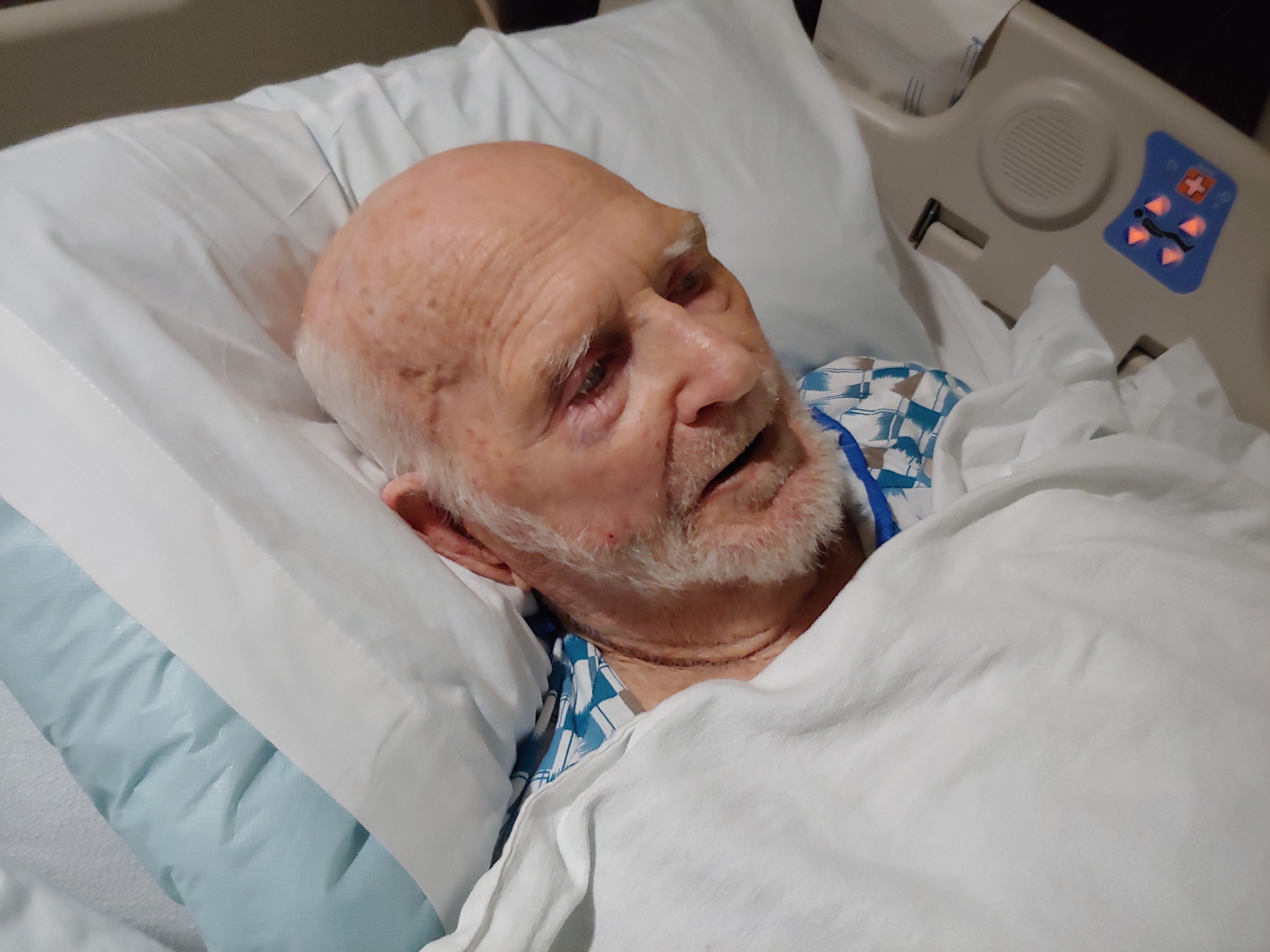
1105181807a
Still a small smile.

Later that day, when I told Dr. Mac the evening Zyprexa seemed to make Dad more agitated instead of less as it was supposed to do, she wanted to revisit his history of hallucinations and his increasingly weak legs. “Let me go back and look at his chart again,” she said. “I’ll call you back.”

“Dad,” I said, “would you drink one of your protein shakes? I have a cooler over here with three drinks in it. Which one–chocolate or vanilla?”

His eyes lit up a little. “Chocolate!”

I rolled the bed up and offered him the straw in the bottle. He tried to take the bottle.

“I want to drink it. Myself.”

“Well, okay.” I grabbed some Chux pads and tucked one around the top half of his body. I helped him hold the drink, with him struggling to wrest it from me, until I knew he’d had enough that he wouldn’t immediately pour the stuff all over himself.

He drank almost all of the eight ounces. He drank almost ALL of the EIGHT OUNCES, the most food of any kind he’d had since more than a week ago. 

Dr. Mac called.  “Diana, this is not Alzheimer’s. I’m thinking more like Parkinson’s with Lewy bodies. That would explain the reaction to the Zyprexa. Do you know much about Parkinson’s?”

“Enough. A lot,” I said.

She said he wanted to confer with the hospitalist, Dr. Meadors, about switching him over to something like Valium, which would be much more effective if we were treating Parkinson’s.

Sure enough, the Valium (or whatever it was) helped calm him. Dr. Mac called to say that Dad appeared now to qualify for in-patient hospice, and she had arranged a meeting with Rosie from Alive Hospice downtown. She explained her wish for inpatient hospice.

“The Parkinson’s thought changes everything. His medications seem to be headed in the right direction. He could use the meds management at inpatient to get them all tweaked to the point that you could manage him at home with the help of home hospice.” She fears for my ability to physically manage him at home right now and for my mother’s emotional health as she watches Dad decline.

I made her promise that she will always work toward our goal of getting him home. She repeats to me all the information I’ve given her, including the DNR and comfort care directives.

End of day, Wednesday, November 7.  Dad slept peacefully almost all night.

Yesterday morning, he knew me when I arrived. He smiled and said, “Hello, honey.” Dr. Mac called to discuss the latest strategy since he has improved enough that he probably does not qualify for inpatient hospice. “We’re thinking we can send him over to the rehab facility.”

Dad and I sat in quiet most of the day yesterday. He was tired. He thought he might want sausage and eggs. I tried. He drank a bit of milk shake. I tried again. I massaged his aching hands with cream, swabbed his gums and washed out his mouth.

“You’re going to make me bald,” he said when I rubbed his head. That’s a little joke we have. Not long after that, we both dozed at the same time.

When I told him I was leaving for the day, he said, “Be careful driving home. Is it still raining?”

I said, “No.” It did not rain all day yesterday.

Just as I started to exit the room, he called softly but firmly, “You are going to call Red Blair to help you get that big machine off the hill, aren’t you?”

“I sure will,” I promised.

*****