
Irritation and Ablation

Some things irritate me so much I feel skin pulling loose from my bones. This is an asthma story. It may bore you. I’m sorry it’s so long. Don’t let it irritate you.

I’ve visited allergists and specialists so many times. When I was in high school–Go, Pirates!– my mother took me to my doctor because I kept breaking out in hives. One time, the cause seemed to be canned ham. (Remember canned ham? In my younger years, I sent one to every friend or family funeral.) Next, it was green beans from a can. Really?

The doctor(s) finally concluded it was, indeed, a food allergy, but could never pin it to one food. Maybe it was something used in the canning process of meat and vegetables.

Looking back, I wonder if it could have been stress. The doctors asked my mother if I was upset about anything. She said no. She didn’t ask if my algebra teacher, Sullenberg, could have finally irritated me so much that I developed red bumps all over, from my scalp to the soles of my feet.

The hives case seemed to just go away when I moved from 11th grade to 12th grade and no longer had to deal with the mathematical chaos in my brain. No algebra, no geometry, no calculus, and, thank the heavens, no trigonometry, even though the recommendation for academic students was to study trigonometry. Or was it calculus?

As a young mother, I was a magnet for contact dermatitis, the kind that peels off layers until there’s blood. On my physician’s advice, I was to wear gloves all the time, especially when peeling potatoes or changing the bed linens. (Yes, really.) I’d already begun to wear brightly colored latex when washing dishes, so I grabbed them every time I touched root vegetables or washed the sheets. But my hands were still so raw that the FBI could not have lifted a thumbprint.

The next doctor advised that I was probably reacting to the wet latex when moisture leaked through the lining of the gloves. He ordered some neoprene gloves. They were vast and magical, lined with a knit cotton and wouldn’t let anything seep through to my hands, but I couldn’t master changing sheets or peeling a spud.

He also sent me to the radiologist to have X-ray treatments on my palms and the inside of my fingers twice a week. Those were the cure. I never had contact dermatitis again after ten treatments. Now, AI tells me that X-ray is not the first-line treatment for contact dermatitis and is even considered to be highly ineffective.

Then, one day much later, the hives reappeared. The doctor gave me Valium that I took once a day, every day, even through my pregnancy with my second son and a couple of years after, until the experts decided we really shouldn’t be taking Valium.

The hives were gone, really gone, until my sons were in fifth and eighth grades and I was in a marriage gone to Hades and smoking like I was already in hell. I kept telling my doctor that Valium did the trick some years before, and he said, “Oh, I bet it did!” (He wouldn’t let me take even a smidgen of Valium.)

This time it was Elavil, but I was only to take it when I felt hives coming on. It worked, but it also knocked me out for two or three hours, which was highly unpopular in my profession. That would have been the case in any sort of work, I would guess.

More than once, my assistant would knock on my door to check on me, only to find me with a throw pillow under my head on the desk, bleary-eyed and drooling. I learned later that Elavil is an antidepressant sometimes given for headaches. My mother suffered from migraine headaches and was prescribed Elavil in the 1960s.

Years later, after the second divorce and marriage to Dave, I contracted a virulent case of bronchitis. I coughed and wheezed for weeks, until a doctor I worked with said, “Diana, you’ve got asthma.”

I said, “Surely not, at my age.”

He assured me that he’d seen several cases of adult asthma and referred me to a pulmonary specialist at Vanderbilt, one Elizabeth Willers.

“Yes,” she said, “this is cough variant asthma. The first thing we need to do is send you to ASAP to find your allergies.” ASAP is the Allergy, Sinus, and Asthma Program, operated by Vanderbilt.

I said, “I don’t think I’m allergic to anything.”

Dr. Willers answered, “You’re allergic to something or you wouldn’t have asthma.”

The testing involved tiny pricks on the inside of my arms with various allergens. After testing, I reviewed my results with a Nurse Practitioner.

“Good news and bad news,” the woman said. “The closest you come to an allergic reaction on this test is cat hair, and your reaction was not very high on that, certainly not high enough to be called an allergy.”

“Cat hair,” I said. “I’m not close to any cats.”

She nodded. “So you’re not allergic to anything. But you are highly irritated by a lot of things.”

I sighed and told her, “You have no idea.”

*

It was back to Dr. Willers, who was surprised by the results.

She said, “So you may be allergic to something that we can’t test for. The main task at hand is to treat you for asthma. She prescribed a new medication called Advair, a small disk-inhaler filled with two kinds of medicines combined.

Advair did a strange thing. It made me cough worse. Dr. Willers changed it to something else, then something else, and something else, and treated me for a couple of years until I had to make traffic and parking easier. Willers was leaving Vanderbilt, too, and she gave me a recommendation.

Laura Hunt was, and is, a fantastic specialist at a Vanderbilt-associated clinic at Williamson Medical Center, about fifteen miles away. (The traffic and parking were so much better! Hunt was not her last name then, but she got married. Now I can’t remember her other name.) She and I clicked right away, and we charmed each other with humorous stories. She was fun.

Dr. Hunt ordered some serious testing and, sure enough, I had asthma. For some reason, she wanted to try Advair again. Once again, the cough became severe.

“Why didn’t you tell me you’d tried Advair before?” she asked. “I’m supposed to make you well, and I’ve actually given my patient something to make her feel worse!”

We sampled every inhaler known to medicine, some I’d already taken, until Alvesco seemed to help more than anything else. I took it for years. Dr. Hunt also ordered a nebulizer, several rescue inhalers, Singulair, Zyrtec, and Asmanex, some of which I was already taking. And I got to experience that rapturous asthma test every other year. I flunked that test time after time.

The cough would reappear. Prednisone would kick it in the butt, but oh, the joys of steroids, and in a month or two, I would start coughing again. I was in and out of the clinic so often, I knew every employee by name, even following their marriages, births, divorces, and children.

I decided I needed to find a pulmonary specialist closer to home. All of my physicians (and my mother’s and father’s) except for Dr. Hunt practiced at St. Thomas West. It seemed logical to have them all in one place. Dr. Hunt agreed with me, citing having my parents’ physicians and mine at one place, given they’d moved in with us recently. I was managing their health and mine.

*

My primary care doctor’s nurse sent a referral to St. Thomas Pulmonary Group and handed me a card with the appointment date. I wasn’t sure which physician at the group I’d be seeing, but the nurse told me I’d be seeing one of the new ones.

At the pulmonary desk, the receptionist said, “You’ll be seeing one of our new physicians, Dr. Willers.”

“Elizabeth Willers?” I asked.

“Yes, she is not a newly credentialed doctor,” she said. “She comes to us from Vanderbilt.”

I did not tell her that I already knew Dr. Willers, but I thought, “What a full circle.”

When Dr. Willers came into the room, she said, “Long time, no see.”

“They told you I was with you a few years over at Vanderbilt, didn’t they?”

“Yes,” she said, “but I think I would have remembered you in a few minutes. I remember your voice. Weren’t you the one who told the ASAP nurse you were irritated by many things?”

We both started laughing. She asked me if I was doing well on the current medications.

“Okay,” I said. “Just okay. I’m still coughing.”

“And you’re taking everything we can give you,” she said. “How often are you using your ProAir?”

“Maybe once or twice a week,” I said, “but I don’t have acute attacks when I can’t breathe. I have coughing attacks that last for months, it seems, until I take some Prednisone. I hate that stuff.”

“Prednisone is a double-edged sword,” she said. “It works, and pretty fast, on these conditions we prescribe it for, but there are those side effects.”

“Yes,” I said, “sometimes nothing else helps.”

“Diana, if you ever feel like you need a tapered regimen of Prednisone, just call in. By now, you know when you need it. Just call and I’ll send in a prescription.”

“Okay, are we going to do anything else?”

“I would think about keeping that nebulizer close. Use it twice or three times a day when the coughing starts to get worse. Let’s set you up to see me in three months. Do you need some Prednisone today?”

“Yes,” I said, not admitting that I wanted to keep it on hand for the worst fits.

She said she was happy to see me, that I had been one of her first patients, and was looking forward to working with me. I told her I was delighted to see her again, too.

On my second visit with Dr. Willers, I told her, “I’m coughing constantly. I’m exhausted.”

She leaned back against the sink and informed me of a new biologic to treat asthma where no allergies are positive. She said she had heard really good things about this treatment for eosinophilic asthma. She referred me to an allergist who would determine what kind of asthma I had and if he would recommend Fasenra, a relatively new biologic administered in an injection every other month.

The allergist confirmed my situation with eosinophils and prescribed the biologic. If you’re not on Medicare, you can give the injection yourself via a pre-measured pen, but since Medicare thinks I’m old and decrepit and incapable, I have to go to an infusion center.

After the first injection, I stopped coughing. I only saw this allergist one time. When the nurse at the center told me that my prescription would run out in a couple of months, I called his office. No one answered the phone. There was no message. No message, no letter, no nothing.

I called Dr. Willers’s office to get a referral. I received no reply to the message I left, so I called the office again a week later and then the week after that, and finally spoke with the office manager.

“He closed his practice,” she said, “and has gone to work at the VA hospital.”

“What do I do?” I asked. “Could someone at your office refer me? My prescription is about to end.”

I don’t remember her exact explanation, but the answer was that you need to see your provider.

“I don’t have an appointment with Dr. Willers until two months after my prescription is null.”

I knew how difficult it was to get an appointment with the St. Thomas Pulmonary Clinic. I said, “I guess I’ll just miss a couple of months.”

She answered, “For your next appointment, you will see a new doctor. Dr. Willers has left our practice. Let me see who I put you with.”

I stood there looking both ways for Sunday. I’m sure my mouth was open.

“You will receive a letter this week,” she said. “Ah, here you are. You’re going to see Dr. Ashley Clark. Is that okay?”

“I guess so,” I said.

“And, I’ll put you on the list in case someone else cancels.”

I think I thanked her.

*

After a little over a year in the practice, Elizabeth Willers had left St. Thomas Pulmonary. She didn’t know where she was going, but the practice allowed her to compile an email list. I received the letter announcing her departure and also invited those who wished to stay in touch to send an email to a dedicated address. I sent a fun note, but I haven’t heard from her.

I think she was trying to make a decision about retirement.

“Meanwhile,” as Stephen Colbert says, I went to a routine checkup with my primary care doctor.

When I told Dr. B the story, she said, “Oh yeah, Dr. T went to the VA. I wonder why he did that. Well, we can get you a new allergist.”

She typed a little on her laptop, “Oh, let’s see if we can get Keegan. He’s not accepting new patients, but let me go to my office. I’ll call him.”

Dr. B re-entered the room, carrying her laptop. “We got him,” she said.
“They’ll call you and make the appointment.”

Yeah, I thought, they’ll call me.

Well, they did, and I saw him the following week. I talked to him about my prescription, and we talked about my asthma and the coughing. I was disappointed that he didn’t do something different for a biologic.

*

My new physician for breathing is Ashley Clark. I like her as much as I did Dr. Willers. She’s shared some laughs, especially about my journey to get a new set of Fasenra injections. I laughed with her, even though I told her it wasn’t funny.

I also asked her why the Fasenra didn’t seem to be working as well as it did the first few months.

“Maybe we should switch you to another biologic,” she said. “There are a bunch of them out there. I’m going to see if we can start you on Dupixent.”

*

Can you count the number of irritations in this story? I could, but it might join the “many things” I mentioned to the ASAP nurse.

Today, I’m irritated that it took me so long to write this epistle. There really is no need to add to my irritation list. The world is full of them these days.

***
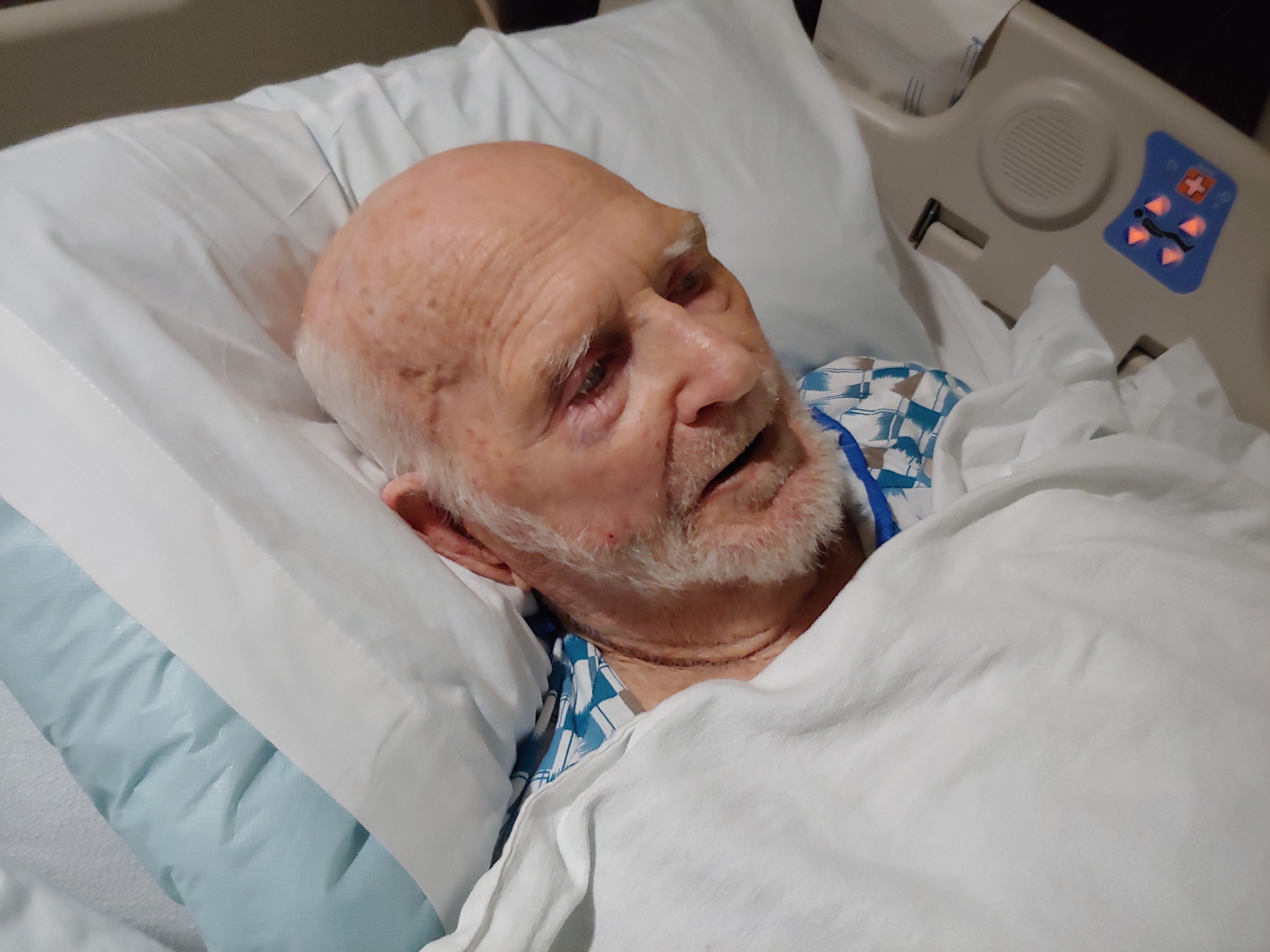
Trying hard to leave.

My daddy hovers, sometimes thrashes, naked, his mind somewhere along an invisible jagged line between his tiny spot of time and space on earth and the ultimate reality of Infinity.

His heart beats so fast sometimes that we fear stroke. Doctors get his heart rate down and his blood pressure goes up. Get the blood pressure down too low and some other wheel falls off the old bus.

He fell in his bedroom sometime very early a week ago Tuesday morning. Before we found him on the floor with a bloody gash on his head,  he’d pulled shirts, belts, and a bootjack from his closet. He told us he’d ducked into a shed for shelter from the rain and realized he’d stepped into some man’s corn crib. Then he couldn’t get out of the field and had crawled through rough straw for miles.

Dad did not get confused because he fell; he fell because he was already confused in the night and hallucinating. We’ve seen a slow slide toward dementia for about three years, but since last Christmas the disease has tracked him like a cat, consistently and with increasing speed. We’ve watched a wretched auto-immune disease rob him of the ability to enjoy food and then to swallow well. His legs grew weaker and weaker, so often he could not stand, even with his walker.

In the emergency room after the fall, he fought with three cats, two black and one black and white, that kept pouncing on the bed. Every time he kicked them off, they came back.  I shooed them away. He re-told the corn crib story with variations and repeated an earlier adventure stripping tobacco with two youngsters who would not talk to him. He was pretty sure they could talk, they just wouldn’t. The ER physician called a hospitalist to provide overnight observation.

Once in the room on the fifth floor tests began, including an ultra-sound on his legs. The technician came in Wednesday morning, made it through the scan of one leg and then Dad refused. He kicked at the machine operator. She dodged and moved the equipment. He kicked some more. When nurses arrived to rescue the tech, he doubled his fists and slapped at them.

I said, “I don’t think you’re going to get that next one.”

She smiled and said, “I’m pretty sure of that.”

Within a few hours, the a-fib grew worse and Dad grew so wild and combative I wished for restraints. They came quickly. He did not sleep–not one wink-– for four days.  One night, I bent over to pick something up just under the edge of his bed and even though his hands were tied, he grabbed my hair. It took a few minutes to pry his hand loose.

My dad’s wild mind fashioned a scary story with escalating horror. He gave me the base plot as he dressed me down. I was trying to kill him, leading a band of nurses are my followers. He kept saying that he can’t believe I would do this for money.  “Greed. Evil. You are no daughter of mine.” I stood stark still, as if at attention, stung and disoriented. The words might have attached themselves to a deep sorrow if I hadn’t heard a voice. “This is not your dad.”

For several hours, there was a huge farm machine loose on his farm. We–the nurses, Jade, John, and I–had already destroyed the farm with this wrecker/excavator. We knocked down trees and ran through the shallow creek, breaking the flat limestone into small pieces. We were going to let it run over him, and then it was somehow above him and we were preparing to let it fall to crush him. One hour we were setting him afire. Another time, we were trying to poison him.

He disowned me, then started yelling again. I tried to slip a dry mouth lozenge in his mouth but I wasn’t quick enough. He can’t bite since he has no teeth but he clamped his jaws shut, turtle tight. Then he said to the air on his left, “Jameson, look at your mother. This is the kind of mama you have.” Jameson is my grandson, not my grandson, and he is safe at home in his own bed.

Dad got back to serious yelling. “Where is Mom [my mother]? She’s the only good person around here.”

The student nurse asked, “Does he like music?”

“Yes!” I said. “I can’t believe I haven’t thought of that. I should have brought in a player. There’s no music channel on the TV.”

Wait, I thought. I could stream from my laptop.

I grabbed my almost-dead HP from my bag and began the frustrating process of hooking up to the hospital free-for-visitors wi-fi. It’s a finicky network. I spent twenty minutes and then gave up.

Dad changed the venue. “Help! Come on, we’re down here in the bottom by the creek. They’re trying to crucify us all.”

The last time he had mentioned crucifixion, the nurses were attaching restraints. I watched him pull at the cords and thought of rodeos and roped calves. I remembered a pig bound and hung for slaughter at my grandfather’s farm, and of holding my dog Murphy for an injection.

That night, I left him praying. The words were plain and the sentences cohesive. “Lord, thank you for this life I’ve been given. And if you want me to die now, I’ll come. I ask you to forgive Diana and all these evil persons who are doing this to me. They know not what they do. Take care of their little children.” I walked out of the room, on down the long hall to the parking garage.

The next time, he was on the hill at the farm in Smith County. He called for his mother. “Mama, come on here. I’m up on the hill. They’re about to kill your last son. Don’t you see the smoke?”

He did not remember that seventy-two years ago on the same day, Halloween, he and my mother took a long taxi ride to Georgia and married. He was seventeen, she “fourteen-almost-fifteen,” they said.

My mom waits at home, not really worrying, just pondering. She is dressed in blue matching pants and top, her curly hair neatly combed back, and her ensemble accessorized with the usual rings, earrings, bracelet, and necklace.

After two days and several doses of psychiatric drugs, the restraints were removed. He was still agitated but not trying to hurt anyone. He rolled his sheet and blanket into a wad and tossed them to the floor. He pulled his arms through his gown, easing the heart monitor through a sleeve. The gown and a couple Chux pads found the floor. I heard a pop, pop, pop as he removed the leads to the heart monitor. He seemed pleased that he had wires to untwist. He repeated the process several times.

He slid down the bed and pounded the foot rail in a surprisingly steady rhythm. He called for my mother, yelling louder than he’s been able to in years.

I told him, “Dad, Mom is not here.”

Sometimes, for a minute or two, he believed me when I told him, “You’re in the hospital, Dad.”

“In the hospital? What am I doing here?”

I told him, “You have to stay for a while until you get better, and you are getting better.”

“Am I in South Carthage?”

“No, Dad, you’re in Nashville. At St. Thomas.”

At times, it connected and he said,  “Oh-h-h-h-h-h.” Another time he added, nodding his head, “So that’s the problem!”

One afternoon, he asked, “Did you know the cats are back?”

“No,” I said. “What are they doing?”

“Oh, they’re just lying around down there at the foot of the bed.”

I said, “But you’re not trying to kick them off.”

“No, I got used to them.”

From time to time, the psychiatrist Dr. Le Coguic stuck her head in the room to ask a few questions with telling answers.

She: What year is it, Mr. Blair? He: 2017. She: When were you born? He: Five, twenty-nine, no. Five, nine, no. Twenty-five. She: That’s good enough! Now who’s the President? He: Truman. She: Hmmmmm.

I snuck in a word there. “He really knows. I asked him myself yesterday and he said Truman and I said, ‘No, it’s Trump, Dad,’ and he said, ‘Yes, that’s who I mean so just pretend I’m saying Trump when I say Truman.'”

Dr. Le Coguic laughs out loud. “Good enough!” she said.

The next time she asked him, he said, “Oh, that damn Trump. Truman.”

The morning of November 7, I walked into the room where a soft-spoken chaplain introduced herself to me as Gail. She was asking Dad if he was a spiritual person. She didn’t understand him, but he answered her, “I suppose so. I’ve got a Master’s of Divinity from seminary.” I translated a few sentences to her until Dr. Chris MacMurdro from the Palliative Care Department stepped in. Because Dad was still talking with Gail, Dr. Mac asked if we might step down the hall to talk.

“Call me Dr. Mac or Chris,” she said and explained her specialty.  After several minutes of discussion about what I might expect or anticipate or decide, Dr. Mac told me with his refusal to eat or drink, Dad would likely be gone in two weeks. It’s too early for hospice, she said, but you will need them. If Dad goes to a skilled nursing facility, he might get a few days.

Just as Dr. Mac and I were ending our conversation, Gail approaches us from the doorway of the family waiting room. “Your dad,” she said, and placed her hand over her heart. “Oh my. And thank you for helping me understand what he was saying. I could understand him after that.”

“Good,” I said.

“This is the first time a patient has prayed over me,” she said.

“He did?” I asked.

She teared up. “I asked him if he would like me to pray with him, and he took my hands and said, ‘I’ll pray for you.'”

“And he did?” I said.

“Yes, and now I have to go sit down somewhere and cry.”

***

1105181807a
Still a small smile.

Later that day, when I told Dr. Mac the evening Zyprexa seemed to make Dad more agitated instead of less as it was supposed to do, she wanted to revisit his history of hallucinations and his increasingly weak legs. “Let me go back and look at his chart again,” she said. “I’ll call you back.”

“Dad,” I said, “would you drink one of your protein shakes? I have a cooler over here with three drinks in it. Which one–chocolate or vanilla?”

His eyes lit up a little. “Chocolate!”

I rolled the bed up and offered him the straw in the bottle. He tried to take the bottle.

“I want to drink it. Myself.”

“Well, okay.” I grabbed some Chux pads and tucked one around the top half of his body. I helped him hold the drink, with him struggling to wrest it from me, until I knew he’d had enough that he wouldn’t immediately pour the stuff all over himself.

He drank almost all of the eight ounces. He drank almost ALL of the EIGHT OUNCES, the most food of any kind he’d had since more than a week ago. 

Dr. Mac called.  “Diana, this is not Alzheimer’s. I’m thinking more like Parkinson’s with Lewy bodies. That would explain the reaction to the Zyprexa. Do you know much about Parkinson’s?”

“Enough. A lot,” I said.

She said he wanted to confer with the hospitalist, Dr. Meadors, about switching him over to something like Valium, which would be much more effective if we were treating Parkinson’s.

Sure enough, the Valium (or whatever it was) helped calm him. Dr. Mac called to say that Dad appeared now to qualify for in-patient hospice, and she had arranged a meeting with Rosie from Alive Hospice downtown. She explained her wish for inpatient hospice.

“The Parkinson’s thought changes everything. His medications seem to be headed in the right direction. He could use the meds management at inpatient to get them all tweaked to the point that you could manage him at home with the help of home hospice.” She fears for my ability to physically manage him at home right now and for my mother’s emotional health as she watches Dad decline.

I made her promise that she will always work toward our goal of getting him home. She repeats to me all the information I’ve given her, including the DNR and comfort care directives.

End of day, Wednesday, November 7.  Dad slept peacefully almost all night.

Yesterday morning, he knew me when I arrived. He smiled and said, “Hello, honey.” Dr. Mac called to discuss the latest strategy since he has improved enough that he probably does not qualify for inpatient hospice. “We’re thinking we can send him over to the rehab facility.”

Dad and I sat in quiet most of the day yesterday. He was tired. He thought he might want sausage and eggs. I tried. He drank a bit of milk shake. I tried again. I massaged his aching hands with cream, swabbed his gums and washed out his mouth.

“You’re going to make me bald,” he said when I rubbed his head. That’s a little joke we have. Not long after that, we both dozed at the same time.

When I told him I was leaving for the day, he said, “Be careful driving home. Is it still raining?”

I said, “No.” It did not rain all day yesterday.

Just as I started to exit the room, he called softly but firmly, “You are going to call Red Blair to help you get that big machine off the hill, aren’t you?”

“I sure will,” I promised.

*****


Lent…and New Year’s Resolutions

 Boy-oh-boy, Ash Wednesday seemed to come early this year—what to give up for Lent, what to take on, what to lose, what to find, what to… I’m still pondering my New Year’s Resolutions.

I made some. It took me until January 11 to adopt my list of intended personal improvements for 2013. I make resolutions every year. There have been years—and years—that I have vowed to “lose fifty pounds and walk to China” as my friend says and at first I added to my 2013 list,“Weigh xxx on x date.” (On x date, the Revells will be attending the Bucking Horse Sale in Miles City, Montana.)

There’s a reason I don’t include that intention on my final 2013 list: I’m a bit superstitious. Dr. Joyce Brothers (remember her?) appeared to me in a dream the night of January 10. In my dream, she just faded in and then faded out, but the next morning I remembered that sometime in the early seventies, I saw her on the Mike Douglas show and she talked about goals. I know exactly where I was standing and what I was doing. The boys were both down for the afternoon nap. I stepped into the living room from the kitchen, drying a plate with a dishtowel. Dr. Brothers said that perhaps it would help to set a “series of small goals” rather than one large one. Mike asked her to give us an example.

She answered, “If you are washing dishes, and it seems too overwhelming a task to accomplish, perhaps you could say ‘I’ll wash all the silverware’.”  Then, she said, after you’ve washed and rinsed the forks and knives, you make a promise on the salad plates.

Dishes? She thought washing the dishes was worthy of goal-setting? I sat down in the rocking chair, the plate and towel in my lap, when I heard her say, “You psychologically reward yourself when you accomplish that small piece of your larger goal.” I thought, maybe even aloud, that anyone who had to set a series of small goals to wash the dishes was in bad trouble for anything truly worthy of accomplishment.

After my Joyce Brothers sighting that morning, I considered my long, oppressive list of possible resolutions and thought about small steps I could take to work toward the major changes. I concluded that might be too ambitious and unrealistic and that what I needed was a shorter list. I was a tad inspired—only a tad—but I reduced the multiple-item list to three. I combined, eliminated, and re-stated resolutions to get to:

  1. Never wear pants that are too short.
  2. Walk every day.
  3. Get off sugar, as in “eliminate sugar from my diet”.

Gone were such specificities of the original promises as “Be two sizes down in my jeans by May”, “Give away half of my 40 T-shirts”, and “Walk to China and lose 50 pounds.” I completely forsook entire original list items like “Meditate/Read/Journal daily”, “Write every day”, and “Organize that *!%$ garage.” I cleverly placed myself in the arena of the possibility of success by declaring only three (3) resolutions.

#1 seemed easy. I tried on and sorted “too short” and “okay”. The dress pants are fine, but only one pair of jeans gets the label “okay”. #1 could get difficult, certainly expensive. There are two resolutions to this resolution dilemma and I’m going to use both of them. One, wear lower heels with the shorter jeans. Two, save the shorter jeans for summer cropped jeans; they’ll look fine with sandals. I changed #1 and I think it’s going to work:

  • Never wear pants that are too short. (Substitute “buy” for the “wear“.)

Let’s talk about #2. I don’t know when (although I do know why) I made the decision, but I changed #2:

 Walk every day.  Get some kind of exercise every day.

Then I changed it again:

Walk every dayGet some kind of exercise every day. (Substitute “MOVE” for the strike-through words.)

I figured the stairs to The Cellar would count; I could make extra trips up and down. I also ordered Zumba Gold – Live It Up. I haven’t started my dance exercise education yet but I have new shoes. And I’ve kept the bird feeders filled (another abandoned resolution from List Uno). And I’ve made great progress on one I mentioned earlier in this writing, the one about “that *!%$ garage”.

Let me just say that it takes stamina and calories to hoist boxes of chafing dishes and bins of T-shirts. I moved a before-plasma, ante-LCD 36-inch TV along with an HP multi-function printer that insists it has a paper jam when I know that it does not. (Somebody else is going to have to deal with that big fat liar.) I climbed on ladders and stools; I stretched, bended, and bounced. I dug and sifted and swept.

I also sat and sorted and remembered. Things like a program from my high school musical, Guys and Dolls, provided not only a jaunt up and down Memory Lane but also time for rest. I gave myself permission to spend time. I let myself wander through the boys’ report cards and achievement tests; there was plenty of time to re-visit favorite cards and letters.  I remembered that resolution I wrote that said, “Work at being present” and followed it with “Live in the moment”. My leafing through old pages was hardly “present” but I was present for the experience and I was certainly living in that blessed moment.

I sort of “came to” (Southern speech for “woke up from being out cold”) one evening after a particularly productive three hours in the garage. I only stopped working when the back end of the garage became too dark, even with the door open, to see what I was doing. I considered that I was tired; I wondered how many calories I had expended. But my promise to myself wasn’t to burn calories; it was to set aside time to just move—intentionally and regularly.

So, today, while Dave installed two additional overhead utility lights so that I can see to finish my storage project, I hurried to a neighborhood church to start a regimen on the family life center’s walking track. I remember that walking time is thinking time and I turn joyful. Walking is meditation. I think of savoring these weekly hours on the track.

Walking at the church costs $15.00 a year. I get a tote bag when I walk 592 miles—“to Branson, MO.” If I come back (and I might not since I’ve never been to Branson), I get a gift certificate for double that mileage. At least it’s not to and from China.

January 15 marked the first day of infringement on #3.

I hate to blame a baby, but when my new grandson Jaxton didn’t arrive by 4:00 o’clock in the afternoon, and there did arrive a prediction that “it will probably be 6:30 or so”, OtherGrammy Helen and I made a break for the cafeteria. After a small and sensible meal, we dawdled in the hospital gift shop, almost as if our absence from the OB waiting room could somehow hasten Anjie’s labor.

There was a sale on everything Christmas-themed. I found the perfect thing, a size 18-24 months furry reindeer jacket, complete with antlers and red nose on the hood.. Somehow, a Snickers bar, a Yorkshire Mint Patty, and a bag of Peanut M & M’s snuck their way into my bag to keep company with Jaxton’s next (first) Christmas coat.

I’m not saying a word about what Helen and Anjie’s sister Jackie brought back to the waiting room. That’s their business, but I will say that the condition and inhabitants of the place where you wait for babies propelled all three of us into a gone-rogue sucrose attack.

Six young women sported primary colored hair; I lost count of combinations on others. There was no end to the tats on one guy, even when he stood still, never mind the piercings. A full-back dragon on another (shirtless) was mesmerizing; the tail swerved down his right leg. (He donned saggy shorts.) And there was this one fellow who somehow lost the entire crotch of his pants! How do I know? Because he showed us.

For some reason, a fast-food bag rested under every third chair. I noted McDonald’s, Arby’s, Hardee’s, and Taco Bell (my choice of the four–it was NOT my bag, though). A garbage can sat less than twenty feet away from any row of chairs.

A young mother (I don’t know what relation she was to which imminent birth) arrived with a fat set of keys on an 18-inch pink lanyard. For forty-five minutes, she swung the keys by the end of the strap, round and round through the air, scraping the floor with a loud crash when gravity inevitably brought them down swing after swing. She only lost complete control of the keys one time and they launched across the room, unfortunately stopped by the full wall of windows. I fleetingly hoped the big wad of metal would break the plate glass and sail into the HVAC unit on the roof, but no. She was just as quick to retrieve the keys and start the swing all over again.

And then First-time Grammy (FTG) two rows away succumbed to the stress of pre-Grammyhood and stood in the middle of the room to sob, “Why don’t they do something for her?” Shortly thereafter, “they” did do something for “her” and FTG’s daughter brought her own nine pound daughter into the world via C-section. First-time Grammy de-railed again but was, this time, quickly comforted. I felt her helplessness—and then her relief.

Jaxton Edward Graham said hello with a loud wail at 8:35 p.m., according to the young blonde female doctor who finally came to take us to the room at 10:30. I fell in love with all 6 pounds 7 ounces of him. He looked teensy in the arms of his big daddy.

I ate the M&M’s on the drive home. All that was in the bag of reddish brown fur was Jaxton’s reddish brown reindeer coat. The sugar solution evades me yet.

I do know this: Resolutions only work for me if there is only one resolution. It’s a vague statement, an elusive promise, but the same every year, every month, every day: Balance. Everything in moderation. Live abundantly, but live. Be frugal, but generous. Organize for the future, but live in the moment. Let the past be gone, but savor memories. Be happy, and dance. Dance, and move. Move a little, and move more.  Moving inspires good eating. Eat well can mean eat less. A treat is special at a special time.

Pare down and attend more intensely. Diana, dwell on the riches: a new grandbaby, healthy Mom and Dad, loving children, a place to write, books to read, a working body. Warmth in winter, shade in summer, the stillness of the ravine.

Clean out the clutter. Give away. Consume little. Share everything. Work to be a good human.

So what singular item do I choose that might start a chain of living in balance? What might feed my spirit most? What might be most appropriate for Lent?

In the most real observance of Lent, we discover the full humanity of the Jesus of Christianity. So much of the time, it is so much easier to imagine mystical divinity than to accept the flesh and blood human—the human like us, the human that we are also meant to be.

For my Lenten journey, I’ll begin with time for a thoughtful walk—three or four times a week. At the very least.