The Friendly Beasts

Four years here in The Compound on this ravine and we’ve had emergency services out four times. HazMat came first with several big red trucks and firemen, then two ambulance calls with accompanying fire engines, and, right at dawn this morning, a stuck-dog call.

I first heard a dog crying at 4:30 this morning and wondered if I was dreaming. Or was it Murphy whining?

Yesterday, Dad told us about his dream the night before. He was hooked up to all manner of tubes and restraints a la hospital and could not get loose. I suppose that was akin to a nightmare. He woke, not realizing he’d had a dream, and began to look for the things that bound him; finally got out of bed, turned on the light, and got on the floor to look under the bed. After he got back up from the floor, which is no easy feat for an 83-year-old in the middle of the night, he forgot what he was looking for and decided to go back to bed since he couldn’t find whatever it was. He said he didn’t recognize the occurrence as a dream until he was almost asleep again—and it woke him up again.

So, this morning, foggy-headed, I guessed I could have been in a stupor post dog-dreams. I ambled into the bathroom where, after a few minutes, I placed the sound as real and coming from the patio under the window. Foxes mating, maybe the foxes were mating. Is this the time for the foxes to mate? I ruled out Murphy because she was in her crate at the other end of the house. I tried to see the patio from the bathroom window but there was not enough light in the pre-dawn.

I put on a pot of coffee and checked the view from the from the dining room. I made out a shape of a large black mass that looked to be flopping around down there.

Astigmatism, uncorrected, makes objects appear much larger than they really are and I was wearing my computer glasses which do not afford me the best vision for distance. I searched for, and found, my better-suited “spare pair” for a better look. He was big. He was a big black German Shepherd—maybe a mix—with brown paws and brown around his mouth and maybe some on his belly. He seemed to be hurt. He got up only to drag himself a few feet and cry again.

I was reminded of a canine hit by a car in the hindquarters, not a pretty sight. I turned from the window, a hollow feeling gathering in my middle. And if he’s not hurt, I said to myself, he must be sick. Rabies?

And then I heard scraping. When I returned to the window, there was enough light to see that this “somebody’s buddy” was stuck, caught; by what? Was that a wire? And where was the wire caught? He had dragged the wrought iron teacart several feet out into the yard from its normal position beside the picnic table.

Caught on a serving cart. No, wait, the “wire” was red, and maybe a lead of some kind, and it was wrapped around one of the bird feeder poles now pulled from the ground. He really was caught.

5:25. I decided to wake Dave. Actually, I figured he might be awake now, anyway, because he went to bed very early. If he wasn’t ready to wake up, he should be.

“There is a big dog…” I began.

When I finished, Dave said, “I thought I heard Murphy doing that thing she does when she’s dreaming.”

“What should we do?” we asked each other, agreeing that there was no use in calling our pitiful animal control service. We’ve had experience with Metro Animal Control, an office that is staffed less than 40 hours each week. Animal Control will come to pick up an animal, or ask a neighbor to quiet a barking dog, IF the complainant does the legwork; you know, somehow trap the dog or chase it back home and make a note of the house number.

We weren’t sure that the big black dog was friendly so neither of us wimps were keen to get close to the animal.

“You know,” I said, “I think I’ll call the police. They’ll send somebody and maybe they’ll bring a net.”

“Good idea. Don’t call 9-1-1, though,” Dave said.

“No, I’ll call the non-emergency number. You remember what that is?”

***

Two police cars and two fire trucks arrived five minutes after the call. I’d had just enough time to throw on what could loosely be described as clothes. I headed out to the side porch to meet them.

And there, curled up against the gate to the porch, was another big black dog just like the other one, and he wasn’t about to budge.

Oh, he got loose, I thought, so I headed to the front door to tell the firemen. But, on the way I looked out the den window and saw the first big black dog with the red lead, still caught on the teacart and the birdfeeder.

“Hey,” I called in the most voice I could muster. I’ve had laryngitis for a month. “Here I am,” I squawked. “There’s another dog. Right there, on the ramp.”

One of the four firemen and three policemen in the driveway answered me, “Yeah. Well, where is the other one—the one you called about?”

“Down the driveway, in the back,” I said, and they all traipsed down the hill.

I ran down the inside stairs to The Cellar. By that time, one of the firemen had removed the lead from the dog’s neck and wound it into a circle. Another was stroking our new friend’s head. I opened the door.

“He’s friendly,” he said. “This lead was on a stake, see?” He held it up, the contraption that anchored the poor animal to my yard furnishings. There was a screw-like thing attached to the end of the ropey thing.

“Looks like he pulled the stake out of the ground and got loose. I think he’ll go home. They usually do. But now, he doesn’t have any tags for us to see where he lives.”

All of them started back up the driveway, the men and the big black dog.

“What about the one on the porch?” I asked from the rear of the parade.

“You don’t know that dog? It’s not your dog?”

“No. It’s just like this one.” I pointed to the first dog, the one that had just been un-hitched.

“You want us to get him off the porch?” One of the firefighters sounded a bit indignant. The whole bunch stopped. I did, too.

“Well, I don’t know if he’s friendly,” I said.

“You want me to check?” he asked.

“Yes, please, if you wouldn’t mind.” They resumed the trek up the hill. I followed.

“He’s okay,” I heard one call. “They’re together.”

“Right,” I said. I never would have thought of that.

One of the policemen was radioing and I heard him say “animal control”. I could have sworn I heard him follow with “tried to snap”. They were all headed back to their respective vehicles. The fireman who un-bound the dog turned to ask, “Is there anything else we can do for you, ma’am?”

“No, and thank you,” I said and then asked the policeman with the radio, “Did you all call Animal Control?”

“Yes, I did.”

“But they won’t be out, will they?” I asked. “They’re not even open yet.”

“I left a message,” the policeman answered.

My fireman turned around and walked back to the driveway.

“No, they won’t be out,” he said. “By the time they get to the office this morning, these dogs will be gone.” Then he added, “They’re practically useless anyway unless the dog is violent or dangerous—and then we’ll get them out of bed.”

He looked toward the two dogs walking into the street together. “But these dogs aren’t bad. We like to give them a chance to go on home.”

“I agree,” I said. We both turned our heads toward yet another police car pulling into the driveway but neither of us cared much and resumed our conversation.

“They look healthy and well-cared-for,” I said. “And I’d hate for them to go to the pound.”

“Yeah, they’re definitely somebody’s pets.”

There were no sirens, but one car and one fire engine left with their lights on.

Dave says the neighbors are going to wonder about us.

ROAR: wRiting On the Ravine

I started this blog in 2009 with the intent to document what I knew was a major change in our lives—mine and Dave’s, Mom and Dad’s. I knew we had committed to a job that could be described as “challenging”. Most of what I’ve posted here is directly related to multi-generational relationships, caretaking, or the natural lives of the creatures that live and visit here.

I’ve not said too much about my writing life. It’s time to work that into the story.

I hope to assemble a collection of the On the Ravine writings for a memoir—someday—but right now I’m writing a novel. I’ve been writing a novel for over six years, so it would not be a surprise that I’m much closer to finishing said work than I was six years ago, or even four years ago when we claimed this spot On the Ravine.

During the time that I have been working on the novel, I’ve been in four different writing groups. About two years ago, I found “The One”, “The Fit”. There are five of us, one leading, mentoring, and teaching the other four of us. We each started with a novel, mine the furthest along since, after all, I had written the thing three times already. We are five talented, smart, experienced, and wonderfully supportive women—and we know it. I also know that I am incredibly lucky to have found this group. I’d rather miss a party than to absent myself from our Monday night reading and critique sessions.

So why now? Why talk about the writing?

For one thing, I feel the need to explain the decreasing frequency of my postings. I have plenty to write about without bringing up my wannabe-isms, and I do make notes and journal entries about hospitals, gardens, and wild animals. You won’t believe this, but in the middle of that last sentence, I jumped to my window to make sure that I was really looking at a hawk under one of the bird feeders. It was, indeed, a Cooper’s Hawk—and he wasn’t there for the safflower seeds.

I started a piece on what happens when all the ravine residents get sick at the same time, a recent experience. I wrote a few paragraphs on the title “Comings and Goings” about a dear old friend’s passing the same week in January that grandson Jaxton was born. I made an account of a pharmacy clinic visit with Dad. I jotted a few lines to remind myself of several funny scenes from an overnight visit from Jameson and Carly. I may yet publish the hilarious story of the strawberry cake I made for Vicky’s birthday. Given some dedicated time, either one of those pieces could be posted.

I find that the story I am telling in long form just takes over. It leaves any personal accounts in unfinished condition while all spare energy is directed toward what happens to my make-believers, the characters; these are true friends of mine for some seven years. I go to sleep with them on my mind and I wake wondering what they’re up to. They invade my favorite TV shows and I think about them even when I am not writing but staring out the window which, any writer will tell you, is also writing.

There are other renderings about ravine life that will wait for months, or years, to be published. I avoid complaining about the weightiness of responsibility. I don’t mention the fear of the time when my parents will leave me, something else that is closer than it was four years ago. I do write about some of the more difficult issues, even the painful ones, but you don’t see those stories—yet. The words are only spoken, quietly, when I share these experiences with Dave or my closest friends, until it is more appropriate to include a broader range of readers.

There is another, not frivolous at all, reason to say “I’m writing”. This responsibility to my parents, my other family, and my husband, combined with the commitment to writing, creates a need for more hours than I can count on. I hold frequent sessions with myself devoted to developing a better routine, wasting less time, doing a better job of this and that. In the competing pulls and pushes, every whatever-sized thing is much larger than I ever imagined and something gets left out or dismissed.

It is difficult, and sometimes downright useless, to try to explain why I can’t often meet for lunch, and maybe not even for coffee. I’ve lost friends by my inability to explain, and by their inexperience and lack of understanding. There is no blame in my heart; I see what I might look like from the other side.

My husband keeps on trying, helping, doing, being, and there are those persons of soul-kinship who understand, and if they happen to not understand, they accept. It would be grammatically incorrect to say “They BE” but that’s what they do. They just be—with me, for me, around me. “They just be” seems so much stronger than “they just are”.

I won’t be talking about details of the novel or specific writing concerns, but I cannot help describing the feelings I got this weekend at the Celebration of Southern Literature in Chattanooga. There I was, not just close enough to touch, but sometimes actually touching writers like Dorothy Allison (Bastard Out of Carolina), Lee Smith (what didn’t she write), Arthur Golden (Memoirs of a Geisha), Jill McCorkle (Going Away Shoes), Maurice Manning (Bucolics), Randall Kenan (The Fire This Time), Allan Gurganus (Oldest Living Confederate Widow Tells All), Bobbie Ann Mason (Elvis Presley)… They talked about their work, they read from their stories and poems and plays. That list I just wrote—they’re just the ones that popped into my head as I sat here. There were so many more.

I toggled between two opposing responses: “I am a storyteller” and “Who am I to think I could possibly write?” Tony Earley was at the conference, too. (Jim the Boy, Somehow Form a Family, The Blue Star) At another event several years ago, Tony told us that he doubts his ability every time he sits down to write. I’m so glad he said that, and even happier that I remember it.

I like to summon him up from time to time, this Tony Earley.


Lent…and New Year’s Resolutions

 Boy-oh-boy, Ash Wednesday seemed to come early this year—what to give up for Lent, what to take on, what to lose, what to find, what to… I’m still pondering my New Year’s Resolutions.

I made some. It took me until January 11 to adopt my list of intended personal improvements for 2013. I make resolutions every year. There have been years—and years—that I have vowed to “lose fifty pounds and walk to China” as my friend says and at first I added to my 2013 list,“Weigh xxx on x date.” (On x date, the Revells will be attending the Bucking Horse Sale in Miles City, Montana.)

There’s a reason I don’t include that intention on my final 2013 list: I’m a bit superstitious. Dr. Joyce Brothers (remember her?) appeared to me in a dream the night of January 10. In my dream, she just faded in and then faded out, but the next morning I remembered that sometime in the early seventies, I saw her on the Mike Douglas show and she talked about goals. I know exactly where I was standing and what I was doing. The boys were both down for the afternoon nap. I stepped into the living room from the kitchen, drying a plate with a dishtowel. Dr. Brothers said that perhaps it would help to set a “series of small goals” rather than one large one. Mike asked her to give us an example.

She answered, “If you are washing dishes, and it seems too overwhelming a task to accomplish, perhaps you could say ‘I’ll wash all the silverware’.”  Then, she said, after you’ve washed and rinsed the forks and knives, you make a promise on the salad plates.

Dishes? She thought washing the dishes was worthy of goal-setting? I sat down in the rocking chair, the plate and towel in my lap, when I heard her say, “You psychologically reward yourself when you accomplish that small piece of your larger goal.” I thought, maybe even aloud, that anyone who had to set a series of small goals to wash the dishes was in bad trouble for anything truly worthy of accomplishment.

After my Joyce Brothers sighting that morning, I considered my long, oppressive list of possible resolutions and thought about small steps I could take to work toward the major changes. I concluded that might be too ambitious and unrealistic and that what I needed was a shorter list. I was a tad inspired—only a tad—but I reduced the multiple-item list to three. I combined, eliminated, and re-stated resolutions to get to:

  1. Never wear pants that are too short.
  2. Walk every day.
  3. Get off sugar, as in “eliminate sugar from my diet”.

Gone were such specificities of the original promises as “Be two sizes down in my jeans by May”, “Give away half of my 40 T-shirts”, and “Walk to China and lose 50 pounds.” I completely forsook entire original list items like “Meditate/Read/Journal daily”, “Write every day”, and “Organize that *!%$ garage.” I cleverly placed myself in the arena of the possibility of success by declaring only three (3) resolutions.

#1 seemed easy. I tried on and sorted “too short” and “okay”. The dress pants are fine, but only one pair of jeans gets the label “okay”. #1 could get difficult, certainly expensive. There are two resolutions to this resolution dilemma and I’m going to use both of them. One, wear lower heels with the shorter jeans. Two, save the shorter jeans for summer cropped jeans; they’ll look fine with sandals. I changed #1 and I think it’s going to work:

  • Never wear pants that are too short. (Substitute “buy” for the “wear“.)

Let’s talk about #2. I don’t know when (although I do know why) I made the decision, but I changed #2:

 Walk every day.  Get some kind of exercise every day.

Then I changed it again:

Walk every dayGet some kind of exercise every day. (Substitute “MOVE” for the strike-through words.)

I figured the stairs to The Cellar would count; I could make extra trips up and down. I also ordered Zumba Gold – Live It Up. I haven’t started my dance exercise education yet but I have new shoes. And I’ve kept the bird feeders filled (another abandoned resolution from List Uno). And I’ve made great progress on one I mentioned earlier in this writing, the one about “that *!%$ garage”.

Let me just say that it takes stamina and calories to hoist boxes of chafing dishes and bins of T-shirts. I moved a before-plasma, ante-LCD 36-inch TV along with an HP multi-function printer that insists it has a paper jam when I know that it does not. (Somebody else is going to have to deal with that big fat liar.) I climbed on ladders and stools; I stretched, bended, and bounced. I dug and sifted and swept.

I also sat and sorted and remembered. Things like a program from my high school musical, Guys and Dolls, provided not only a jaunt up and down Memory Lane but also time for rest. I gave myself permission to spend time. I let myself wander through the boys’ report cards and achievement tests; there was plenty of time to re-visit favorite cards and letters.  I remembered that resolution I wrote that said, “Work at being present” and followed it with “Live in the moment”. My leafing through old pages was hardly “present” but I was present for the experience and I was certainly living in that blessed moment.

I sort of “came to” (Southern speech for “woke up from being out cold”) one evening after a particularly productive three hours in the garage. I only stopped working when the back end of the garage became too dark, even with the door open, to see what I was doing. I considered that I was tired; I wondered how many calories I had expended. But my promise to myself wasn’t to burn calories; it was to set aside time to just move—intentionally and regularly.

So, today, while Dave installed two additional overhead utility lights so that I can see to finish my storage project, I hurried to a neighborhood church to start a regimen on the family life center’s walking track. I remember that walking time is thinking time and I turn joyful. Walking is meditation. I think of savoring these weekly hours on the track.

Walking at the church costs $15.00 a year. I get a tote bag when I walk 592 miles—“to Branson, MO.” If I come back (and I might not since I’ve never been to Branson), I get a gift certificate for double that mileage. At least it’s not to and from China.

January 15 marked the first day of infringement on #3.

I hate to blame a baby, but when my new grandson Jaxton didn’t arrive by 4:00 o’clock in the afternoon, and there did arrive a prediction that “it will probably be 6:30 or so”, OtherGrammy Helen and I made a break for the cafeteria. After a small and sensible meal, we dawdled in the hospital gift shop, almost as if our absence from the OB waiting room could somehow hasten Anjie’s labor.

There was a sale on everything Christmas-themed. I found the perfect thing, a size 18-24 months furry reindeer jacket, complete with antlers and red nose on the hood.. Somehow, a Snickers bar, a Yorkshire Mint Patty, and a bag of Peanut M & M’s snuck their way into my bag to keep company with Jaxton’s next (first) Christmas coat.

I’m not saying a word about what Helen and Anjie’s sister Jackie brought back to the waiting room. That’s their business, but I will say that the condition and inhabitants of the place where you wait for babies propelled all three of us into a gone-rogue sucrose attack.

Six young women sported primary colored hair; I lost count of combinations on others. There was no end to the tats on one guy, even when he stood still, never mind the piercings. A full-back dragon on another (shirtless) was mesmerizing; the tail swerved down his right leg. (He donned saggy shorts.) And there was this one fellow who somehow lost the entire crotch of his pants! How do I know? Because he showed us.

For some reason, a fast-food bag rested under every third chair. I noted McDonald’s, Arby’s, Hardee’s, and Taco Bell (my choice of the four–it was NOT my bag, though). A garbage can sat less than twenty feet away from any row of chairs.

A young mother (I don’t know what relation she was to which imminent birth) arrived with a fat set of keys on an 18-inch pink lanyard. For forty-five minutes, she swung the keys by the end of the strap, round and round through the air, scraping the floor with a loud crash when gravity inevitably brought them down swing after swing. She only lost complete control of the keys one time and they launched across the room, unfortunately stopped by the full wall of windows. I fleetingly hoped the big wad of metal would break the plate glass and sail into the HVAC unit on the roof, but no. She was just as quick to retrieve the keys and start the swing all over again.

And then First-time Grammy (FTG) two rows away succumbed to the stress of pre-Grammyhood and stood in the middle of the room to sob, “Why don’t they do something for her?” Shortly thereafter, “they” did do something for “her” and FTG’s daughter brought her own nine pound daughter into the world via C-section. First-time Grammy de-railed again but was, this time, quickly comforted. I felt her helplessness—and then her relief.

Jaxton Edward Graham said hello with a loud wail at 8:35 p.m., according to the young blonde female doctor who finally came to take us to the room at 10:30. I fell in love with all 6 pounds 7 ounces of him. He looked teensy in the arms of his big daddy.

I ate the M&M’s on the drive home. All that was in the bag of reddish brown fur was Jaxton’s reddish brown reindeer coat. The sugar solution evades me yet.

I do know this: Resolutions only work for me if there is only one resolution. It’s a vague statement, an elusive promise, but the same every year, every month, every day: Balance. Everything in moderation. Live abundantly, but live. Be frugal, but generous. Organize for the future, but live in the moment. Let the past be gone, but savor memories. Be happy, and dance. Dance, and move. Move a little, and move more.  Moving inspires good eating. Eat well can mean eat less. A treat is special at a special time.

Pare down and attend more intensely. Diana, dwell on the riches: a new grandbaby, healthy Mom and Dad, loving children, a place to write, books to read, a working body. Warmth in winter, shade in summer, the stillness of the ravine.

Clean out the clutter. Give away. Consume little. Share everything. Work to be a good human.

So what singular item do I choose that might start a chain of living in balance? What might feed my spirit most? What might be most appropriate for Lent?

In the most real observance of Lent, we discover the full humanity of the Jesus of Christianity. So much of the time, it is so much easier to imagine mystical divinity than to accept the flesh and blood human—the human like us, the human that we are also meant to be.

For my Lenten journey, I’ll begin with time for a thoughtful walk—three or four times a week. At the very least.

Lincoln’s Teacher

I could count on her combing her hair at the same time every day. It was just after the bell at the end of the first recess, the one that signaled the beginning of the next class time. She would open her desk drawer with her left hand and slide out the big black comb with her right hand, easing it up to her head in one smooth, remembered motion. Her hair was really black, parted on the right side, and it lay flat like she had had that part in the same place for as long as she’d had hair. It fell from the part over her ears to just above her chin in a wavy sort of bob.
She always started talking before she finished combing, to inform and relate details to the day’s agenda. I don’t remember that she combed her hair after the afternoon recess; maybe the wind didn’t blow as much on the playground in the afternoon. Or maybe it was just that the morning recess was close to lunchtime and she wanted to look nice in front of the other teachers in the cafeteria. I always thought that Mrs. Sexton was pretty tough and it bewildered me that she could be such a “lady” at the same time. She carried herself with a smooth elegance.
Mrs. Sexton read a devotional first thing every morning from a worn King James Bible while she stood on the left side of her desk. It was 1959, a different time, before diversity and consideration convinced us to leave Bible-reading to the church and home. I met my first Catholic that year, a girl named Wendy whose family transferred from Illinois; my dad supported Kennedy for President. Wendy was also the first girl I ever met who wore Buster Browns.
The old, massive and beat-up oak desk was turned catty-cornered, almost in front of the door, to face the field of sixth-graders. For some reason, it always seemed that she was in the middle of the room. She had a way of engaging the whole group even as she singled out any individual student. I can’t imagine that teaching was hard for Mrs. Sexton; it was as much a part of her as combing her hair after morning recess. I always knew she would miss her conversations with her students if teaching were ever taken from her.
It was from Mrs. Sexton’s morning readings that I first understood the Beatitudes. When she read “Blessed are the poor in spirit,” I heard her familiar and very honest endearment, “Bless his heart.” This was no mere Southern tagline; Mrs. Sexton knew how to issue a real blessing. Years later, I would hear ministers of the Word sermonize that “blessed” was from the Greek meaning “happy,” but twenty-five sixth-graders in 1959 heard the word “loved” when Mrs. Sexton said “blessed.”
Once she read about the Pharisee and the Sinner and how the Pharisee was so smug and self-righteous, thanking God that he wasn’t like “those other people” and how God heard and loved that poor sinner when he was only able to cry, “Lord, be merciful to me, a sinner.” Sometimes her head would droop and her voice would trail off as she read; I knew that she was resting in the Word.
I don’t remember a discipline problem in Mrs. Sexton’s classroom. A few times the wrinkles between her eyes deepened and she firmly demanded—and got—a change in behavior, but she did not raise her voice. Her voice was Southern soft and slow, coupled with diction made perfect by reading aloud. Her talk revealed deep and consistent compassion with no reluctance to bare itself, even to sixth-graders.

Albert was tall and dark and he was probably two grades behind where he should have been for his age. He came to our class in late September after school had already begun, and one morning, just as we were finishing the Pledge of Allegiance, Albert just fell over. I guess he must have fainted. Mrs. Sexton crossed the room to his desk, helped him to his feet, and walked him out into the hall. When she failed to return in a few minutes, I tiptoed to the door of the classroom and peeked out into the hall to investigate. I was nosy and brave, urged on by the rest of the class’s promise that they were depending upon me, as usual, to report back. Mrs. Sexton stood in the hallway, watching Albert and a lady from the cafeteria edge down the stairs.
“Mrs. Sexton, Mrs. Sexton, what’s wrong with Albert?” I couldn’t help asking.
Her back to me, she answered just loud enough for me to hear. “He is hungry. He’s just hungry.”
“Well, what’re you gonna do, Mrs. Sexton? What’re you gonna do?”
“We’re going to feed him,” she replied firmly, and I knew that she had summoned the cafeteria worker to take Albert to the school kitchen to give him something to eat. When she turned around to head toward the classroom, scooting me along with both hands, I could see that she had been crying.
All she said to the class was “Albert’s going to be fine. We’re taking care of him. Let’s read our Social Studies lesson aloud today.”
We never heard Albert utter a word until that day that Mrs. Sexton recognized him as a natural cast for Abraham Lincoln in the February school play. Wearing a very tall and striking black hat, Albert delivered his lines proudly to an assembly of the fourth and fifth grades, along with the other sixth-grade classes. We strained to hear the quiet, high-pitched delivery of the lines he had perfectly memorized. He never smiled, but then he was quoting some serious words.
Mrs. Sexton stood in back of the auditorium, smiling, hands behind her back.
Many years later, my two sons were zoned for Lebanon’s inner-city school, Highland Heights Elementary. Several friends and other well-meaning parents advised me to send them to a private school, or to use an alternate address and send them to another public school where the proposed benefits included air conditioning, smaller classes, and more “middle-class type” students. I never once heard that the other schools had better teachers. After a few short weeks at Highland Heights, I knew that Jade and John were in the right place.
One afternoon, Jade announced as I walked in the house, “Mom, we had a substitute today, and she says she knows you!”
“Oh?” I tossed the word over my shoulder from the kitchen.
“Let’s see…what was her name…I can’t remember. She said, ‘When I saw those little glasses perched on your face, I knew who your mama was.’ She’s kinda old. She said she was your teacher when you went to Highland Heights and that you were one of her favorites. She only teaches at Highland Heights and she’s real nice.”
“Mrs. Sexton,” I told him. “Ruby Sexton. She is my all-time favorite teacher.”
“What made her your favorite?” Jade asked.
I told him the Albert story.

More years passed; both boys went to college just about the time my husband and I separated for the final time. I was unsettled and lonely. I saw Mary Ruth, an old family friend, at the grocery store. She invited me to visit First Baptist.
“Sit with Ruby and me,” she said.
“Ruby Sexton? You sit with Ruby Sexton?”
“Oh yeah, we’ve been friends for years. You must have been in one of her classes.”
One Sunday morning two weeks later, I slipped into a pew next to Mary Ruth and Mrs. Sexton.
“Ruby, I need to introduce you, or should I say, ‘re-acquaint’ the two of you,” Mary Ruth said.
“Honey, you don’t need to acquaint or ‘re’ or anything, I know Diana Blair when I see her. Diana, step over her and sit by me,” she said.
“Mrs. Sexton, you don’t know how good it is to see you,” I said. “I don’t know how you recognized me after all this time.”
“Oh, it hasn’t been that long, has it?” She paused and patted her silver hair. “You know, I was cleaning out some boxes the other day and I found a little story you wrote. I’ve saved it all these years. It’s the one about your trip to the Smoky Mountains with your family. I always loved that story. It started off, ‘There was a light on before daylight in the Blair’s house on Saturday morning. We got an early start on our visit to the Smokies.’ Do you remember writing that story?” she asked.
“Maybe. Or maybe I just remember going to the Smokies.” We both laughed and I asked, “Mrs. Sexton, do you remember that boy Albert? He was tall and lanky and dark-headed, and one day he fainted during the pledge…”
“Albert. Yes.” She turned her head to face mine and smiled. “Albert, the perfect Lincoln.”
***

All Is Well

Audrey scooped Breyer’s Vanilla Bean and generously dusted it with Hawaiian Pink sea salt. “Watch,” she said. “I just want you to see how much salt you need to use.” Then she finished with a generous pour of peppery Kiler Ridge Gregg’s Reserve olive oil and placed our desserts in front of us. Olive oil. Really. On ice cream. All I could say was, “Oh, wow. Oh, wow.” I’m still marveling.
We are in California for what turns out to be our bi-annual visit with the Grillos. These old friends come our way one year, we go theirs the next, and in either Tennessee or California, one of us plans road trips and events for nearly a week of days. In the West, we’ve headed out to Hearst Castle, Mendocino, and Napa Valley and, in between, gone for plays, music, wine, and art, and the frequent runs to San Francisco, Monterey, and high school reunions. Down South, we visited the Biltmore, Rowan Oak, and the Grand Ole Opry. There’s always something to do in Nashville for entertainment or sightseeing: the Country Music Hall of Fame, Cheekwood, the Schermerhorn, or the Nash Trash Tour. We also eat. A lot.
We arrived on Election Day, planning ahead to either celebrate wildly or drink our sorrow. We did neither, although three of us did stay awake long enough to hear the President’s speech. Mrs. Grillo (Ja, superbly playing the role of Cruise Director) reminded us to rest up for our next day’s trip to Kiler Ridge, a family olive farm on the top of the hills above the coastline.
The California central coast has the perfect Mediterranean climate and chalky soil for wine grapes—and for Italian olive trees. It was pretty much perfect weather for us, too. There was a slight breeze but the sun was warm. Hummingbirds dove in and out of tall blooming sage and lantana. We inhaled the clear air and oscillated around the circular panorama of mile after mile, hill after hill of olive trees and grapevines.
It was harvest day and the frantoio operated with great roars, whines, and poundings on a big batch of olives from a neighboring farm. Gregg explained the crushing, grinding, and separation process and we sampled the fresh oils. The tasting room was closed to the public as is usual during a harvest but since we had made reservations months ago, Audrey and somebody’s nona cooked lunch for us: a fresh salad, succulent Linguica sausages, and thin pasta, all featuring one of the oils from the shelf.
We sat at the big farm table at Audrey’s invitation and she sat out the plates of fresh greens. It was in that moment that I remembered times I love the most; spongy moments with friends or family when we soak up the often-overlooked assurance that everything is good, that all is right in God’s world and ours. More frequently, those brief breezes of warmth waft over us, unacknowledged, as the busy-ness of living and caretaking insulate us from the contentment that would drift down to warm and soothe if we were but receptive.
Our friends tell us who we are. J became my best friend in seventh grade, my touchstone for all but the first few years of my life. We figure this year is our fiftieth friendship anniversary. At some point that neither of us knows, we lost the opportunity to choose to be friends; we became “just us, just there, just together”—family, I suppose. It was natural that the Alex we embraced in high school would take an easy place in our friendship and Dave would be loved just for himself, after the initial admission by association.
J and I are just alike and we are completely different, the way sisters are often described. She is dark-headed and so slight; I am blonde and quite round. She is oriented toward rules and order; I often fly by the butt of my bloomers. I think of her as the quiet to my boisterousness, the fragile to my hardiness. But then I consider the underlying similarities, for underneath the blonde my roots are dark. And while I may seem to prefer a broad view, there is a level of routine and predictability that I need in order to breathe. Turn us loose on the Beatles or Motown and we can both raise the roof; set us down on a park bench in autumn and we are happily silent together. I can remember times when she was an indestructible buoy for my wounded, drowning soul and named my very self so that I could once again claim my bearings.
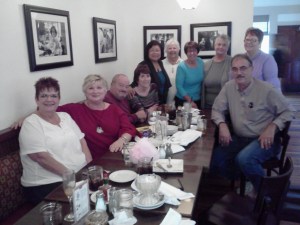
Yesterday, there occurred another moment of precious being. A half dozen friends from high school and Facebook met the four of us for what Alex described as a “four-hour lunch”. He exaggerated; it wasn’t nearly four hours. It was long enough to find ourselves, together, after all these years—and yet it was not even a blip of the time I could have basked in that sunshine of memories, laughing, jokes, teasing, affirmation. All of these wonderful women have carried gifts through the last forty-five years that we saw in each other in high school: ability, tenacity, warmth, acceptance, appreciation, beauty, and fun.
We checked in on our families; husbands—present and ex, children—some just over surgery or illness, grandchildren—there for us to spoil (yes!), and friends we wished for. We resurrected memories; who kissed who when, whose history class was it, where exactly we each went in the first few years after high school. We’ve kept up well on Facebook. I am grateful for social media but there are things we haven’t said online so seeing each other was my cake’s favorite frosting—salted caramel or anything with cream cheese.
I told Cynthia how envious I was of her, when we were on the yearbook staff, of her perfect tan that she got watering the yard. She brought me a bracelet of many colors that she made. Linda C. and I love to cook; she told me how much fun she had making my pulled pork recipe for a bunch in the Coast Guard. Linda G. and I cannot remember a class we had together but who cares. I remember loving the way her hair flipped. Cathie got the real story of how that fabulous kiss happened in the production of Guys and Dolls; she also re-trained us in the Queen Mum wave. (Her son is the mayor of Dublin, CA.) Joyce is coming to Tennessee to visit, I’m sure, and I told her how much I enjoy the pictures of her grandchildren. Rosemarie rode her bike to the restaurant and she loves me even though I’ve always been “mericani” to her “extreme Sicilian”.
And there were the words we didn’t say in person, either, but thoughts and feelings that wrapped us together around our trusted history—whatever pieces we can call up, our admiration for each other—unspoken now as it was in teenage days, and our love and appreciation for where each of us has been and how we fit this puzzle of life currently laid out on the table.
At Pittsburg High School, I sometimes struggled with acceptance. I was not Italian enough, too simultaneously smart and silly, less popular than I wanted to be, and, a lot of times lonelier than I should have been. But, yesterday, I was me and each of us was “just us”, woven into fabric as tightly as Italian linen, transparent as the restaurant’s window letting in too much sun, and as comfortable as an old pair of sweatpants I almost wore to the gathering. If Ja had not asked, “Hey, aren’t you going to change your pants?” I would have sported pulled polyester grey-with-white-stripe half-hemmed almost-pajamas with the silver-studded batwing red sweater.
So once again, in the moment somewhere around the end of the first hour, I knew who I was because they told me. We told each other, and all was well.
The saying of the mystic Julian of Norwich comes to me, “…All shall be well, and all shall be well, and all manner of thing shall be well”. Julian claimed it to be said to her by God Himself. This November, with friends in central California, I believe her.

Turnip Greens

Last Tuesday, I put up turnip greens, mainly to save Mom from doing it. Mom has been an expert canner and freezer in her time, but her time for that sort of homemaking is over. Unfortunately—no, wait—Fortunately, Dad’s time for gardening is not over. So from the end of May through the first part of November, he announces at cocktail hour: “I’m going to have a mess of green beans tomorrow” or “Did you see the sweet potatoes I dug?” or “Looks like there are more butternut squash”.
On Sunday, it was “I’m going to have a big load of turnip greens tomorrow.” And he did.

The station/assembly line.

I love me some turnip greens, but I don’t want turnip greens that have stems in them and I don’t want to grit my teeth on sand, ever, when I chomp down on their bitter goodness. Those picky preferences of mine make my turnip green preservation experience a bona fide chore and since the details of the event are so recent, I thought I would share my foolproof method with you. Don’t stop reading because you hate greens. You may have to take on this project some day; it’s amazing what we’ll do for our kids—or our parents.
My Aunt Ogile said you ought to cook your turnip greens with fatback before freezing but not to add salt because that will make them tough. I just wilt mine, plain, trusting the advice of several reliable websites. It makes me happy to offer you my easy, shortened process. Please read through the entire set of instructions prior to embarkation.

HOW TO FREEZE TURNIP GREENS by Dinah
1. Set up your turnip green station. You will need a big mess of turnip greens, paring knife, clean sink with stopper, container for stems and other non-turnip green items, in-sink clean dish drain (forget the colander, you can’t get enough in one of those), and a pan for trimmed greens. Running water helps. Setting up for this official, assembly-line-type operation sort of cements your commitment to the project.

The work-in-process.

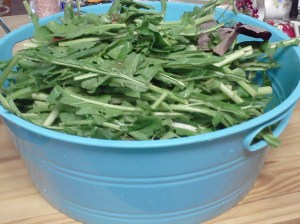
2. Dump your greens on the counter (maybe on a big paper bag); you’re going to work off the stack. Be sure to get out your largest kettle so that you can marvel appropriately at how that huge pile of greenery, when wilted down, barely covers the bottom of the big pan.

3. Cut out all the big stems. Since you’re going to be lifting leaf by leaf (oh, yes, you are), toss out all the grass and dogwood leaves you find nestled between these turnip tops. (Note: It is possible you won’t have any dogwood leaves. Our turnip patch is just a couple of feet away from an old white dogwood whose leaves turn brown and fall just about time for the first picking of greens.)

What I threw away.

After you have been trimming for, oh, twenty minutes, you’ll want music. I heartily recommend rotating twenty-minute shifts of classic country and R & B soul. You really don’t need anything too dance-worthy as that makes you get too frisky with the paring knife. I suppose you’re wondering why I didn’t tell you to put the music on before you get started trimming. Well, I have found that I need a few minutes of quiet to get my routine, and my rhythm, established. It’s a bit like trying to find a driving destination while the radio is on. Got to turn that thing down!
4. As you strip the leaves, throw them in the sink. Go ahead and start the cold water. You’re going to need a lot of water. You can turn off the water when it gets about, um, four to six inches from the counter top. If you don’t have a ruler handy, four to six inches would be the approximate width of the very largest turnip plant leaf in your stack—if you have a good crop this year.

5. When the sink looks full enough of greens and water, stick your hands in and swish, swish, swish. Do not splash, splash, splash or you and the kitchen will look like you and your bathroom after a happy toddler’s bath.

6. In the middle of one of the latter swishes, lift a layer of greens out with two hands and lay them in the clean dish drain. Repeat until the sink is empty of greens.

7. Now—look in the sink! See all that dirt and sand? Amazing! So, pull the plug and wash the sink.

8. (a) Put the plug back in the sink and start the cold water. (b) Start layering all the just-washed greens into the sink (yes, again). [Somewhere in this step is a good time to rotate your music selection!]

9. Go to #3 and continue through #8. (Yes, we are going to wash these wretched pieces of greenery again.)

10. When you have washed the trimmed leaves—and the sink—three times, go to #8 and complete (a) but don’t do (b). Let the sink fill with water. Now, this is tricky because you don’t want to put too much in nor too little. Check out the next step so that you have some idea of how much you need. (Woman up! There are some decisions that I cannot make for you.)

11. Do not go to #9. NOTE-ALARM-ATTENTION: If you get lost here, you could be washing turnip greens until the Lord comes to take us Home.

12. Take the thrice-washed greens and gently layer them into the sink of water. Barely—barely, I say—move the greens around with your hands. You can’t call this a swish. It’s more like the wake of a toy aircraft carrier.

13. Dry your hands. You’re going to let the greens soak for twenty minutes. The idea here is to let whatever grit might still be present to drift to the bottom of the sink. [There is ample time to change from George Jones to Aretha here. I hope you can find “Pink Cadillac” because it would not hurt to get your dancing done at this point. Oh, wait, the real name of the song is “Freeway of Love”. I bet you could find it by “Pink Cadillac”, though.]

14. Look at your counter. Are there more unattended greens lying there? Okay, then don’t think you have time for a nap. You could, however, down three PBR’s or a half-magnum of Chardonnay. Only your own experience will tell you if you need refreshment and what kind.

15. After the twenty-minute respite, gently lift (but do not swish) the greens from the water and place them in your big old pot (hereinafter referred to as your “BOP”). Go ahead and set it on the stove. Do not turn on the flame. Just let the BOP rest there.

My BOP of greens.

16. Now, without whining, go to #2 and repeat through #6 for the remaining pile. You only have to do the repeat until all the greens are washed and in the BOP.

17. You may wonder what to do since the BOP is already full, even overflowing. Just keep stuffing. Push ‘em down, push ‘em down, wayyyyyyy down.

18. Add four or five inches of water to the pan. No, I do not know how you are expected to measure since the BOP is not see-through. Just put some water in, force the lid on, and put your project on the burner—on High.

19. When you hear the water boiling in those greens (“glug, blop, s-s-s-s-s-s-s-s-b-b-b-b-b”), give it five minutes and take a big metal spoon and poke the greens down. They’re going to start getting smaller…

20. Repeat the poke-down into the boiling water until all the turnip greens are dark and limp. NOTE: If, at any time, you hear only a s-s-s-s-s-s-s, that means your BOP is out of water and your greens are s-s-s-s-sticking, as in “pre-burning”. Add some water! If you are so numb from your refreshing adult beverage (allowed and even encouraged in #13) that you fail to note the first signs of sticking and start to smell burning greens, you’re s-s-s-s-screwed. Throw out the whole thing. This prophetic warning should scare you into paying attention because you will feel poorly when your labor just to get to this point is declared vain.

Take your big spoon and root around in there to make sure they all got the message. Hopefully, there will be enough of the wilted turnip tops to cover the bottom of the pan and, unless you’re working with a non-stick pan, the bottom you do see will not be black. Yes, they really do shrink down that much. No, they’re not exactly dissolving before your very eyes. They’re just getting smaller.

21. Turn the stove off. Clean up the kitchen. You’ll have plenty of time because the greens have to be cool before you put them into bags. Don’t, however, leave this cleaning task until tomorrow. You need a week to appreciate the reminder of this achievement.

22. When the greens are cool, drain them. Oh yeah, this is where a colander comes in handy. You might even be able to use a large tea-strainer for what remains of that huge pile on the counter that you started with.

23. Stuff them into freezer bags, press the air out, and lay them flat to freeze.

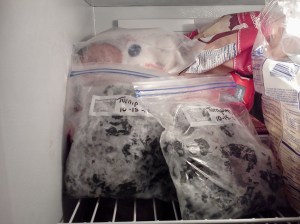
I got two quarts out of that. Two quarts. Two meals. Two flat, frozen one-quart squares of turnip greens.

What I got.

Don’t think you’re being original if you started hunting Southern home-cooking restaurants after just reading the directions for freezing your greens, but don’t think you can compost the big pile of turnip greens on the counter and no one will know. You’ll know—and you’ll remember that I told you every homemaker wannabe needs this experience at least one time.
Now that I’m an expert, I’ve settled on Cracker Barrel and it’s possible there is a Cracker Barrel near you. I could drive 120 miles, eat country cooking for an hour, and come back home in the time it took me to put up two quarts of turnip greens and clean the kitchen. In fact, I’d still have twenty minutes to spare for a quick nap.
There’s just one little problem with abandoning home-freezing. I could never convince Dad not to grow those turnip greens—or squash—or eggplant—or peppers—or corn—or green beans…
Maybe I would never even try.

When You Lose

I’ve seen it, a kind of numbness that sets in with a loss. A love that is irreplaceable, someone who was the last ounce of family glue, or the always-there funny-but-deep friend—any one of them creates an uncharted hole for us to sink into, scale the walls, clean up, and fill in. Affirming the good psychological work by Kubler-Ross and private counselors (and despite the efforts of grief groups and the prayers of the faithful), the loss really becomes about the one left behind. The numbness—what to do with the numbness?
Sara Walker died on August 28. Sara Walker, Camden and Scott’s mom, Brian’s wife, Dinah and Michael’s sister. She and Brian were friends of my son John and his wife Vicky. Brian was one of John’s best buds in high school, and Camden and Scott enjoyed play dates with my grandbabies, Jameson and Carly. Sara was Dave’s physical therapist after his shoulder surgery a few years ago and a “rock” to her colleagues at Star Physical Therapy in Brentwood.
A baby girl, Camden and Scott’s sister Anna was stillborn in December, 2010. In early 2011 Sara was diagnosed with Stage IV colon cancer. Doctors did not believe the two events were connected, still don’t. Through this last year and several months, Sara waged a valiant fight against this monstrous destroyer. She exhausted every clinical trial available.
Sara chose to post updates on the Caring Bridge website and she consistently proclaimed that “either way, I win”. She said if she won this battle, she would get to raise her boys and be a wife to Brian; if she lost, she won the final victory and would go home to Heaven where she would hold Anna in her arms and praise God forever.
As of a few minutes ago, Sara’s Caring Bridge site was visited 697,665 times since she began to tell her story. I wonder if that is a record in Caring Bridge history.
I don’t think I ever really thought we’d lose Sara.
Just a few weeks ago, Dave’s friend John Walker died suddenly of a heart attack. John Walker, international banker, father of Scott, husband of Shelley. The name Walker is coincidental. So is the son’s name, Scott. As far as I know, the two Walker families did not know each other.
A close friend said John had recently been diagnosed with a heart problem and was waiting for a second opinion. He was the last person you would ever expect to have a serious health issue. He did all the right things: ate right, played tennis two or three times a week. He was always laughing and joking. With all his exuberance, John seemed to live a low-stress life. Who would have ever thought…
I dreamed of John a few nights ago. He was laughing that big, full laugh and shaking hands and bouncing around the room at the Cross Corner, his sports bar after-work stop where a Celebration of Life packed the place on that Thursday night in July.
At 2:00 p.m. the day before Sara died, I rounded a curve on John Bragg Highway, the place where I start slowing down to turn off the busy four-lane onto the country road that takes me to my weekly meeting with the writing group. It’s a bad spot with no turn lane, just over a little hill, and you have to turn from the faster left lane while doing everything possible to warn the drivers behind you to slow down or pull around.
The minute I crested that rise, I felt the rush of that hormone that floods us when we’re scared. That release of adrenalin occurred almost simultaneously with a violent collision of what turned out to be an SUV and a motorcycle just where I intended to turn. Twenty-foot flames shot into the air as both vehicles caught on fire. My leg shook so hard that I could not drive. I managed to pull back into the right lane to roll onto the highway’s shoulder. Four fellow drivers drove off the road, too, some of them easing to a stop, some skidding and screeching at the site. Car doors flung open and strangers became neighbors before the emergency vehicles arrived.
I sat watching the fire. The ambulance was there but there was nothing to be done by the paramedics but watch. My friend, the host of the writing group, called to ask where I was since she had expected me earlier. She jumped on her scooter to ride down to the intersection while I took the back way to her house. I met the Woodbury Volunteer Fire Department truck not too many minutes before I met her at the end of her lane. Or maybe it was the Readyville Volunteer Fire Department.
When we sat down at the breakfast bar in the kitchen and pulled out the laptops, we learned of the fatality in the collision. Several hours later, the Courier said that a twenty-eight year old man from Woodbury, the driver of the motorcycle, died when he hit the SUV turning off John Bragg Highway. The bike was traveling at high speed from the opposite direction that I drove and it lodged under the bumper of the other vehicle. Both caught immediate fire.
The man’s name was Ray Knox. I didn’t know him but the news said they called him Ray-Ray. The only news source I could find that reported the wreck was the Cannon Courier, the small town Woodbury, Tennessee newspaper. The obituary said he left a son and three daughters, his mother and grandmother, sisters, and a “host of aunts, uncles, cousins and friends.”
These were untimely, unpredictable deaths, all of them. I have not experienced a death of someone so close to me, let alone a sudden one, so I recognize my inadequate empathy. The pit I feel for Sara’s passing is a tiny pin-prick indention compared to that of Brian and the others but, even so, there is this numbness. I can’t imagine who could ever take John’s place or who would feel so adventuresome as to try. There’s a hole. And then there is Ray-Ray, someone I do not know but someone who left a host of mourners and multiple stages of simultaneous grief, people who will never, ever, forget that Monday afternoon when they got the call.
Vice President Joe Biden spoke at Ground Zero on the anniversary of the 9/11 attacks. This is a man who knows the utter shock of a sudden loss, having lost his wife and a baby daughter in a car crash in 1972. His two toddler boys almost died. Biden’s empathy allowed him to speak a personal truth. “…no matter how many anniversaries you experience, for at least an instant, the terror of that moment returns; the lingering echo of that phone call; that sense of total disbelief that envelops you, where you feel like you’re being sucked into a black hole in the middle of your chest.”
I’ve tried to write this story since way before 9/11. I couldn’t find a way to close. Now it comes to me that the reason I could not find an ending is that there really isn’t one.
My sorrow for Sarah, John, and Ray-Ray seems like grief-by-association, a feeling that is both instant and lingering, close and yet far away, vague but piercing. I see that, because we have this marvelous capacity for life and love, we are all on the trajectory of losing or being lost. We wept this year for Mary, Dave’s mother. She was ninety-two but we wanted more time with her; we miss her. My mother and father, who are so vibrant, have the predictable battles with the illnesses of aging. I’ve had over sixty years with them, but I don’t see any trade-off in the works of their long lives for less grief. I try not to think that Dave might someday leave me, or that I might die leaving him to deal with the same grief that I fear for myself.
So when I acknowledge that I will lose, I keep coming back to “What will I do with the hole? How will I treat the numbness?”
Tuesday night, author Anne Lamott spoke at Tennessee Tech University in Cookeville. Anne Lamott seems like an old friend, one with wisdom I’ve relied upon, humor I’ve adopted, and faith that makes me wonder. My friend Leslie, an equal fan of Anne’s, picked me up for the hour-and-a-half ride. Since Leslie lives in Huntsville now, we catch up in spurts when she comes to Nashville. We talked all the way to Cookeville, and all the way back. We discussed health issues, aging parents, and loss. We didn’t talk about the “fear” of loss, but it was on my mind.
While we sat in the second row of the big auditorium and Anne told a poignant story about a recent date-gone-badly, I remembered something she wrote about dying, about losing somebody who is your world.
“You will lose someone you can’t live without, and your heart will be badly broken, and the bad news is that you never completely get over the loss of your beloved. But this is also the good news. They live forever in your broken heart that doesn’t seal back up. And you come through. It’s like having a broken leg that never heals perfectly—that still hurts when the weather gets cold, but you learn to dance with the limp.”
I pray that all the ones who loved Sara and John and Ray-Ray learn to dance. I hope I dance. I hope you dance.

Leaving Montana…and Mary

We buried Mary Lorraine Cahoon Revell at the base of a big tree, in a grave with Leo’s ashes and three tiny babies that died when they were still brand new. Tall trees shade most, if not all, of Ronan Cemetery. The ponderosa pines cover the hill along with bare lodgepoles and furry Rocky Mountain junipers. Quaking aspens shimmer in the breeze. Through the trees the Mission Mountains form a deep teal silhouette. Could anyone find a more peaceful place?

Sandee, Dave and Vicki’s younger sister, made almost all of the arrangements for Mary’s services. Mary lived the final six or seven years just a mile or two from Sandee in West Seattle. When Mary had a stroke in March, Vicki and Dave flew to Seattle to be with her in her final days, and when she passed away, the three children and two sons-in-law were at her bedside. After the cremation, Sandee brought her mother’s ashes to her home to await the ceremony to be held in July.

Dave told everyone, “Sandee needs to document all her preparations for Mom’s memorial and send a file to the Vatican.” He says he’s sure that no more preparation goes into a funeral for the Pope than went into Mary’s services.

On Tuesday before the Thursday mass and burial, I accompanied Sandee to the florist’s shop as she finalized the order for the table bearing the urn and photographs. She also asked for a basket arrangement to grace the front of the altar. The large photographs of Mary cradling the urn were to be decorated with trailing roses of every shade available. The arrangement for the front of the church would be filled with calla lilies, Stargazers, and red roses, backed with a fan of curly willow. When the florist brought out long-stemmed samples of the different colors of roses in her cooler, she asked me if I would like to take them home.  For the five days we stayed in our little cottage on the Swan River, I cared for them in a plastic water bottle vase. I probably love roses as much as Mary did.

Sandee and I also met that day with the Parish Administrator to finalize plans and review the bulletin and music. Mary had songs she asked me to sing. One of them was “In the Garden”.

Sacred Heart, like many of the very small town parishes in Montana, shares a priest with two other towns, but Sister Barbara is a full-time servant of the Church. Sandee and I had both talked with Sister by phone; we all agreed it was good to put faces with names and voices. Tigger Ann, Sister Barbara’s yellow tabby, also joined our meeting. She perched on the table—only for a minute or two—before walking across our papers and notebooks, knocking over a potted plant, and biting my hand twice when I tried to scratch her head. I thought it was a loving gesture on my part; she thought it was an invitation to inflict pain. She didn’t break the skin, but the second time was the last time I tried to pet her.

“Let’s go make sure of where we want to arrange your table and flowers,” Sister Barbara said. The table would bear the photographs of Mary, some of her personal items, and the urn of ashes. Sister Barbara called them “cremains”. Sandee referred to them as “Mother” and told a funny story about how her husband Bob wanted to put Mother in the trunk for the ride from Seattle to Ronan. Sandee told him she didn’t put Mother in the trunk when she was alive and she wasn’t going to put her in the trunk now. So Mother rode between Sandee’s feet all the way to the final resting place. Sister Barbara and I both laughed at Sandee’s story.

When we eased into the sanctuary to choose places for the table and flowers, Tigger Ann followed. Tigger Ann was obviously accustomed to being in the church. She strolled down the aisles, rubbed her back on the undersides of the pews, and posed in front of the altar for Bob to take pictures. We titled her “The Church Cat”.

Yes, the five foot table could be placed in front of the piano and the basket arrangement would be fine in front of the altar. Tigger Ann would not be present on Thursday. Sister Barbara told us she knows Tigger Ann is a bad kitty but she loves her anyway. We got that.

It was warm the day of Mary’s memorial service at Sacred Heart Catholic Church. Sandee and I arrived early, Sandy to set up a photo display in the fellowship hall and to arrange the tabletop items. I was the helper but I don’t remember what I did to help.

The florist came with the flowers an hour before the Mass. The two floral displays for the two photographs of Mary would not both fit on the table, and the basket was pretty but looked a bit puny in front of the altar. Okay, we agreed, let’s put the basket in front of the lectern. Perfect.

“Maybe we could put the larger photograph in front of the altar,” Sandee said.

I said I thought that would look lovely. Then I happened to think about it the second time, you know, from a “church” perspective.

“We better ask Sister about that. I’m not sure they want us to do that,” I said.

“They” didn’t.

“Is this what you thought these flowers would look like?” Sandee asked.

I said no but I thought yes.

“It’s nothing like I imagined. Far different from my plan for a vase of multi-colored roses on the table with the urn and pictures,” Sandee said.

“But they’re beautiful—and we can find a place for them,” I said.

The photograph of Mary in red, caressed by a frame of two dozen roses in red, pink, lavender, yellow, white, and darker pink, smiled from the tea-stained lace-draped table. To its side, Mary’s light blue sweater, the one with the pearl buttons, dressed up the urn and made a soft nest for her candy dish of chocolates, pocket mints, and glasses. A Murano green glass rosary, a gift from both daughters purchased on a trip to Italy, twinkled against the blue sweater.

The smaller of the two pictures went to the reception table.

The new priest, Father Miroslav Szynal, halted a few times to settle on an English word as he recalled the same piece of the Mass in Polish, or perhaps, French, since he arrived only a few days earlier from Canada. His English definitely rang with a French accent. The one word I can recall that gave him pause was “bury”.

At the end of the service when he invited all to the cemetery and the luncheon following in the parish hall, Father Szynal said, “Mary is now Heaven’s beautiful rose.” He must have taken seriously the information about Mary’s life that Dave’s sister Sandee furnished him. I’m sure it wasn’t his intention, but with that statement he endeared himself to all the more sentimental members of the family.

Mary and Leo were rose growers and judges. They traveled around the Northwest showing and critiquing. The first time they visited our home after Dave and I married, they brought along a catalogue from Heirloom Roses in Oregon.

“Pick one out,” Mary said. “We’re going to give you a rose—and the catalogue.”

I picked Glamis Castle. It was not too large and its soft white petals cupped around a pale, pale pink center. The description said it was good for cut flowers and that it made a great hedge. To me that meant I might not kill it.

“That’s a David Austin rose,” Mary said.

When she noticed the silence and the blank look, she added, “He’s an Englishman who did a whole line of roses and branded them. We love David Austen roses.”

“I’ve never kept a rose alive,” I said.

“Oh, just learn everything you can about them. Read your catalogue there. It tells a lot.”

Leo told me the main thing in growing roses is to dig a big hole, a really big hole. “And put some manure in the bottom of the hole—don’t mix it in—and feed your roses compost tea.” Later he told me how to make manure tea, what he really meant by “compost tea”.

“At least you won’t have to fight the deer,” Mary said. Leo had erected 8 ft. chain link fences around their 200+ roses on their creekside property in Victor, Montana.

I studied that Heirloom Roses catalogue, started growing roses, and Mary and Leo and I always had something to talk about. Nearly all of my roses are own-root roses from that same company I started with. Some of my most successful roses are the climbers, which Mary told me they could never “do much with”.

“You ought to think about joining the Rose Society,” Leo said one time. “You really learn a lot.”

“And there’s a man in the Nashville Rose Society that was a good friend of ours,” Mary said. “He’s a rosarian. Be sure to call him up if you have a problem and he might come over and look at your roses for you.”

The Missoula Rose Society sent roses to Mary’s memorial, all grown by these fellow Rose Society members. There were six large vases of more varieties than a person could ever order from a florist. We sat them all over the church, one on “Mary’s table”. Then we moved them to the tables in the fellowship hall for the luncheon gathering. Those were the roses I kept wanting to photograph.

Glamis Castle almost died a few years ago. I learned that a lot of learned growers considered it a “dog” of the David Austins. “Too spindly,” they said. “Too delicate. Too mildew-y. Strange fragrance.” I thought I might replace Glamis Castle—with another Glamis Castle. Leo was gone; it was one of the ways I remembered him, this little scrubby rose. Then I saw a little life and vowed to save it. By the time we moved in late 2009, I had nursed it back to some health; it was three canes, just about a foot tall.

“I’m going to take it with me,” I said. “If it dies, it dies.”

The transplanted Glamis Castle was the first rose I planted in the new rose garden at our new home. I chose the spot most visible from my window by my desk. In no time at all, she was three feet tall and blooming her heart out. I could smell the exotic myrrh scent that makes some people wince. I like it. I guess I’m used to it.

From the porch of our Swan River Cottage, we watched wildlife gather unafraid. Does and fawns nuzzled the wild undergrowth in the yard. Calliope hummingbirds dove and buzzed. We thought we might see the bears we’d been warned about. We really were out in the woods and it was a peaceful place to be on Thursday night after the elegant ceremony and burial rites, the well-presented luncheon, and a sweet family gathering at the condo Sandee and Bob rented. The last two days of our trip, we rested and visited with family.

We talked to my mom almost every day while we were gone. Dad told Mom to tell me that the deer were eating his okra and beans and that now they’d taken a few bites out of my roses. This is the first year we’ve even seen deer here on the ravine. Mom said she was going to perfume up some streamers to stretch around the rose bed. She said that seemed to work at the farm.

On Sunday morning, I changed the water in the plastic bottle of multi-colored roses from the Ronan florist and set them on a living room table before we left for the airport. I knew the landlady would enjoy them. She emailed me to say that we left the roses and that they were beautiful. “If these hold sentimental value for you, I’d be happy to press them for you,” she wrote. “I’ve never pressed flowers before but I’d be glad to try.”

“No,” I answered on my phone. “Just enjoy them until they’re gone. I left them for you.”

Why is it that the flight home seems shorter than the one going out? We drove in the garage about 10:30 Sunday night feeling not too tired. On Monday, I checked the deer damage to the rose garden. Bambi’s mama didn’t do too much harm. She only ate what she could easily reach. But there were those red plumes and wimpy-but-thorny canes sticking out of most of the roses in the garden that I noticed a couple of weeks before we went to Montana. I had vowed to find out what to do about that and get them all cleaned up as soon as we got back home.

“I do wonder what causes that,” I thought. Since there were three red rosebushes on the way from Heirloom Roses and I did not yet know where I was going to plant them, I strolled around the property looking for a spot where Dad could see the new roses from his window. He loves red flowers.

Laundry, doctor appointments, and other duties took precedent over the rose bed and it wasn’t until the new roses arrived on the following Saturday that I headed outside to survey the placement possibilities. I thought perhaps I might move a mini on one side of the rose garden and I could plant one of the reds there. The mini really needed a pot.

“Okay,” I thought, seeing again the dark red broom-like branches and extra thorns on the roses, “I’ve put this off long enough. I may as well go inside and see what’s causing this and get that resolved before I start planting the new ones.”

Photos and articles on the internet named the disease in my rose garden: Rose Rosette Disease, a fatal, incurable mite-borne disease. There’s hardly anything one can do to prevent it except to dig up and destroy any plant showing symptoms, especially a nearby wild rose.

The two Dublin climbers would have to go. One Pink Lady in the big lower garden was infected. In the rose garden, Blue Girl, Blue Skies, Lemon Spice, Imagine, Jude the Obscure, Café Ole, The Alnwick Rose, and one of the Deep Secret—they all had to go.

Dave told me to check to see how late the dump was open on Saturdays.  I asked the lady who answered the phone what they might do with my infected roses if, per her instruction, we were to deposit them on the “mulch pile”. Diseased roses cannot be composted; they really need to be burned.

“That’s just what we call it, the mulch pile,” she said. “The place that I’m telling you—all that gets burned.”

We dug and wrapped and loaded. We tied down the overflowing bed full of thorny discards. I drove.

“Did you hear back from the guy from the Rose Society?” Dave asked.

“Yeah, I did. I think I’m going to join the Nashville Rose Society. He was good help. I think I would have known if I’d been going to their meetings.”

“Would knowing have made a difference?” Dave asked.

“Well, he said if you can get the infected plants early on, you might save some of the others. Maybe I wouldn’t have lost so many.”

“Did you tell him you have three that don’t have it?”

“Yes, and he said he would just take a ‘wait and see’ attitude toward those.”

“I wonder why they didn’t get it. That one red rose was right between two sick ones.”

“That was one of the Deep Secrets. It’s the one that tried to die when we first planted it, remember? It seems it was stunted for three years. And then, that little yellow one, it’s a mini and it doesn’t appear that the small mini’s got any of the rose rosette at all.”

“That little white one seems to be doing great. It’s not a mini, is it? Isn’t that the one you brought over from the other house?”

“Yep. That’s Glamis Castle. I’m sure glad we didn’t have to dig that one up.”

***

GWD: Gardening With Dad

Just a few days ago, we had the hottest day in Nashville history. Ever.
109. Degrees. It hasn’t cooled down much, either. And to think my last post was “It’s Hot As…” and it wasn’t even 100 then. But, guess what? You think that might stop us from gardening here in the compound? Guess again. GWD—Gardening With Dad—continues, and parts of the gardens thrive, actually most parts.
Last week, I told a California friend that it must be too hot for the hummingbirds because I haven’t seen one, and then, this morning, a shiny red throat buzzed in and out of the red daylilies. I still don’t see any at the feeders but, hey, that sugar juice in those hanging jars is hot!
The mockingbirds are always with us, though, annoying creatures that they are. They are trying to help us, though, probably without any honorable intention. They’re mocking the squeaks and whistles from the animal pest control boxes we bought off the Internet. We hear the warnings overhead. If they would just fill in the spots closer to the ground where the sounds of the Yard Sentinels don’t reach, I think we could keep the gardens clear of the critters who love to mow down beans, okra, and corn, not to mention the raiding of the ripening melons on the ground. The raccoons are believers; they don’t go near the vegetables.

     Dad’s harvest is abundant. We’ve eaten romaine, sweet corn, green beans, cucumbers, cabbage, eggplant, yellow squash, zucchini, blackberries, onions, red potatoes, beets and tomatoes. Mom and I put green beans and blackberries in the freezer; then she made pickled beets and a few jars of blackberry jam. Today we got lima beans. We’re waiting for watermelons, butternut squash, and peppers—and there’ll be more of almost everything else.
We share with the neighborhood. The Al-Akashis next door bring us some of their yield and we try to outdo them in reciprocation. Dad leaves baskets on the back porch of the single-mom family across the street. A church friend stopped by to leave plastic communion cups and candle holders in our recycling bins. She got tomatoes, squash, and cucumbers.
After the July 4th indoor cookout (or should that just be a “cook-in”), our guest went home with corn, squash, and something else that I can’t remember. I took a load to a nice lady at the end of the street who rescued Murphy and me from a big dog last week. She was ecstatic, her husband less enthused. I think he’s afraid she’s going to make him eat eggplant.
The weather forecast for the week says “more hot and dry” with only the slightest chance for rain. We hear thunder almost every day and some clouds gather but it doesn’t rain.
Dad waters the vegetable garden and young trees from the big rainwater tank he placed in back of the apartment. Dave and I tap the Cumberland River flow from the front and back spigots to water roses, pots of all manner of blooming things, vines (morning glories, hyacinth bean, and cypress), and various beds. And still, much is dry and brittle. The lawn crunches under foot. I don’t pull weeds down in the big garden for fear of unsettling a perennial in this punishing heat. Some previously dependable sun-lovers cry uncle.
I try to water my portion of the grounds early. It takes just about an hour to hand water the pots, the plants under the ramp, and the “back door garden”, the one beside the patio entrance to The Cellar. After that, I set a sprinkler on the big corner garden for at least an hour and follow with an hour of drip irrigation on the roses. Dave has a similar regiment out front.
Our standard is every other day. We will lose some plants to this heat wave, even those that we water every morning. The roses are fine and so are the daylilies. In fact, almost all the perennials promise to be with us next year and the year after.
We have a couple of new intruders who threaten petunias and even the roses and daylilies. Deer. Walking through the vegetable garden. I’m sure they are thirsty. They circumvent the solar-powered noisemakers, double back to lick their lips from green tomatoes, and then prance through the patio to the petunias. I haven’t seen chomps out of the roses—yet—but we all know Bambi loves her some rosebuds.
And then there’s Old Fatso, the resident groundhog. Dad has watched him pretty carefully all spring and summer. Old Fatso respects the whistles and shrieks from the Yard Sentinels and so does his newly-discovered cousin (or brother or sister) so they’ve avoided the garden, but one day Dad found him eating the petunias on the side of the apartment where there is a dead spot for the alarms. Does everybody just love petunias? I feared Old Fatso had transgressed beyond redemption. Doesn’t he remember the disappearance of five family members we took over to the Agriculture Center last year?
When I left Mom and Dad after the cocktail hour last Saturday, I noticed the daylilies swaying and shaking down in the lower gardens.
“What?” I yelled and burst through their door above the courtyard. “Get out of my garden!” Old Fatso hauled A to the ravine.
“Okay, Dad,” I said the next morning, “I want you to set the trap over there in my big garden. He won’t be expecting you to try to catch him over on that side so maybe we can get him.”
“Yeah. I was thinking about that. I think I’ll put some cantaloupe in there for bait.”
“What are you going to do about the deer?” I asked.
“I’m going to stake a string around the garden.”
“String?”
“Well, your mom is perfuming up some strips of cloth and we’re going to tie them on the string. They don’t like that.”
At dusk, Dave and I watched the raccoons push the trap around in the garden, trying to find a way to get the cantaloupe without entering the cage. We both agreed that we would need to free a raccoon the next morning. There was nothing in the trap.
Dad pulled out of the drive in his Nissan pickup the next morning. I waved him down.
“Where are you going so early?”
“To get some apples. Old Fatso loves apples.”
After a little rehab work, Dad moved the big cage back to the downside of the vegetable garden. The scent of steaming Red Delicious filled the hot air under the trees next to the ravine.
“I got Old Fatso!” he yelled the next morning when I went out to water.
“I guess you and Dave will be making a trip to the agricultural center?”
“Yeah, sometime today.”
Dad turned in his chair that evening to look out the window.
“What are you looking for?” I asked.
“Nothing,” he said. “I just miss Old Fatso.”
“Do you think you really caught Old Fatso?” Dave asked. “That groundhog we took over to the ag center was scrawny; he looked like a young one.”
“You’re right. That wasn’t Old Fatso. That must have been his cousin.”
“I named that one Jumbo,” Mom said.
“Yeah, we caught Jumbo, not Old Fatso,” Dad said.
***
A bunch of my friends are enjoying a summer bounty of vegetables from Avalon Acres, a local farm that receives and distributes produce, meat, and dairy from other local growers. We have GWD, Gardening With Dad, here on the ravine. Avalon Acres’ program is CSA, Community Supported Agriculture. Such an alliance allows the local farmers to sell their produce, meat, dairy, and eggs; it is a wondrous treat for the rest of us.
“What did you get?” I asked a friend just after her box arrived from Avalon.
“Fennel, Veronica cauliflower, cherry tomatoes, a yellow melon of some kind, peaches, corn, eggs…and goat’s milk and goat cheese!”
“Wow!” I said. “I wish I had some goat cheese. We need some goats.”
***